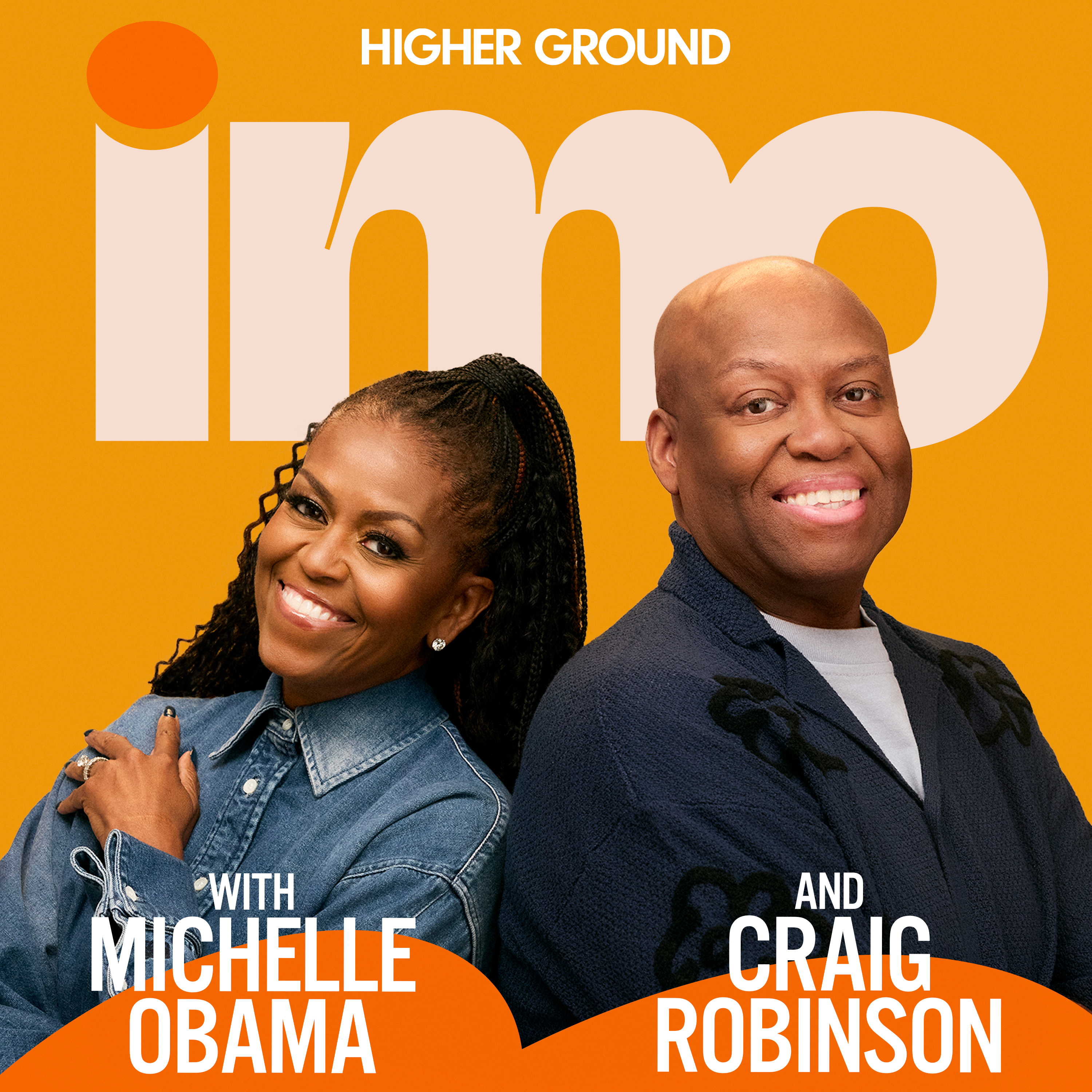
Pod Insights IMO with Michelle Obama and Craig Robinson Love the Process with Cynthia Erivo About this episode Actress, singer, author and producer Cynthia Erivo joins Michelle and Craig to talk about the creative process behind her new book, what it was like to grow up in South London, and her incredible journey from drama school to Broadway and the big screen. Plus, she shares what viewers can expect in Wicked: For Good, which is out November 21st. The group also answers a listener’s question about finding balance and making more space for a creative life.
Have a question you want answered? Write to us at imopod.com http://imopod.com.
See Privacy Policy at https://art19.com/privacy and California Privacy Notice at https://art19.com/privacy#do-not-sell-my-info.
Transcript 12,607 words · 4 speakers
Speaker names marked ? are inferred from speaking time and the show’s known hosts — they are not voice-verified.
0:00 Speaker 00 Whenever someone says, I want to be like you. And I go, I don't want you to be like me. I want you to be the very best version of you. So whoever you are meant to be is who you're meant to be. You just have to find out how to be the very best version of you.
0:19 Michelle Obama? This episode of IMO is brought to you by Progressive Insurance.
0:25 Craig Robinson? Well, I haven't seen you in a while.
0:27 Michelle Obama? I know. You're looking very rust.
0:32 Craig Robinson? You know, I dressed warmly because of our first guest, because I have so many goosebumps. I was gonna get.
0:40 Craig Robinson? I wanted to make sure.
0:41 Michelle Obama? Make sure you weren't.
0:42 Craig Robinson? Stay warm.
0:44 Michelle Obama? Well, we are in our new IMO studio, listeners and viewers.
0:49 Craig Robinson? Yeah. What do you guys think of the new digs, huh?
0:52 Michelle Obama? It's just, it's a whole new setup. Now, there's still gonna be some changes, I understand. This is just, you know, first week up getting ready for this series of taping. So more to come, but it's really cool. I think our crew loved it. They got more space. They're not all squeezed up.
1:10 Craig Robinson? Yes.
1:11 Michelle Obama? They're not jammed in some little room somewhere.
1:14 Craig Robinson? Some dining room that we've been using. No, this is, and you know, I've even had the, I had the benefit of seeing the space before it was ready. And it has really shaped up. And, and you know what I can really tell? The sound, doesn't it sound good in here?
1:31 Michelle Obama? Yeah, it sounds good. It sounds professional.
1:33 Craig Robinson? Yes, it sounds very warm.
1:35 Michelle Obama? It sounds like we're making inroads into the podcasting community. It feels like progress. It sounds like progress.
1:41 Craig Robinson? I know.
1:42 Michelle Obama? But yeah, this is a big move. Really proud of the IMO team for, you know, I mean, we've really built a good year of shows. And, you know, let's take a minute to just thank our listeners and our viewers for helping make IMO, our first season, a success. And we're just excited to keep it going, right?
2:05 Craig Robinson? We are, we are. It really feels like home now. IMO, when we're on the set, it feels like we belong here and we're doing some good work and helping folks and.
2:17 Michelle Obama? Yeah. Well, we, we are both excited. You talk about your goosebumps, but. We have got a great guest to help inaugurate our new studios.
2:29 Craig Robinson? Yes.
2:30 Michelle Obama? And we are both very excited.
2:32 Craig Robinson? Yeah, and my sister is talking about Cynthia Erivo, who is a Grammy, Emmy, and Tony Award winning, and three-time Academy Award nominated actress.
2:46 Michelle Obama? Crazy.
2:47 Craig Robinson? Singer, producer, and now author.
2:50 Michelle Obama? Mm-hmm, yeah.
2:51 Craig Robinson? Because Cynthia will publish her next book, Simply More, a book for anyone who has been told they're too much, which, how could anybody tell her that she's too much?
3:03 Michelle Obama? Well, you all used to tell me I was too much all the time, which we're gonna talk about that. See there? Okay, Cynthia, you hear what I'm going through.
3:13 Craig Robinson? But her book is coming out November 19, 2025, via Flatiron Books. And Cynthia also stars in soon-to-come-out Wicked for Good. November 21st.
3:26 Michelle Obama? Now, that's some goosebumps, because wicked, boy.
3:30 Craig Robinson? Yes, that was, ugh.
3:32 Michelle Obama? Well, we'll talk all about that, but yes.
3:34 Craig Robinson? Let's get Cynthia out here. Cynthia, please come join us.
3:39 Michelle Obama? Cynthia Erivo in the house.
3:40 Speaker 00 Hi, honey boo.
3:44 Speaker 00 Thank you for being here.
3:48 Michelle Obama? How are you doing, my friend?
3:51 Speaker 00 I'm good, and good. Thank you for asking. How are you?
3:53 Michelle Obama? I'm great. I am great. I'm just happy to see you in the flesh. Feels like I've been with you, because you have been everywhere. You're everywhere.
4:05 Speaker 00 A little bit nuts, yeah.
4:06 Michelle Obama? Yeah.
4:06 Speaker 00 Yeah. You know, and I've been trying to make sure that I am present whenever I go to places and do things. But it's been a really wonderful year of varied experiences.
4:18 Craig Robinson? Right.
4:19 Speaker 00 So I feel like all the things I've wanted to do, anything that's been on my bucket list, there are lots of things that I've been able to tick off, so.
4:26 Michelle Obama? We were talking when you arrived to the studio about the, just briefly, about the last time we were together, which was a little while ago. You were just a baby star.
4:39 Speaker 00 Still in the color pencil on stage. That's right, yeah.
4:43 Michelle Obama? Yeah, it was the, if I remember, it was the United Nations Summit. In September was, what year was it? Was it 2016? So it was our last, one of our last gatherings. And I would host the spouses of the world leaders. And, you know, we, as a part of the, I don't know, entertainment of showing off our country, we decided to do some partnerships with Broadway.
5:15 Speaker 00 Yeah.
5:16 Michelle Obama? And so a couple of the big shows at the time came and performed. And Cynthia sang, "I am here."
5:23 Speaker 00 That's right.
5:24 Michelle Obama? And, oof, killed it. Killed it, left everybody in tears. But that was, I got a chance to hug you.
5:32 Speaker 00 Yes, we still have that picture.
5:34 Michelle Obama? I do too.
5:35 Speaker 00 Oh, my goodness.
5:36 Michelle Obama? I do too.
5:37 Speaker 00 I do, I do.
5:39 Craig Robinson? Well, we're gonna talk about a whole bunch of things. But I want to talk about your book.
5:45 Speaker 00 Yes.
5:46 Craig Robinson? And I wanna, my first question is, it just being so accomplished. What prompted you to write your book now as opposed to some other time?
5:58 Michelle Obama? Like when you were 70.
6:01 Speaker 00 Well, because I knew that I wasn't gonna be writing a biography necessarily. Because I didn't want it to be that, because I do want to write that when I'm 70. That's, that is for then. But I, I think I, I realized I had learnt a lot up until this point. And I, I think I'd been writing so many speeches and giving speeches. And, and they, they kept connecting with people that I thought, if I could find a place to just explain and share my thoughts and feelings and, and lessons that I've learnt up to this point, that might be really helpful. Because it seems that when I Put some of that, impart some of that in the speeches. It connects. So I thought, well, if I can just put it in one place where everyone can have a listen, not just the people in the room.
6:45 Speaker 00 That way I can share a little bit of insight. Not necessarily a how to, but how I did.
6:51 Craig Robinson? Mm hmm.
6:51 Speaker 00 Yeah.
6:52 Michelle Obama? That's what makes this project so special. Simply more.
6:57 Speaker 00 Yes.
6:57 Michelle Obama? Um, because it isn't a memoir. Uh, it's, it's really, it's, it's, it's like getting a peek at your diary.
7:05 Speaker 00 Yes.
7:05 Michelle Obama? Um, just sort of walking through your life and how you've thought about things.
7:10 Speaker 00 Yeah.
7:10 Michelle Obama? Um, and I, I think it's important for listeners and viewers to understand that this book is really, um, it, it's a, it can be a workbook.
7:18 Speaker 00 Yeah.
7:19 Michelle Obama? In life.
7:19 Speaker 00 Yeah.
7:20 Michelle Obama? And I love the way at the ends of each chapter.
7:22 Speaker 00 There's always a question.
7:23 Michelle Obama? There's a question, there's a, there's a message. Um, Craig noticed because he read the book too.
7:30 Speaker 00 Yes.
7:30 Michelle Obama? Uh, that there's also poetry.
7:33 Speaker 00 Yes.
7:33 Michelle Obama? You know, which is just hearing your thought process, your creative thought process. It's really a beautiful sharing gift.
7:40 Speaker 00 Thank you, thank you. And I wanted it to be that. I, I remember when, when I started, I knew that I wanted it to feel like something you could pass on to people. If you read it and you wanted to give a gift to someone and that, that it felt like a gift. And it's easy to digest, but it also makes you go back and go, actually, I do need to answer that question for myself. Or maybe I haven't thought about that question before, or maybe no one's asked me that question. And so I've put in things that maybe I haven't been asked, but have asked myself.
8:10 Michelle Obama? Yeah.
8:10 Speaker 00 Have wanted to ask others.
8:12 Craig Robinson? Um, I, I am so opposite in the creative realm. I mean, I grew up an athlete.
8:17 Speaker 00 Yeah.
8:18 Craig Robinson? And my, and my family's creative. Misha's really creative.
8:21 Speaker 00 Yes.
8:21 Craig Robinson? And we've talked about this, like she, she, when she was six years old, she used to write in a spiral notebook, short stories that would.
8:31 Michelle Obama? Yeah, I did.
8:32 Craig Robinson? Would crack our family up. Well, we gotta find them, cause.
8:35 Michelle Obama? We, well, we had them bound and this is the, the trouble with, you know, living your life is, is the first family. There's so many moves and so much of our life was out of our control. I can't find the the book now.
8:48 Speaker 00 Yeah.
8:48 Michelle Obama? Because it was bound with some of the stories and I think it got lost in.
8:53 Speaker 00 I hope we find it.
8:54 Michelle Obama? Many, many moves, but yeah.
8:56 Craig Robinson? But high comedy, like we would be sitting as a family and she'd be reading the story. My mom and dad would be laughing hysterically.
9:05 Speaker 00 Yeah.
9:05 Craig Robinson? And I would be more laughing at them laughing.
9:08 Speaker 00 Yes.
9:09 Craig Robinson? At her writing.
9:10 Speaker 00 Yes.
9:10 Craig Robinson? I didn't really get it at the time.
9:14 Craig Robinson? But that kind of creativity.
9:16 Speaker 00 Yeah.
9:17 Craig Robinson? Is is just awe inspiring to me.
9:20 Speaker 00 Thank you.
9:20 Craig Robinson? And and I think of it kind of like athletically.
9:23 Speaker 00 Yeah.
9:24 Craig Robinson? How do you practice?
9:26 Speaker 00 How do I practice? I think I, well, strangely enough, it's it's for me, it's like training. You do it often. You continue to do it and you try and find ways to better it. You try and find ways to expand. I'm listening to others. I'm reading other things. I'm reading other poetry. I'm, you know, taking in, if it comes to TV and film, I'm looking at other actresses and I'm learning, like educating myself on what there is, just so there's always inspiration. The well is never empty, you know? And I think that's what, because I understand what you mean as an athlete. Because I I think of myself as an athlete as well. And I I know that it takes training to get to the point that you want to get to. And I think that is applied to everything.
10:08 Speaker 00 If you, I always say, if I stop using my voice as in to sing, it won't work for me anymore. So every day, there's a little bit of singing. Every day I hum, every day I do a scale, every day I warm up, just so that the next day, if I have to sing a song, my voice is already ready, didn't have to.
10:25 Michelle Obama? See, I would just love to live with you.
10:29 Michelle Obama? Because then I would hear you singing all the time and be like, shh, she's singing again.
10:37 Michelle Obama? I think that's why I can't sing, because if I could sing, I would be singing all the time.
10:42 Speaker 00 You see, I've heard this, people say this, but you'd be surprised. Because because you sing so much, because you have to sing. Sometimes those moments where it's silent. You just are. And and and and it's quite, I have music going on in my head all the time. And so the quiet is quite nice, you know, when when you don't have to. And and your voice needs a rest sometimes, just like your body does, yeah.
11:05 Michelle Obama? But we were talking about my childhood and how much, as you could hear, my, my family's support.
11:12 Speaker 00 Yeah.
11:13 Michelle Obama? You know, it, I mean, when you get that positive feedback
11:16 Speaker 00 Yes.
11:16 Michelle Obama? from the creative process.
11:18 Speaker 00 You keep going, yeah.
11:19 Michelle Obama? You just, you just keep going.
11:20 Speaker 00 Yeah.
11:21 Michelle Obama? And that makes me think of, of your childhood. I mean, something that was just beautiful to, to read about was your amazing upbringing.
11:31 Speaker 00 Yeah.
11:32 Michelle Obama? And you heard the banter that we had about being too much.
11:36 Speaker 00 Yeah.
11:36 Michelle Obama? I mean, when, when you, in your book, you described how you have been described as sometimes
11:42 Speaker 00 Yeah.
11:42 Michelle Obama? too much.
11:43 Speaker 00 Yeah.
11:44 Michelle Obama? It was the same thing for me. You know, too loud, too bossy, too, you know. And it was a joke in our family, but, you know, it was still this feeling of, well, I, I think I'm just fine.
11:58 Craig Robinson? So there she was, bossy.
12:00 Speaker 00 But so was I.
12:01 Michelle Obama? Yeah.
12:02 Craig Robinson? Were you?
12:02 Speaker 00 Yeah, I was, I was very bossy.
12:04 Michelle Obama? Yeah, that's what Capricorns, you know. And the other thing I read about, what you said about Capricorn.
12:10 Speaker 00 Yes.
12:10 Michelle Obama? It's like, I'm probably like you as a Capricorn. I don't necessarily buy into the, I shouldn't say buy in, I just don't focus on Zodiac.
12:20 Speaker 00 Zodiac, yeah, yeah.
12:20 Michelle Obama? And all that, but when I read about a Capricorn.
12:23 Speaker 00 You're like, oh.
12:24 Michelle Obama? I'm like, oh, yeah, that is me.
12:27 Michelle Obama? Right a lot and, you know, other people being a little bit mad because you're right.
12:31 Speaker 00 Yes.
12:32 Michelle Obama? And then sometimes that's the too much.
12:35 Speaker 00 People don't necessarily like, well, because we're observers. We see a lot, we pay attention to a lot, we listen and don't necessarily speak. So you, if you're really paying attention to a Capricorn, you'll see what they're thinking on their face because they won't necessarily say it out loud until it's necessary to say it out loud. And when they say out loud, it's been thought about and usually it's right.
12:54 Michelle Obama? There you go.
12:56 Craig Robinson? I can't imagine.
12:57 Michelle Obama? But your, but, but your upbringing, your.
12:59 Craig Robinson? Yeah, yeah, let's get back to that.
13:01 Michelle Obama? Tell us about South London.
13:04 Speaker 00 Yeah.
13:04 Michelle Obama? Stockwell.
13:05 Speaker 00 I, you know, I went back there a couple of days ago. I was in London. I was, I filming something and we had, we had a bit of an afternoon off. And so as we were going from one set to another, we had lots of space in between and, which never happened. So I asked if we could drive past my old home in Stockwell. And we parked up for a little bit and just sat and watched and looked. And I talked about where, where I lived and what the place was like and. Um. It was really wonderful, actually. I lived in a little masonette that.
13:39 Michelle Obama? And what's a masonette?
13:40 Speaker 00 It's like a a big historic building that's been converted into a a set of flats.
13:45 Michelle Obama? Mm hmm.
13:46 Speaker 00 Um. Just like council building, but uh they've converted it. And I lived with four other neighbours. Um. One lived opposite and then the two lived downstairs. And then it was sort of connected to another building. Um. And we all sort of lived together. If my mum needed help, then she'd go to Tyra, who was next door, or Sharon, or Clive downstairs. Um. And we all sort of looked after each other. Um. And I never, I never felt too much with them. They all were so kind and and sweet. And so there's this really wonderful sense of community within that building.
14:25 Speaker 00 And then within my home, my mum kind of knew before I did what I was going to do. And and always just encouraged it. All she really wanted was for me to work as hard as I want, needed to, to get what I wanted. Um. I don't think she ever, uh, nothing is a surprise to her.
14:44 Michelle Obama? Hmm.
14:45 Speaker 00 All of this isn't surprising to her at all. Um. And she, which is why she's sort of in her element currently, because she's sort of like, well, I knew it was something was gonna happen. It was, there was no choice. At eighteen months in my, in a baby book, she kept a baby book for myself and my sister. And it sort of marks uh milestones when I first started walking, when I first started speaking. Uh, when I first had literally solid food, anything. But also she put in there what she thought I would be. And uh at eighteen months, she thought I would be a singer and an, and a doctor, both.
15:19 Michelle Obama? Wow.
15:20 Speaker 00 Singer and.
15:21 Michelle Obama? Did she say, what did she see in you at eighteen?
15:23 Speaker 00 She said she hums when she eats.
15:25 Michelle Obama? Wow. Hmm. On, on key.
15:29 Speaker 00 Comes when she eats. Will be a singer or doctor. Because I was also good at like picking information up and and I would like play write and it might be scribbled, but I was still really interested in work and I still write in cursive.
15:45 Michelle Obama? When did you start getting feeling these messages of you're too much? Because it wasn't happening in your
15:52 Speaker 00 No, it was when I went to school.
15:54 Michelle Obama? Yeah.
15:54 Speaker 00 When I went to school, I think first at primary school, towards the latter part of it, that's when I started like feeling, oh, I guess, I guess this I got I'm doing too much, I'm too loud, I'm too bossy, I talk too much, all of those things. Because I was never told I'd talk too much. My mom never told me that. My mom never told me not to ask questions, so I would ask all the questions and she would answer them. And I was always curious and I wanted, I knew how to cook by the time I was 11, like because I was always in the kitchen with her, like all of those things. So by the time I got to school, it was very odd because now all of a sudden the things I had learned didn't make sense and people wanted less of it.
16:38 Speaker 00 And that's, that's, I think, the first time that I thought, oh, I don't, I don't fit necessarily. But I think I was so stubborn that I didn't want to. I didn't try to.
16:52 Michelle Obama? It's like, I'm good.
16:53 Speaker 00 I'm fine.
16:53 Michelle Obama? Yeah, what's wrong with you people? Sounds familiar.
16:58 Craig Robinson? Yeah.
16:58 Michelle Obama? It's like, you guys need to get your acts together.
17:01 Speaker 00 Yeah.
17:02 Craig Robinson? Yeah, why are you so insecure, right?
17:04 Speaker 00 Yeah, yeah, yeah.
17:04 Craig Robinson? Why aren't you doing more, actually?
17:06 Speaker 00 Yeah. It was, I was when, it was always when I was in a class, I remember there was a mathematics class I was in. And I, I didn't understand the equation that was being asked of us. So I just asked the question, I don't understand what this is, can you please explain it to me? I, I don't understand why this is happening here. And I, I just kept asking what I didn't understand. And so they moved me out of the class. So what that meant was that I was falling behind because I wasn't able to be in the class that I was meant to be in. And all it was, was that I was asking too many questions and she thought I was talking too much.
17:50 Craig Robinson? This segment is brought to you by Progressive Insurance, where progress isn't just in a brand's name. It's what they stand for. Because owning a home is just the beginning of the journey. You know, when I think about balancing a career and family and personal life, it reminds me of shifting from investment banking to coaching.
18:16 Michelle Obama? Hmm.
18:16 Craig Robinson? You know, I remember you and I talking about it. And it took being organized. It took planning, you know, it took courage. But, but most of all, I had to create a new sort of paradigm for me to live in, using the tools that I had learned from banking.
18:36 Michelle Obama? Hmm.
18:36 Craig Robinson? And it's just like when you're buying a new home.
18:41 Michelle Obama? Hmm.
18:41 Craig Robinson? You know?
18:42 Michelle Obama? Yeah.
18:42 Craig Robinson? You, you, you have to plan, you have to shift gears. It helps you build a foundation for your family.
18:49 Michelle Obama? That's right.
18:49 Craig Robinson? To build equity, for your family to build a future.
18:52 Michelle Obama? Hmm.
18:53 Craig Robinson? What were some of the unexpected benefits and challenges of homeownership?
18:58 Michelle Obama? Oh, yeah, the challenges are that the home belongs to you. It is yours. No longer do you have a superintendent you can call, you know, when, you know, when something breaks, you've got to know how to fix it. You've got to develop your own sort of cadre of support staff, you know, a good plumber. Now, we both lived in condominiums. The beauty of the first condominium we bought was that it was a part of an association, unlike you. So there was a, you know, sort of a general management office that we could go to, which helped us in that transition. But then when we went on to buy our first standalone home,
19:42 Michelle Obama? you know, we learned pretty fast that, you know, having a house is a big responsibility. You know, you want to keep it nice. It's not just what's happening on the inside, but it's what's going on on the outside. Tuck pointing, all the unglamorous things like fixing. Your roof and mowing the lawn. But at the same time, you you find that it's all worth it. You are making an investment in something that you will own. You know, so all that hard work. What we learned was equity that was ours. We we built that equity and it was ours to keep forever and ever. What about you?
20:19 Craig Robinson? Well, I would echo everything you said.
20:24 Craig Robinson? But one of the real benefits of having a condo was that we didn't have as much as you do with a regular home. So when you're a first time home buyer, you're not bombarded with the lawn and the tuck pointing and and refinishing the roof. Now, you paid an assessment to to take care of that stuff. But, you know, if I had to do all of that stuff, I would have been writing a check for every single thing like you do when you own a home. But to your point about building equity, you know, I was, I dad told me when we first were thinking about buying a home, he said, you know, if I had bought a home earlier,
21:07 Craig Robinson? I would have reached as far as I could and caught up to the payments. Like buy more house than than you can afford and you'll you'll you'll grow into it. Because that power of equity, that investment you talked about was such a huge benefit to to him at the age of, you know, forty something when he first bought his place and and to us when we were in our twenties. So staying in your home is just as important as getting in. And that means being prepared for what comes next. It's not always easy, but you don't have to do it alone. Progressive can help you navigate the complexities of homeownership.
21:52 Craig Robinson? From helping you learn how to manage unexpected expenses to home maintenance tips, Progressive offers expert tools and resources, not to mention homeowner insurance plans to help you stay steady and secure. With over $7 million invested in 2024 towards housing initiatives and new offerings like the Up Payment Program, Progressive is committed to helping homeowners like you stay rooted and thrive for generations to come.
22:25 Craig Robinson? Homeownership isn't about getting in the door. It's about protecting what you work so hard for. If you're looking for expert advice, financial tools, and the resources you need to maintain your home and your peace of mind, visit progressive.com/openedthehouse. Because when it comes to holding on to your home and everything it represents, Progressive Insurance is here to help you stay the course.
22:59 Craig Robinson? So your mom saw that light in you.
23:01 Speaker 00 She very much did, yes.
23:02 Craig Robinson? At 18 months, she wrote down,
23:04 Speaker 00 Yeah.
23:04 Craig Robinson? the doctor singer.
23:06 Speaker 00 Yes.
23:07 Craig Robinson? When did Cynthia know Cynthia was going to be that person? Because I think for a lot of young people, they don't have the confidence of pushing through that first level of rejection.
23:23 Speaker 00 Resistance.
23:24 Craig Robinson? However you want to put it. For you, when was that where you were like,
23:28 Speaker 00 I had a couple of moments. Yeah, I had a couple of them. There was, when I was five, I, it's interesting. I always start with this because it was so uncomplicated for me when I had that age. I'd been asked to sing Silent Night for a Nativity play. I was playing a shepherd. So I still to this day don't know why they asked me. And I think it's because I had the confidence to do it. That's, I don't even think they thought I had a great voice. I think I just wasn't shy. And I, and I remember singing the song. And I remember seeing smiling faces. And I remember people clapping afterwards. And I knew, and I understood that that was a measure of joy that people had experienced
24:13 Speaker 00 that came from me. And it was that clear. Okay, well, I want to keep doing that. Whatever that is, that makes people.
24:23 Speaker 00 Joyous, respond in that way. I would like to continue doing it. I think it wasn't until I was about eleven that I really knew that I had something. Um, I was really good at English and I, I was really creative and I was writing all these stories and uh, I was singing on the playground and people kept asking me to sing. So I would sing with like a couple of friends and we would be on the playground. It would be us and they would come and we could do little shows. And then I went to like a little, um, I guess it was like a, a performing arts sort of extracurricular, short term thing. And we, we did a play and I remember being able to imagine everything around me. And that sort of was that moment where everything clicked. Oh, I'm good at this.
25:08 Michelle Obama? Yeah.
25:09 Speaker 00 This is what I meant to do.
25:11 Michelle Obama? And that was at eleven?
25:12 Speaker 00 That was about eleven. And, but then you start to, you, you explore it and think, well, how, how far can I go it, it with all of it? And I've had different moments in my life where it's been reconfirmed. Even when I've had the little doubt, then it's been reconfirmed again. And, and one of those moments is when I had a strange moment when I was about eighteen, where I just stopped singing.
25:36 Michelle Obama? Hmm.
25:36 Speaker 00 I don't know what it was, but I had, it was, it's very hard to, to sort of get yourself into, into the business. And I think I had, I think I had sort of lost a little bit of my spark. And my mom realized I wasn't singing and she just wa, she like walked past one day randomly on the way to the kitchen. Um, and she said, I hope you're still singing.
26:00 Michelle Obama? Hmm.
26:01 Speaker 00 Didn't say anything else.
26:02 Michelle Obama? Hmm.
26:03 Speaker 00 Still singing, aren't you? I said, um, well, I guess, I guess I am.
26:10 Michelle Obama? Hmm.
26:12 Speaker 00 Because I think it was just the, just the fact that she had noticed.
26:15 Michelle Obama? Hmm.
26:16 Speaker 00 Sort of woke me up. That it wasn't just a thing that made everybody happy. It was something that made that made her happy too. It like it's something that connected with her.
26:27 Craig Robinson? Parenting right there. She put some pressure on you.
26:30 Michelle Obama? I mean, that was, we call that jujitsu parenting.
26:34 Craig Robinson? She knew what she was doing.
26:35 Michelle Obama? It's like, you know, and you just bow.
26:38 Speaker 00 Yes.
26:38 Michelle Obama? And say, thank you.
26:40 Speaker 00 Thank you. Thank you very much.
26:42 Craig Robinson? What does it feel like to be so good and so many things? Because again, I come from the sports side and the male side. We're all dying to be the Michael Jordan or the Lionel Messi. Or we want to be the best of the best.
27:00 Speaker 00 Yeah.
27:00 Craig Robinson? And it's really, no one can be.
27:03 Speaker 00 Yeah, because everyone's themselves. That's why.
27:08 Craig Robinson? Say that again, please.
27:09 Speaker 00 No one can be Michael Jordan or Lionel Messi because they already exist.
27:13 Craig Robinson? Right.
27:14 Speaker 00 Michael Jordan exists.
27:15 Craig Robinson? Right.
27:15 Speaker 00 So does Lionel Messi.
27:16 Craig Robinson? Right.
27:17 Speaker 00 That is for them. What it is, and I have to say this a lot to to younger people is that whenever someone says, I want to be like you. And I go, I don't want you to be like me. I want you to be the very best version of you. So whoever you are meant to be is who you're meant to be. You just have to find out how to be the very best version of you. Because I'm already me. I exist already. And I don't know, and I've never thought about being so good at many things. Because I think I'm a constant student.
27:48 Michelle Obama? Work in progress.
27:49 Speaker 00 Yeah, I'm always learning.
27:50 Craig Robinson? Can you talk a little bit about that process for you so that our listeners can get a feel of it?
27:55 Speaker 00 If you think of it like a mountain, but it's constantly growing. You can only see each peak from where you are.
28:05 Michelle Obama? You think you've hit the top and it's like, oh, there's another mountain.
28:09 Speaker 00 There's another one. And that doesn't necessarily mean that this is a mountain of difficulties. It's just another set of things that you have to learn. And you have to that you have to explore. So you get to that peak and you go, well, there is the choice to stay here. Because it would be quite nice and the view is really lovely from here. I could just stay. I mean, it's beautiful here. I can stay here. It's delightful. The air is lovely. It's great. I can just be here. I've got my supplies. I don't really need to go anywhere.
28:37 Michelle Obama? Got you, thermos.
28:38 Speaker 00 However, yeah, my tea's still hot. It's great. However, what is up there?
28:46 Speaker 00 The choice is, can I stay here? Yes. Do I want to know what's up there?
28:51 Michelle Obama? Hmm.
28:51 Speaker 00 Yes. Well, then I have to scale it then.
28:54 Michelle Obama? Yeah.
28:55 Speaker 00 And, and that's what it feels like.
28:56 Michelle Obama? Hmm.
28:57 Speaker 00 You can be good at any number of things. You can be better at any number of things. You can be amazing at any number of things, but that keeps going to. I don't ever think you ever get to the real true peak.
29:10 Michelle Obama? Hmm.
29:11 Speaker 00 Because if you do, then what's the point? Then you have to stop.
29:14 Michelle Obama? Yeah.
29:14 Speaker 00 And I, I don't think I ever want to be the person that has learned everything and knows everything.
29:19 Michelle Obama? Right.
29:20 Speaker 00 Because then I, and there's nothing left to learn. There's nothing left to explore, nothing left to find. And I'm constantly finding new things. I'm constantly rediscovering myself as a performer. I'm constantly learning new skills. My voice, for me, is one of those things that keeps proving to me that there's more to learn.
29:37 Michelle Obama? So much of learning are these peaks of development.
29:40 Speaker 00 Right.
29:41 Michelle Obama? And it, that require failure and learning and wisdom. That there's no way you can have, you can't skip a step.
29:48 Speaker 00 No.
29:49 Craig Robinson? Right.
29:49 Michelle Obama? Um, and, and, you know, learning to find the joy in that process.
29:54 Craig Robinson? That's the, that's it. And that's what young people today, I'm just speaking to my son who happens to be here.
30:03 Speaker 00 Oh.
30:03 Craig Robinson? You have to love.
30:05 Speaker 00 The process. And I love it.
30:09 Craig Robinson? Yeah.
30:09 Speaker 00 I really do.
30:10 Craig Robinson? It's clear.
30:11 Speaker 00 I, I really, I really have found joy and enjoyment in the learning process. The doing is, is like the extra cherry on top.
30:20 Michelle Obama? Yeah.
30:21 Speaker 00 The bit before where I can figure things out, I'm learning and decide, how do I, well, how am I going to do this? How did this work?
30:27 Craig Robinson? Yeah.
30:28 Speaker 00 Maybe I'll do it like that. Maybe I'll do this song here, or I'll take this song apart. And that for me is where the creative process actually really lives.
30:36 Craig Robinson? Yeah.
30:37 Speaker 00 Because the, the, the thing that's complete is, is what comes from the creative process.
30:42 Craig Robinson? Right. Right.
30:43 Michelle Obama? And, oh, I'm sorry.
30:44 Craig Robinson? I want to, and, and we can go back if, if I'm, because I'm changing gears a little bit because I'm thinking about this love in the process.
30:51 Speaker 00 Yeah.
30:52 Craig Robinson? I I'm I'm getting the vibe that you were coming up straight singing.
30:56 Speaker 00 Yep.
30:56 Craig Robinson? And then now you switch over to drama and acting. And I wanted to hear about how that.
31:03 Michelle Obama? Was that a switch?
31:04 Speaker 00 It wasn't a switch. It wasn't a switch. I I I loved I loved acting. So I my first sort of like taste of acting was when it was about eleven. And then I started getting into like plays and school shows.
31:15 Craig Robinson? Okay.
31:16 Speaker 00 When I was about fifteen. Um, but I just didn't know it was possible.
31:21 Michelle Obama? Yeah, you hadn't seen it before.
31:22 Speaker 00 Exactly. So I I I kept trying again when you don't have a there's no playbook. There's no instruction booklet. There's no blueprint. So you don't really know how to even begin to go about it. And no one had mentioned drama school at my school to me. So I didn't even know it was an option.
31:39 Craig Robinson? Mm hmm.
31:39 Speaker 00 So I I had we had moved to self to East London by this point. And there was a really there's a lovely theater Stratford Theater Royal.
31:50 Speaker 00 Um, that I used to go to. And then I ended up taking sort of like a part time job there. And I worked in every possible spot you could think think of. It was at the.
32:02 Michelle Obama? Ticket sales.
32:03 Speaker 00 Ticket sales. I was in Usher. I was at the bar. And wherever you could find, I was there.
32:07 Craig Robinson? Mm hmm.
32:08 Speaker 00 Um, and I started as I was watching these plays and actors come in and out. I was really inspired by it. And I I knew I wanted to do I want to do that too. I want to do that. How can I? I remember I asked if I could audition for one of the plays that was going on, the musical that was going on. I was told no. And it really I was really upset because I was like, well, I know I can. I know I can. I know I can. But. I think it was important for me to experience that because it just pushed me to figure out how.
32:38 Craig Robinson? Mm hmm.
32:39 Speaker 00 They then had this sort of young actors company thing that they were doing that I discovered. And I was like, I will, I want to do that. So I applied for that, got in, and I realized that.
32:51 Speaker 00 When I, on the first day, sort of like the enrollment day, the first day we come in and you're meeting the teachers, you're meeting the tutors. The one, the main tutor who was taking the course was a woman called Rae McKen, who I'd met five years before. So I'm 20 now and I met her when I was 15, doing a youth group production of Romeo and Juliet at the Young Vic. And I had not seen her since then. And this was the first time I was seeing her and she said, well, did you, have you applied? Are you gonna train? And I didn't know what she meant.
33:25 Michelle Obama? What was that?
33:26 Speaker 00 I didn't know, I said to her.
33:27 Michelle Obama? Because it was a path that was unknown to you.
33:29 Speaker 00 Completely unknown. I literally said to her, what do you mean? What, what does that mean? Why are you going to, you're gonna go to drama school? What's drama school? That's a thing? What, what do you mean?
33:41 Craig Robinson? There's a school for acting?
33:43 Speaker 00 And that's, you can go to school for acting, you can go and train to be an actor. I said, huh. I didn't, I had no idea. She said, well, I think you should, I think you should train. I said, okay. I think you should go to the Royal Academy of Dramatic Arts. I said, she called it RADA and I didn't know what that was. I said, what's RADA? She said, the Royal Academy of Dramatic Arts. I said, no, I'm not gonna get into the Royal Academy of Dramatic Arts.
34:10 Michelle Obama? That sounds, that sounds like I'm not.
34:12 Speaker 00 Yeah, I'm not gonna get into that place.
34:15 Michelle Obama? I'm sorry.
34:16 Speaker 00 I'm not, I'm not gonna get in.
34:17 Michelle Obama? What's your name? Marie Kay, what was it?
34:19 Speaker 00 Rae, Rae, I'm not gonna get in.
34:20 Michelle Obama? Love you.
34:21 Speaker 00 I'm not, love you, love you so much, I'm not gonna get in. So I'm not gonna do it. She said, well, if you don't apply, you can't do this course.
34:27 Michelle Obama? Oh, that's a good one.
34:29 Speaker 00 Don't, don't try me with a challenge.
34:31 Craig Robinson? Yeah. We clearly are figuring that out.
34:33 Speaker 00 Don't tell me I can't do something because then I'm going to.
34:46 Craig Robinson? We're happy to team up with Progressive Insurance for this episode. Owning a home is a huge achievement, but staying in your home and maintaining it, that's where the real journey begins. From routine upkeep to financial planning and protecting what you've built, there's a lot to manage. Progressive Insurance is here with tools, tips, and resources to help you stay ready for whatever comes next. With $7 million committed in 2024 towards housing initiatives and continued support through new initiatives like the Up Payment Program, Progressive is not only opening the door to new home buyers, but also helping them plan for the long haul. And that reminds me, just recently, we had to get a new hot water heater after living
35:30 Craig Robinson? in our place for eight years. Everything was fine, then one day, out of the blue, bam, cold water only. You never know when you're going to need something as a homeowner. Maintaining your home starts with having the right support. Explore tools, tips, and resources at progressive.com/openthehouse. Because homeownership isn't just about getting in, it's about staying in.
36:02 Michelle Obama? So you get into RADA.
36:03 Speaker 00 Yes.
36:04 Michelle Obama? And it wasn't all smooth sailing. The story that you write about in the book is that people didn't appreciate your gift because it was a majority traditional
36:21 Speaker 00 Yes.
36:21 Michelle Obama? white
36:22 Speaker 00 Yes.
36:23 Michelle Obama? institution.
36:24 Speaker 00 Very much so.
36:25 Michelle Obama? And there were many microaggressions that you faced in the process. Can you talk a bit about that experience and how you persevered?
36:34 Speaker 00 Yeah, the very first one I faced was actually kind of immediate, which was so insane. I went there and just before I'd gotten into school to start the term, I got a job doing backing vocals for a group. And the reason I was excited about it, yes, it was lovely to go and do backing vocals with this group, but it also was a means to pay for the tuition outright. It would pay for the entire thing. And I asked for permission and she said, no, well, no, I don't think you can. I think it's either you go.
37:08 Speaker 00 And do this job and you have to leave or you leave the job and you stay. That was the.
37:13 Michelle Obama? That was the administrator's problem solving, helping a student.
37:16 Speaker 00 Correct. Meanwhile, there's another student in my year who is out for two weeks doing a play.
37:22 Craig Robinson? Oh, no.
37:24 Michelle Obama? Oh, the story, the story repeats itself again and again and again.
37:29 Speaker 00 Again and again. So, and so I.
37:32 Michelle Obama? Oh, the hypocrisy.
37:33 Speaker 00 But then I spent, but I spent the first year paying for it.
37:36 Michelle Obama? Yeah.
37:37 Speaker 00 I then spent the first year being punished for that, for wanting to go and do.
37:42 Michelle Obama? Just even asking.
37:43 Speaker 00 For asking, because then I go, well, okay, I'm, I need a job. I'm gonna do a job part time, but that part time means I'm in school for Monday to Friday and I'm at work Saturday and Sunday. So by the time I come in on Monday, I'm exhausted and I'm falling asleep in classes. And instead of someone going, are you okay? They go, she's not focused. She doesn't care. So we'll give her the smallest role and we'll just, we'll keep punishing for it. And it just, and it went on for so long. I was thought to be unfocused. And then when they thought I was focusing, they, we did like a musical. And they got the smallest role in the musical and they knew I could sing.
38:27 Speaker 00 At this point, it wasn't like a, it wasn't.
38:29 Michelle Obama? A mystery.
38:29 Speaker 00 A mystery. I, I could sing. That's, that was my, that was what I did. And it gets to one of those performing nights and then we find out in the daytime that two of the ladies are not very well. And so instead of saying, okay, you stay off, go home, you reassign the roles. They were in and I was asked to sing for them. And, and I, I can't even be mad at the question because I think I just, and I.
38:58 Michelle Obama? I think you can.
39:00 Speaker 00 But.
39:01 Craig Robinson? That's mighty big of you.
39:02 Speaker 00 But I think I was more, I think to, to this day, I'm still frustrated at the, the. I wish I had known to to say no.
39:10 Michelle Obama? Yeah.
39:11 Craig Robinson? Right.
39:11 Speaker 00 You know, but the but the lesson in saying yes and doing it is was that I would never do that again. I would never allow my voice to be given to someone else.
39:22 Michelle Obama? To be given to someone else.
39:23 Speaker 00 And used that way. I I would be in full control of how my voice is used and and how and whom I use it with and when.
39:33 Michelle Obama? Yeah.
39:34 Speaker 00 That was a real lesson. Uh, in sort of like self-confidence and and advocating for oneself and knowing when to say, actually, no.
39:42 Michelle Obama? Yeah.
39:43 Speaker 00 Because when I asked about that, it was, well, we didn't think that you needed help. You were really, um, efficient.
39:48 Michelle Obama? Yes.
39:50 Speaker 00 And I was like, well, I would, I really hope that anyone who is efficient doesn't experience that because if they're good at what they do, they should they should be given the opportunity to be good at what they do.
40:02 Michelle Obama? Well, this is the for for listeners, when you hear black folks talk about needing to be twice as good. Um, this is what
40:11 Speaker 00 This is, yeah.
40:11 Michelle Obama? The these are the, um, experiences that are not uncommon.
40:16 Speaker 00 Yes.
40:16 Michelle Obama? To people of color all over the world. When someone has a preconceived notion
40:23 Speaker 00 Yeah.
40:24 Michelle Obama? of who we are.
40:25 Speaker 00 Yes.
40:25 Michelle Obama? Based on difference.
40:28 Speaker 00 Yes.
40:28 Michelle Obama? You your need to get through college, the way you had to do it to get through the the program was different.
40:35 Speaker 00 Yes.
40:36 Michelle Obama? Your needs were different, and this is why you have to have diverse faculty and administration administrators so that people can look
40:45 Speaker 00 Well, maybe she's just
40:46 Michelle Obama? Like, I recognize what this student is going through. Um, and I won't see it as a way, oh, you're, oh, you just want to be a backup singer. It's like, no, you you're trying to eat.
40:57 Speaker 00 Yes.
40:58 Michelle Obama? Um, and if you don't have leadership that is diverse enough to be able to see themselves, then you wind up putting students and young people in a position to have to do twice as much
41:08 Speaker 00 Right.
41:08 Michelle Obama? to get through.
41:09 Speaker 00 Yeah.
41:10 Michelle Obama? Um, and I, you know, I want to take this moment because there are young people who will not assume be people who loved you, who saw you, see you on Wicked, they see you as Elphaba, they see you as beautiful, and it's important to know.
41:25 Speaker 00 It's not easy.
41:26 Michelle Obama? It was not easy because there are microaggressions and there are there are people who don't have full understanding of a broad set of experiences. And it makes it hard.
41:38 Speaker 00 Yes.
41:39 Michelle Obama? For people who are other.
41:40 Speaker 00 Yeah. I think it was, I think the wonderful thing about being able to write this book is that I get to share that this was not a walk in the park.
41:49 Michelle Obama? Yes.
41:50 Speaker 00 That this was not easy.
41:52 Michelle Obama? Right.
41:52 Speaker 00 That to get to this point today here, it has taken a lot. It's been a wonderfully crazy experiential journey of ups and downs.
42:05 Michelle Obama? And I.
42:05 Speaker 00 If you couldn't imagine.
42:06 Michelle Obama? I love the way you talk about how hard you work. I mean, and I think that that's a wonderful thing that you have laid out in your book because I, you know, we take, we see the end product of all the work.
42:20 Speaker 00 Yeah.
42:21 Michelle Obama? So you, you, you make it to Broadway.
42:23 Speaker 00 Yeah.
42:24 Michelle Obama? You are in the color purple. You have blown it away.
42:29 Speaker 00 Yeah.
42:30 Michelle Obama? But the one, one thing you, you said, and I don't know whether it was in the book or I heard it on a, in another conversation that you had, but how difficult it is for you to have embodied the role of Seeley.
42:45 Speaker 00 Yeah.
42:46 Michelle Obama? Someone for, for, how long were you on?
42:50 Speaker 00 It was four hundred and, I want to say like four hundred and eighty something performances. It was fourteen months.
42:58 Michelle Obama? Fourteen months. And for people to understand, Seeley's character was, was battered and bruised.
43:06 Speaker 00 Yes.
43:06 Michelle Obama? And told over and over again, night after night.
43:09 Speaker 00 That she was ugly.
43:10 Michelle Obama? That she was ugly, she was unworthy.
43:12 Speaker 00 Yeah.
43:12 Michelle Obama? And you don't realize, yeah, in order to personify that role, you have to.
43:17 Speaker 00 Take it in and feel it.
43:18 Michelle Obama? Take it in.
43:20 Speaker 00 Yeah.
43:20 Michelle Obama? And that, that, that is a hard thing to do.
43:23 Speaker 00 Yeah.
43:23 Michelle Obama? To the point where now even singing, I am here.
43:26 Speaker 00 I just don't do it very often at all.
43:28 Michelle Obama? Can you talk a bit about that work, what that feels like?
43:31 Speaker 00 Yeah.
43:31 Michelle Obama? Because we see the other end of it. We see the performance and we see your career, but I didn't even think about what it.
43:38 Speaker 00 Yeah, because I think people see actors as like you just put something on.
43:43 Michelle Obama? Mm hmm.
43:43 Speaker 00 It's like a costume, you put it on and then you do, you say the words and that's it. But that that's really um one percent of what it is. To to really be able to, and this is what I believe, to really be able to, and I never like it when when other actors are like, just act, just you don't have, none of you is in that in the role. That's not true.
44:05 Michelle Obama? Mm hmm.
44:06 Speaker 00 Because you you are literally the body of this person. You, your body has to take in the character of whoever it is and then give it to to your watcher, to your viewer. And with Seeley, she, she, I really, I love her. And I speak of her like in in present tense because all of these characters, they they are, to me, they're like people. They're like friends who I've met and have some are like distant, some are more present. She is this sort of spark of light who is constantly put down, beaten physically and mentally. Told she's ugly, told she's not worth anything, abandoned, abandoned again, abandoned again.
44:51 Speaker 00 And we, I would do this night after night after night. And so after a while, your body doesn't know what that you're pretending.
45:01 Michelle Obama? Hmm.
45:02 Speaker 00 And so your body just finds, it sort of short circuits the way to get to wherever you need to get to. And so after like performance two hundred, two hundred and ten or something, I hear the word ugly. And that's, it me, that's, it's me.
45:17 Michelle Obama? Mm hmm.
45:17 Speaker 00 I I hear it.
45:19 Michelle Obama? Yeah.
45:19 Speaker 00 Because the the line between myself and the character are, it's so thin that it's almost non-existent. Because it, because that is the short circuit to the character. You have to be able to embody uh who they are and believe the things that are being said of you. And and really hear it so that the reaction is connected and real.
45:44 Speaker 00 And that goes for every single character. Hmm. You sort of make a pact with yourself and the character that they are they are allowed to live in you for as long as they need to until the the project is done. The problem is, after the project is done, how do you make space for yourself again?
46:06 Michelle Obama? Yeah.
46:06 Speaker 00 That can sometimes be really, really difficult. It takes it takes time to to sort of um distill the character from yourself again and find out what your baseline is. Hmm. Because you're still operating from the baseline of the character sometimes.
46:22 Michelle Obama? Wow.
46:22 Speaker 00 Yeah, it takes takes a lot and sometimes it's it's not just like a mental uh a task. For me, it's very physical as well, depending on how much work needs to happen. It takes training, it takes uh I just did um a film called Kuroshi and that was uh Samurai. And I was training every day for a month uh because that's all I had in order to get to Samurai into my body.
46:52 Michelle Obama? Hmm.
46:53 Speaker 00 And Samurai has to be in your body, otherwise it doesn't read. And it it is some of the hardest work I've ever done in in my life, just because it's a completely different way physicality that I haven't used before. And it's the same with flying as Elphaba. You have to get your body has to get used to what it's like to be in a harness in the air when your weight is bearing down on a very thin piece of of uh material, which is uh the harness, which is holding all of your weight.
47:20 Michelle Obama? Yeah. And you talk about the chafing, the you know, the
47:24 Speaker 00 The physical burning of your skin.
47:26 Michelle Obama? Burning of your skin as you were singing and flipping and flying.
47:29 Speaker 00 Yes.
47:30 Michelle Obama? At the same time.
47:31 Speaker 00 Yeah.
47:32 Michelle Obama? And no one thinks of that, they're just thinking Elphaba!
47:34 Speaker 00 Yeah.
47:35 Michelle Obama? Oh, I'm so happy for you and now I'm all
47:38 Speaker 00 The amount of times people are like, oh, I want to fly, it looks so fun. And I'm like, it it's it's fun now because I know how to do it. But at the very beginning, there is a moment when you're in the air where it is not fun at all, where everything hurts. But if you're in the middle of a scene and you need to get to the end of the scene or the middle of a song, you need to get to the end of the song, the pain has to go somewhere else and you have to sing the song. So, yes, it's fun to be in the air, but but after hour ten?
48:08 Michelle Obama? Mm hmm.
48:10 Speaker 00 It's not so funny anymore.
48:11 Craig Robinson? Yeah. Well, I want to go back to The Color Purple.
48:14 Speaker 00 Yes.
48:14 Craig Robinson? Quickly here because I heard that you said that you wanted that part in the worst.
48:21 Speaker 00 Yeah, I knew it. I knew I was supposed to be doing it.
48:23 Craig Robinson? How did you know you were supposed to be doing it?
48:25 Speaker 00 I don't know. I don't know. I, I, I, I knew it was coming and,
48:33 Speaker 00 and just something said, you're supposed to do this.
48:37 Craig Robinson? Okay.
48:37 Speaker 00 I just, I, I was so sure. If you ask me what made me sure, I, I, to this day, I cannot tell you. I don't know. I just knew that it was meant to be the thing I was supposed to be doing. I did not know that it was going to Broadway. I did not know what was coming afterwards. I just knew there was a small little play, a musical, coming to this tiny little theater that held only 200 people, and I wanted to do it. It didn't matter what it was paying. It didn't matter where it was. I knew that this was the production I was supposed to be a part of, and I was meant to be doing it. As clear as day.
49:12 Michelle Obama? Yeah.
49:13 Speaker 00 Someone said, would you play another character? No, I know it's supposed to be silly.
49:16 Craig Robinson? Yeah.
49:17 Michelle Obama? And you talk about the feeling when you, you, you sing the, the, I am here.
49:25 Speaker 00 Yeah.
49:26 Michelle Obama? And feeling the audience's reaction.
49:30 Speaker 00 Yeah.
49:31 Michelle Obama? You know, it's sort of going back to Silent Night, the shepherd.
49:35 Speaker 00 Yeah, yeah.
49:36 Michelle Obama? Can you talk about that a bit, what that felt, what it feels like to use your physical self and be able to move people in that way?
49:44 Speaker 00 Yeah. It's, it's a real, um, out of body, but really organic feeling. It's like, um, it's kind of like flying, you know? Everything sort of feels like it's connected. When you can feel the audience as it's happening, it's like, it's like true, the truest magic you could possibly imagine. I'm here was one of those moments where you could feel the audience take a breath.
50:12 Speaker 00 Like breathe with you because up until that point, they're all like, you can feel the tension in the air. Cause you want her to get to a place where she can say it, where she can do that. And it takes so much, which is why I don't sing it very often because I don't, I don't think that the song is a party trick.
50:29 Michelle Obama? Yeah.
50:29 Speaker 00 I think it is the culmination of a journey that this character has had to be on to get to this point. And, and I feel like you can't.
50:38 Michelle Obama? You have to earn it.
50:38 Speaker 00 Yeah. I don't feel that you can truthfully do that song unless you know the journey that the character has been on.
50:43 Michelle Obama? It's not, I am here.
50:45 Speaker 00 Exactly.
50:45 Michelle Obama? I'm here, I'm me, I'm me, I'm here.
50:47 Speaker 00 That's right. And so when people like use it just because they want to sing it, it always feels a little false to me because I'm sort of like, I don't know.
50:54 Michelle Obama? Because you were Sealy.
50:55 Speaker 00 Yeah.
50:55 Michelle Obama? And it's like, you didn't live my life.
50:57 Speaker 00 Right.
50:58 Michelle Obama? Now, did you feel this, I know, I don't care.
51:00 Craig Robinson? No, no, no, no, go ahead.
51:01 Michelle Obama? Did you feel the same way about Elphaba as you did about Sealy that you knew that this was, this was for me?
51:09 Speaker 00 I think I was so frightened of admitting it because I knew so many people were going up for it. But in my heart of hearts, I, I knew that, that I got this woman. I understood this woman. I knew that woman. If it, there wasn't going to be anyone else, you know, it wasn't, there was no other character that I wanted to play in this piece. And it would have been, it was this, it was Elphaba every time.
51:31 Craig Robinson? Can you help us understand the feeling you had when they called you up and said, Cynthia, you got the job?
51:38 Speaker 00 I don't even think I had any words. I think I just cried and said, thank you so much. And that was, I was just sobbing into my arms. I just, because I think what I had realized maybe at that point is that, is that actually to get to Elphaba was a really long journey. I had been learning her, I'd been learning, unbeknownst to me, I didn't realize it was happening, but I had been learning this character for a really long time. I knew the songs back to front before I had seen the show. So I knew the songs, I connected with the songs, I understood those songs. And then I went to see the show and thought, oh my gosh, I really, I. There's something.
52:17 Michelle Obama? Hmm.
52:17 Speaker 00 And then, and, and then I've been asked to do concerts of this and I do, like, it just kept coming up.
52:25 Michelle Obama? Yeah.
52:25 Speaker 00 It kept coming to me. And then, and then to be asked to come and audition was, I knew I wasn't going to leave anything unsaid.
52:36 Michelle Obama? Hmm.
52:36 Speaker 00 Or anything in the tank. So I let it all go when I was in that audition room. So to get that call was, I really do think it's, well, it did, it changed my life.
52:45 Michelle Obama? Hmm.
52:46 Speaker 00 Um, truly. And I'll never forget the feeling of sort of amazement and speechlessness.
52:56 Michelle Obama? Hmm.
52:56 Speaker 00 That happened that day. So I just, I was so grateful. And I, I think there was like a measure of disbelief that something like this had happened and could happen. It's like a dream, a real dream role.
53:08 Michelle Obama? Yeah.
53:09 Speaker 00 Was in my lap.
53:10 Michelle Obama? And, and, and, and just, a, a, just a dream experience.
53:15 Speaker 00 Yeah.
53:16 Michelle Obama? Because it in, it, it's ending so well.
53:20 Speaker 00 Yeah.
53:20 Michelle Obama? I mean, you can put all that work into any, you know, um, piece of art and it's not received in the way, you know, you don't, you would have done this no matter what.
53:30 Speaker 00 Yes, yeah.
53:30 Michelle Obama? I think I heard you say that in an interview.
53:32 Speaker 00 Yeah.
53:32 Michelle Obama? You would have been, you, you would have put just as much energy into the role, but to have it be so well received.
53:38 Speaker 00 Yeah.
53:38 Michelle Obama? By the, the, the public, people of all ages.
53:42 Speaker 00 Yeah.
53:42 Michelle Obama? What do you think it is about, wicked, about the particular, um, adaptation of it, your performance, um, Ariana's performance?
53:54 Speaker 00 I think it's the humanity. I think it's the humanity in it. I think as much as it's this sort of fantastical, magical world, that it's deeply rooted in humanity.
54:06 Michelle Obama? Mm hmm.
54:06 Speaker 00 Each of these characters has a humanness to them.
54:10 Michelle Obama? Yes.
54:10 Speaker 00 They all have a want, they all have a hurt, a pain, um, especially Elphaba, who, and, and it's so, um, so openly on show.
54:20 Michelle Obama? Hmm.
54:21 Speaker 00 She's so very vulnerable.
54:22 Michelle Obama? Yes.
54:22 Speaker 00 Uh, that I think people connect to that, like they connect to this otherness that she feels, this. Starting at birth. Yeah, from the beginning. And, and I think to be able to watch it play out in front of you sort of validates anyone who feels that way. That you're not, this is not something you're imagining. It actually is true and, and look at it, watch it happening to someone else. Watch it happening to someone and that someone happens to have my face. And I think that adds to the idea that, oh, well, if she, if she is the one behind the face of this character, then it opens the doors to the experience of the person who's playing it as well. And I think the connection to the people and the characters
55:07 Speaker 00 and what everyone else's experience is, has, I think, really exploded this out and open for people. The stories I've had, the connections, the people who have told me what they've been through, how this can, you know, how this has moved them. I, I would, I could be here till the end of the year if I was to tell you all of the stories. And it's really, really amazing.
55:42 Craig Robinson? So what are you most excited about for the next installment now?
55:46 Speaker 00 The thing I'm most excited about for the next installment is the, the growth. They're not in school anymore. They're really grown and I'm, I've seen it and I'm really proud of, of the progression. These are grown women. And I think I, I can't wait for people to experience Elba as, as someone who's really in her power. And, and having to deal with what, the decision that she's made, and she does. It's not easy for her, but I think there's something quite wonderful about the way she moves through the space now. She's not apologetic at all. It's kind of wonderful. Yeah.
56:27 Michelle Obama? One thing I, was anything changed for the movie?
56:31 Speaker 00 A couple of things.
56:32 Michelle Obama? Yeah.
56:32 Speaker 00 But, but maybe not changed, maybe expanded. We just opened up a little bit more. Like, the, the love story between Fierro and Elphaba, that's sort of been expanded. So you can see it more, you can understand it more. It doesn't just sort of happen in, in one song. Because you don't have the time on a stage to, to do all of that. You get to learn a bit more about where, because in the show, Elphaba just sort of goes away for the, a large majority of the second act. And in this, you sort of see where she's been. And you're with her for a little bit and then, and then she sort of like goes away. And I think there's something really lovely about being able to see what world she's created for herself. So that's a little bit different. You just, it's just the expansion of what we, what we know.
57:17 Craig Robinson? I'm very excited.
57:18 Michelle Obama? And let me just tell you, I have a family who are musical cynics. You know, I have some who are like, oh, when do you break out in song? Everybody to a T, bawling, crying, you know, connected in this way, so, I mean, kudos.
57:35 Speaker 00 And I have an answer for you on that, because I've heard that answer, I've heard that question before. When do people break out in song? All the time.
57:40 Michelle Obama? I know, I.
57:40 Speaker 00 People break out in song all the time. People start singing or humming.
57:44 Michelle Obama? Yes.
57:45 Speaker 00 All the time. When you, if you really pay attention, you'll realize that people do it every day.
57:49 Michelle Obama? And we all have a soundtrack to our lives. I know I do.
57:52 Speaker 00 Yes.
57:53 Michelle Obama? I do everything to music.
57:55 Speaker 00 Yes.
57:55 Michelle Obama? You know, I.
57:56 Speaker 00 You put those headphones on.
57:57 Michelle Obama? And it's like, it gets me ready, I see myself, it's like, dun, dun, da, dun, da, da, I'm here.
58:02 Speaker 00 It's, that's what it is. And I think people get so, for some reason, there's this interesting disconnect when you go to a theater like.
58:09 Michelle Obama? And it actually happens.
58:10 Speaker 00 Why are you singing out in, in public? Well, because we always do. We actually always do, and we have a connection to music and music is, and, and, and more so. The, a musical is, is, is where you can go to really heighten one sense of emotion.
58:29 Speaker 00 Music happens when there's nothing else, when you can't say anything else. We can't say anything else. And often, the song that gets sung is the thing that the person doesn't want anyone to see. So it's the innermost thoughts of whoever is performing.
58:44 Michelle Obama? Oh, I love the way you explain that.
58:46 Speaker 00 It's that.
58:46 Michelle Obama? So take that musical cynics.
58:50 Speaker 00 There's a place for it, and it's very important. Go and see more of it.
58:54 Craig Robinson? I think my sister is shooting a shot across my bow with that.
58:59 Michelle Obama? No, no, there have been others. There have been others. Before you leave this table and we move on to other things, I just want to tell you how proud I am of how you are showing up in the world as your true, authentic self.
59:16 Speaker 00 Thank you very much for saying that.
59:17 Michelle Obama? Which is, I know, a part of that peaking that you had to. And I would love to have you just talk a bit before we go about how you've managed seeing all of yourself.
59:33 Speaker 00 Yeah.
59:34 Michelle Obama? Because I know that there are young people out here who are looking and listening. And, you know, I just want you to
59:42 Speaker 00 Yeah.
59:43 Michelle Obama? talk a bit about that journey.
59:45 Speaker 00 The beginning of a journey of trying to be yourself, it takes, it's like trial and error. You know, you really have to be OK with making mistakes and discovering and not quite being comfortable with something and acknowledging when it's not quite comfortable and changing and shifting and being able to distill all the noise that other people tell you about who and what and how you're supposed to be, to find out what you need for yourself. And as I've been doing that slowly, I've sort of been finding little pieces. It's like, you know, treasure hunting, finding the things that make sense to me. Oh, that's what I want to do. Even like someone, like nails. There's something I've been doing since I was 16 years old.
1:00:29 Speaker 00 And I wanted to check myself. Like, am I just saying that? No, and I went back to a picture of me when I'm 16, and I have nails. And they are not as long, but they definitely are neck. I've been doing my nails.
1:00:40 Michelle Obama? They're done.
1:00:40 Speaker 00 Yeah, they're done. And I realized that that's just something that makes me feel Like I'm done. If I don't have a lick of makeup on, but I have my nails done, I feel like I'm done. So that's just something that's like a, I don't know, it's not, it's a part of who I am. It's something that tells a story. It's another canvas for someone else to, to create, but it's also a way to express stories. And it's the same with my, the, I shaved my head, but I've been making my, getting my hair shorter and shorter and shorter. At this point, since I was twenty three.
1:01:17 Speaker 00 And I, I knew it was because I just wanted people to see my face. That, that I had this obsession with being able to just be, show up. Like nothing, nothing hiding anything, or just everything on, on show. And it got progressively shorter and shorter and shorter. And when I got to wicked, my scalp needed to be green. Someone said, oh, I thought that was just sort of CGI. No, my actual scalp underneath the wig is green. And the only way I could do that is if I shaved my head. So I shaved my head and that green is on my scalp. But when I took the wig off and the makeup off, I really liked what I saw.
1:01:53 Craig Robinson? Yeah, there you go.
1:01:54 Speaker 00 So I just stuck with it. And at first I would have someone else help me shave it. And then I was just like, just teach me how to do it, I'll do it myself. So I shaved my head myself.
1:02:03 Craig Robinson? Welcome to the club.
1:02:04 Speaker 00 Thank you.
1:02:06 Speaker 00 And so all it is, is this sort of culmination of all the things that have been, that have been who I am for a really long time. And people have started to sort of accept they're not changing. They just are what they are and they're a part of her. And I've, I've just wholly accepted all of those things and who I am. Because I think they, they make me who I, I'm comfortable as that person, you know? So I was saying to my makeup artist Joanna today, I think sometimes people look at me and think I've, I've put, like I might be. And there was a moment where I think people thought I was putting it on as costume. But now I think people are realizing, oh, it's not costume. It's just how she is every single day. When you meet me in the street and I've got no makeup on, I'm still the same. I still have blows of piercings. I still have my nails done. It's not, you're not meeting another person completely.
1:02:50 Speaker 00 It's just, that's how I exist. And I've gotten to a place where I like to just exist as me.
1:02:56 Michelle Obama? Mm hmm.
1:02:57 Speaker 00 So when you meet me on a red carpet, or you meet me in the street, they're not two different people. It's one person.
1:03:03 Michelle Obama? It's that part.
1:03:03 Speaker 00 Who just happens to be wearing different clothes.
1:03:05 Michelle Obama? And isn't it easier to keep up with?
1:03:06 Speaker 00 Oh, my gosh.
1:03:07 Michelle Obama? You know, it's like, isn't it easily easier? To be able to show up as yourself every single place.
1:03:13 Speaker 00 It's lovely.
1:03:14 Michelle Obama? You don't have to remember the person you told them you were.
1:03:18 Speaker 00 It's so lovely.
1:03:19 Michelle Obama? It is the key to authenticity. When people say, you're so authentic. And it's like, no, absolutely. This is exactly who I am.
1:03:27 Craig Robinson? And we are ready for our question from our listener.
1:03:31 Speaker 00 Okay.
1:03:32 Speaker 03 Hi, Michelle and Craig. My question is about how to find balance. I have a busy job. I'm very close with my family. I work to keep a close group of friends and I try to date when I can. But something I've been struggling with for a while is that I really want to have more of a creative life. I've always loved to paint and write, and I want to make those elements into something bigger in my life. But I find myself feeling like there are truly not enough hours in the day to stay on top of all of my obligations and also build a space for me to focus on my art. I'm now in my mid 30s and starting to panic that if I don't figure out a sustainable way to have a creative life, I'm going to lose this part of myself.
1:04:14 Speaker 03 How do you create that space for yourself to do what you really want to do day to day, especially when you're very busy or torn between a lot of different responsibilities? Courtney in Portland.
1:04:26 Speaker 00 Hello, Courtney.
1:04:27 Michelle Obama? Hmm.
1:04:28 Speaker 00 I have a couple of thoughts about this. I feel that there sounds like there's an organizational problem going on. So like scheduling.
1:04:37 Michelle Obama? Mm hmm.
1:04:38 Speaker 00 And it sounds like you're spreading yourself thin for everybody else and not really making any time for yourself. So I would maybe sometimes say, hey, I can't come to this thing that you want me to come to because I'm gonna be working on something for myself. And I think it sounds like not wanting to let other people down or not wanting to say no to other people, which is really tough. But it's really great in the end. It will actually, I think it will help Courtney, you Courtney, if sometimes those family obligations and those friend obligations don't have you at them. Maybe sometimes you, you, you don't go to those things. And that you take those, those times when you're not at those things to, to care for yourself.
1:05:21 Michelle Obama? Yeah.
1:05:22 Speaker 00 And to pour into the thing that you love. Because if you, if you're five years away from now, if you head away from this moment, five years away from now, and you look back and you go, I didn't make any time for myself, or what do I have to show for it? But everyone else seems to be really, really happy around me. You live, you'll, you'll regret it. Whereas if you spend the time now on the things you love for yourself, you will actually be better for the people around you. You will actually be a better person, a more joyous person, a more satisfied person for, for the folks that you love. And they probably will enjoy that version of you more too.
1:06:06 Michelle Obama? And, and it's a particularly good, important question in this day and age, when time alone is almost like the enemy.
1:06:18 Speaker 00 Yeah.
1:06:19 Michelle Obama? You know, with social media and phones and, you know, video games and, you know, the one thing I had growing up as a child that really encouraged my creativity was a lot of time alone. You know, when we grew up, you, you had seven TV channels and.
1:06:43 Speaker 00 Yeah.
1:06:43 Michelle Obama? You know, kids TV ended at noon.
1:06:46 Speaker 00 Yes.
1:06:46 Michelle Obama? You know, and it didn't start until three. You know, there was just not, there weren't a lot of artificial distractions. The beauty of that is that it gives you time.
1:06:59 Speaker 00 Yes.
1:07:00 Michelle Obama? You know, to be bored.
1:07:01 Speaker 00 Yeah.
1:07:02 Michelle Obama? To let your mind quiet.
1:07:04 Speaker 00 Yeah.
1:07:05 Michelle Obama? To have something to fill up.
1:07:07 Speaker 00 Yeah.
1:07:08 Michelle Obama? Right? And that's where creativity happens. I mean, when I'm six and I pick up a spiral notebook to start writing my first story.
1:07:15 Speaker 00 Yeah.
1:07:16 Michelle Obama? A lot of that was because
1:07:17 Speaker 00 I didn't have anything to do.
1:07:18 Michelle Obama? I didn't have anything to do. And no one, my, my mother was not trying to fill my time.
1:07:23 Speaker 00 No.
1:07:23 Michelle Obama? She was like, go play, go do your thing. You know, nothing is scheduled.
1:07:28 Speaker 00 Yeah.
1:07:28 Michelle Obama? You know, it's the summer, you got all day.
1:07:30 Speaker 00 Yeah.
1:07:31 Michelle Obama? And you're, you've played enough, your brother's sick of you, your big brother doesn't want to play with you anymore. And you think, there are things in my head.
1:07:39 Speaker 00 Yeah.
1:07:40 Michelle Obama? I'm thinking, I'm daydreaming, I'm letting things happen for me. That's where creativity happens.
1:07:46 Speaker 00 Yeah.
1:07:46 Michelle Obama? And if we don't allow for that.
1:07:49 Speaker 00 Yeah.
1:07:49 Michelle Obama? Because we are constantly filling up every second of our time, taking in a TikTok video or listening to someone else, forget even, like if we got off of our phones
1:08:02 Michelle Obama? and, and, and got comfortable with silence and aloneness. That is the space where creativity comes. So I would say to Courtney, I'd also ask her to think about
1:08:17 Speaker 00 The times when she's filling the time when she doesn't need to.
1:08:19 Michelle Obama? That's right. And is she allowing herself spaces of quiet and aloneness?
1:08:25 Speaker 00 Yeah.
1:08:25 Craig Robinson? So Courtney, I hope you, you're picking this up. It sounds like you have to do something that's a little counterintuitive.
1:08:32 Speaker 00 Yes.
1:08:32 Craig Robinson? Be a little bit more selfish in order to be better for everyone else.
1:08:36 Speaker 00 Yes.
1:08:37 Craig Robinson? And to Misha's point, be comfortable being by yourself.
1:08:41 Michelle Obama? Yeah. Let the creativity, give yourself time for the creativity to happen.
1:08:45 Speaker 00 Yeah.
1:08:46 Michelle Obama? Well, this is
1:08:47 Craig Robinson? This has been wonderful.
1:08:48 Michelle Obama? It's been a delight.
1:08:49 Speaker 00 Thank you, thank you.
1:08:50 Michelle Obama? Gosh, congratulations on everything.
1:08:53 Speaker 00 Thank you, Michelle.
1:08:54 Michelle Obama? So many things.
1:08:54 Speaker 00 Thank you.
1:08:55 Michelle Obama? Simply More.
1:08:57 Speaker 00 Yeah.
1:08:58 Michelle Obama? I'm so proud of it.
1:08:59 Speaker 00 I'm really very proud of it.
1:09:00 Michelle Obama? I mean, your album, you should be.
1:09:02 Speaker 00 Thank you.
1:09:03 Michelle Obama? You should, absolutely. It's a beautiful book.
1:09:05 Speaker 00 Thank you.
1:09:06 Michelle Obama? There is more in it, all of this is in it, but lots of wonderful lessons. We get to know you in a very powerful way.
1:09:16 Speaker 00 Yeah, thank you.
1:09:17 Michelle Obama? And it's gonna help some, some, some folks.
1:09:19 Speaker 00 I hope so.
1:09:20 Michelle Obama? So this, this is the time, holidays, when you go see Wicked for Good, pick up Simply More.
1:09:25 Speaker 00 Yeah.
1:09:26 Michelle Obama? And give it to somebody that you love as a gift. And come back and see us.
1:09:31 Speaker 00 I will, I will.
1:09:33 Michelle Obama? You're busy, but we'll be watching.
1:09:34 Speaker 00 But this will be my, this will be one of my stops. I'll always come back.
1:09:37 Michelle Obama? I am home.
1:09:38 Speaker 00 I'm coming. I'll be back, I promise. And I don't break my promises. I'll be back.
1:09:43 Michelle Obama? Thank you for this. Love you much.
1:09:45 Speaker 00 Love you too.
1:09:50 Craig Robinson? Thanks again to our friends at Progressive Insurance for sponsoring this episode. For more information, visit progressive.com slash open the house.
1:10:07 Craig Robinson? This episode is brought to you by Cologuard. I knew that I shouldn't delay screening for colon cancer, and Cologuard has made that process one million times easier for all of us. I just answered a few questions about my age and medical history. And once their licensed clinician determined I was eligible, they issued the prescription and the Cologuard Plus kit was sent right to my home. No doctor's office visit necessary. For me, there was just immediate relief in getting it done. It cost me $0 with my insurance. It took me truly 15 minutes. And now I can rest easier knowing I screened properly. Plus, if you get a negative result, you generally don't need a repeat Cologuard test for three years.
1:10:51 Craig Robinson? If you're 45 or older and at average risk, it's time to screen for colon cancer, even if you feel perfectly healthy. And Cologuard Plus gives you an option you can use right at home. Talk to your healthcare provider about screening for colon cancer with Cologuard or request it online today at Cologuard.com, where they have an easy telehealth option. Don't wait. Cologuard products are intended to screen adults 45 and older at average risk for colorectal cancer. Do not use if you have had a personal history of colorectal cancer or polyps, have inflammatory bowel disease, a family history of colorectal cancer, or certain hereditary syndromes, or a positive result from another colon cancer screening method within that test recommended screening interval. Cologuard results should be interpreted with caution as false positives and false negatives do occur. Available by prescription only.
Previous I’m Not Disappearing - A Candid Conversation About Aging Next Behind The Looks with Meredith Koop Page updated October 31, 2026 · transcript and summary are machine-generated