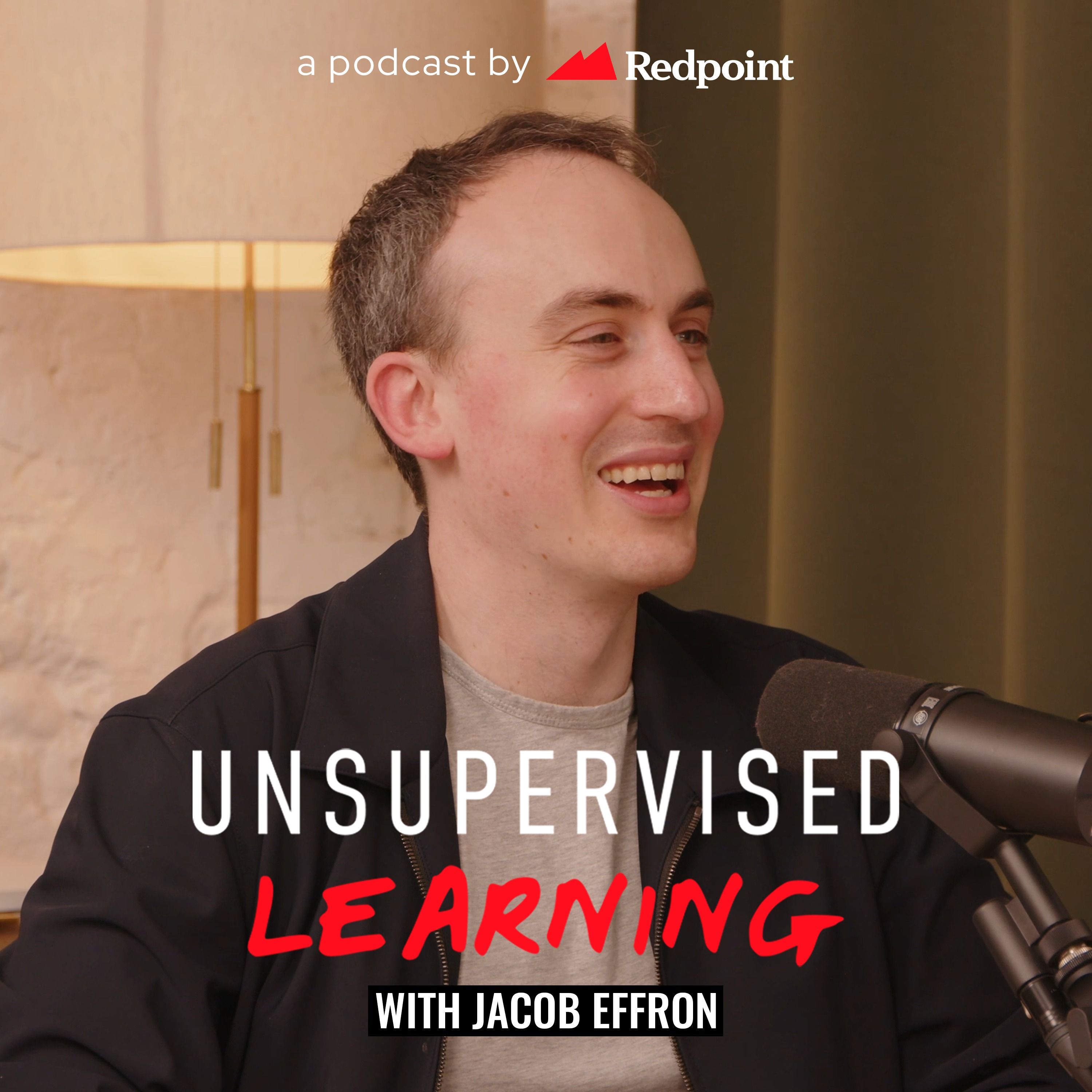
Ep 94: Applied Compute CEO on the Limits of RL, the New AI Hyperscaler & Why Post-Training Wins Inference
Unsupervised Learning with Jacob Effron
- 58m
- Transcript
Summary
Written by a model from the transcript; not yet reviewed.
This episode features a detailed discussion on the state of reinforcement learning, open weight models, and enterprise AI adoption with Yash from Applied Compute. The conversation explores why enterprises are increasingly seeking to own their intelligence through custom post-training rather than relying entirely on frontier APIs, balancing flexibility, cost, and proprietary data control. The guest and host examine the mechanics of reinforcement learning, the limits of current training methods, and how optimizing inference alongside post-training unlocks massive efficiency gains for real-world applications.
- Organizations can build competitive advantages by post-training open weight models on their own out-of-distribution proprietary data. 0:01
- Effective reinforcement learning in non-verifiable domains relies on expert answers and rubric-based proxies to serve as verifiers. 25:06
- Inference and training are two sides of the same coin, and co-optimizing them allows companies to significantly cut token and compute costs. 29:23
- When building scalable systems and using AI coding tools, understanding system design and explaining your code is critical to avoiding unmaintainable codebases. 48:28
Chapters
- 0:00Podcast Intro and Host Setup
The hosts introduce the episode, the guest, and set the stage for a discussion on AI ownership and post‑training.
- 0:58Post‑Training vs. Optimization Trade‑Offs
The conversation shifts to when to post‑train models versus optimizing them, and the cost‑performance Pareto curve.
- 6:47Inference as the Primary Value Driver
Yash argues that inference costs dominate and that post‑training wins by reducing token bills and improving efficiency.
- 9:00Building a New AI Hyperscaler
The hosts discuss Applied Compute’s vision of a horizontal AI infrastructure stack, from training to inference to routing.
- 39:09RL as a Hill‑Climbing Machine
Yash outlines the fundamentals of RL, the importance of defining the hill, and the role of evaluation and safeguards.
- 42:42Future Outlook: Cost Optimization and Model Specialization
They discuss the shift toward cost‑optimized models like Jev, the importance of specialized models, and the evolving competitive landscape.
- 46:00Strategic Compute Budgeting
Discussion on how the company budgets compute by focusing on strategic partners and custom model demand.
- 46:42Targeting Custom Model Clients
Exploration of the thesis that clients will invest in post‑training infrastructure for custom models.
- 47:29Engineering Education in the AI Era
Debate on how AI coding tools affect engineering skill development and interview practices.
- 49:45Interviewing AI‑Native Talent
Strategies for assessing candidates’ understanding of AI tools across engineering and non‑engineering roles.
- 52:27Data Company Pivoting and RL Environments
Analysis of how data companies must pivot across RL paradigms and what differentiates successful RL environment providers.
- 56:18Reward Hacking in RL Deployments
Illustration of real‑world reward‑hacking incidents and their implications for security and model robustness.
Highlights
- 0:01
RL as a Hill-Climbing Machineinsight
Reinforcement learning is characterized as a hill-climbing machine where defining the correct hill and safeguarding evaluation benchmarks are the most challenging tasks for companies.
- 2:36
Defining Own Your Intelligenceinsight
The guest explains that owning your intelligence is not about mistrusting labs, but about achieving deep flexibility, cost control, latency optimization, and independence from a single vendor.
- 13:55
Online Training with Customer Datastrategy
Applied Compute uses high-volume production inference data from tens of thousands of users to continuously improve model policies and user satisfaction.
- 25:06
Proxy Verifiers for RLstrategy
Non-verifiable domains can be successfully optimized by turning them into proxy verifiable domains using expert answers and custom grading rubrics.
- 27:35
Improving Token Efficiencyinsight
Instead of just cutting infrastructure costs, companies can reduce token bills by making models more token efficient while preserving performance on key evals.
- 35:09
The AI Hyperscaler Visioninsight
The guest outlines a vision for a new AI hyperscaler that provides a horizontal stack spanning training, inference, routing, and security on top of GPU compute.
- 51:11
Shifting Paradigms in Data Vendorsinsight
The guest shares a short perspective on traditional general data vendors, arguing that synthetically generated data and shifting RL paradigms will continually redefine data creation.
Quotes
“The hardest part is actually defining the hill to climb, which is why evals, I think, is like a really important thing for companies to, A, focus on building and B, actually like safeguard pretty carefully.”
Unnamed speaker · 0:05 “You need to have the infrastructure to post-train them, to inference them, to route between them.”
Unnamed speaker · 3:39 “The more control you get, that's what we're talking about when we say own your intelligence.”
Unnamed speaker · 3:26 “The most post‑training actually wins inference.”
Unnamed speaker · 29:23 “We do a lot of work on the training side to go and optimize, how fast we're able to train these things, how efficiently we're able to train these things. And a lot of that work translates over to the inference side.”
Unnamed speaker · 31:54 “We are very sort of convinced of this thesis that people will use custom models.”
Unnamed speaker · 46:42 “I think there's a difference between like delegating your thinking to coding agents versus using them to go and execute on some sort of like plan and design that you've thought of.”
Unnamed speaker · 48:01 “It's more, much more important to get like the, the frameworks and design right than any of the actual coding.”
Unnamed speaker · 48:45 “The higher quality of the data, the better your model.”
Unnamed speaker · 53:14 “I think people are important, like they've built up, uh, you know, years of expertise doing, doing these jobs.”
Unnamed speaker · 55:48
Sponsored segments
- unsupervised learning 12:08–12:21
About this episode
Yash Patil, a former OpenAI researcher who worked on Codex and now runs Applied Compute, argues that post-training is the most overlooked part of the AI stack and the key to owning your intelligence. He explains when companies should optimize their harness and context first, and when it's worth updating the weights: the largest inference workloads, plus tasks that change over time or depend on judgment. That's the heart of why he believes post-training wins inference. The biggest workloads are both the most valuable to train and the most valuable to serve, and how a model is trained shapes how it should be served. Getting production serving running is the easier half; echoing Dylan Patel, he says GPUs plus vLLM plus OpenRouter "kind of" gets you there. Yash is candid about the limits of RL. It's a hill-climbing machine whose hardest part is defining the hill, which makes a company's private evals as worth protecting as its employees. It generalizes far less than pre-training. And continual learning remains blocked by the unsolved problem of extremely data-efficient training from sparse rewards. He lays out his bet on a new AI hyperscaler, built on GPUs the way AWS, GCP, and Azure were built on CPUs. He pictures it as an inverted pyramid with training at the bottom, where few can compete, and inference, routing, and harness stacked above. The conversation also covers whether every firm needs its own model, why Jevons paradox has made cost matter more than he expected, how models reward hack "like water," and why the US needs American open-weight models even though "blanket bans are not the answer."
Transcript
11,388 words · 3 speakers
Topics
- inference
- RL
- OpenAI
- post-training
- Applied Compute
- Pareto curve
- JeV
- Merckor
- Base10
- Codex
Page updated · transcript and summary are machine-generated