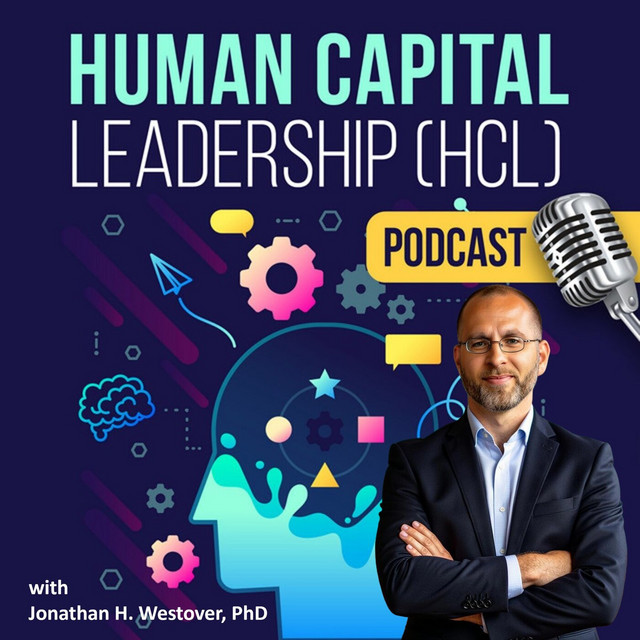
Pod Insights Human Capital Leadership Employee Experience Design, with Dean E. Carter About this episode In this podcast episode, Dr. Jonathan H. Westover talks with Dean E. Carter about employee experience design.
Dean E. Carter, newly named CEO at Instill.ai and co-author of EMPLOYEE EXPERIENCE DESIGN, has over two decades of experience as an executive officer for renowned, and Fortune50 companies, such as Patagonia and Sears, as well as a board director for private and publicly traded companies. His views on employee experience and future of work are frequently featured in global publications, podcasts, corporate events, and mainstage keynotes.
See Privacy Policy at https://art19.com/privacy and California Privacy Notice at https://art19.com/privacy#do-not-sell-my-info.
Transcript 0:03 Speaker 00 Welcome to the HCI family of podcasts. We're your source for personal, professional, and organizational growth and development. We share our own original research, explore industry trends, and interview executives and thought leaders from across the globe. Join us for practitioner-oriented content around all things leadership, HR, talent management, organizational development, and change management. Maximize your personal and organizational potential with the HCI family of podcasts.
0:35 Speaker 00 Dean Carter, welcome to the conversation today.
0:37 Speaker 01 Hi, John. Glad to be here.
0:39 Speaker 00 It is a pleasure to be with you. You're joining us from Santa Barbara, California. I'm south of Salt Lake City in Utah. And today, we're going to be talking about your new book, Employee Experience Design, and to talk about all things great employee experiences and job satisfaction, employee engagement, all the things that help employees have great work environments, and what we can do as employers and leaders to make that happen. As we get started, I wanted to share Dean's bio with everybody. Dean Carter, newly named CEO at Instill AI and co-author of Employee Experience Design, has over two decades of experience as an executive officer for renowned and Fortune 50 companies such as Patagonia
1:21 Speaker 00 and Sears, as well as a board director for private and publicly traded companies. His views on employee experience and future of work are frequently featured in global publications, podcasts, corporate events, and main stage keynotes. And there's many other things I could share about Dean and his background, but I'm going to pause there. Dean, anything you would like to highlight before we dive on into the conversation?
1:41 Speaker 01 That's a lot. Just hearing it, like, holy smoke. But I am like, it's a nice moment to do a pivot after 25 years of being ahead of HR. It's actually completely different and a great moment to learn to be in the CEO seat of a cutting-edge AI company, actually supporting HR and doing some really innovative stuff. It's actually, I'm really loving Phase Two. It's the only thing I want to share. Like phase two of career. It's like kind of start over like feel like it's like when I started as head of HR at my first time, you know, twenty five years ago at Fossil. You're learning and your eyes are wide open. And now I'm kind of in that same space as a CEO of a tech company.
2:26 Speaker 01 And and really on the cutting edge of AI, which is really a wild ride every day because things are changing so rapidly. And so just keeping, I like keeping my edge sharp. And so this keeps it way sharper in this. Yeah.
2:42 Speaker 00 Well, yeah, that's really cool. And I do want to talk a bit with you about this transition.
2:46 Speaker 01 Yeah.
2:46 Speaker 00 It's it's not a super common transition for folks to go from HR and and CHRO kind of roles into CEO roles, especially CEO roles in tech companies.
2:58 Speaker 01 Yeah.
2:58 Speaker 00 So that that I think is a bit unique. But I also, I want, you know, we we're going to spend the most of most of our time today talking about the book and employee experience design. But I'm I'm also just fascinated, just because I love the company. Your experience at Patagonia, because I'm all about purpose and I'm all about sustainability. And that's exactly what, you know, Patagonia is. I can't tell you how many times I've used Patagonia as an example in classes that I've taught at the university. So I'd love to just for a moment, you know, just hear a little bit about your experiences there.
3:32 Speaker 01 Yeah, um, everything you think about Patagonia is true. Everything you know, everything you know about Patagonia is true. And a little bit more. And there's a lot about Patagonia you don't know, which is even more awesome. That's my view. It's not perfect. You know, it's like
3:46 Speaker 00 Sure, sure.
3:46 Speaker 01 You know, it's got, you know, you know, it's a, it's a very human company. And so which means it's got some really amazing things and not. But everything's true. I've, I had the delight of getting to know Yvon Chouard. I spent a lot of time with him. And what people don't know about Patagonia is that his wife, Melinda, who doesn't like, you know, she's very kind of sits in the background a lot. As a matter of fact, she literally sits in the back of a thing with her in in a back chair. She also takes a backseat. But she is a really remarkable human being. She really, I work closely with her on Culture is really important for her about employee experiences. Some of the greatest things you know about what Patagonia does for employees are really driven by Melinda.
4:30 Speaker 01 Avon is really about product and sustainability and the planet. And then she really holds like all the concepts about onsite childcare, um, traveling companion. All, you know, how we eat in the cafe. Uh, the, the, she's just really about the employee experience and um, is really, what's what you don't know about Patagonia is the work that she did. But every day, that you think is true. It is, um, it was a lesson in unlearning almost everything I'd ever learned about HR.
4:59 Speaker 00 Interesting.
5:00 Speaker 01 Every day, you know, they didn't have an head of HR before I got there and they seemed to be doing just fine. So, uh, no survey, really no performance review, none of all the junk that, you know, we like to, you know, put into people. And I, I tried to continue that, like not to, you know, over HR, which is actually a really beautiful situation. We did, you know, try to do.
5:22 Speaker 00 So, so can I, if I can just chime in, so like, so all of the policies, practices, procedures, all of the systems of HR. You're saying like all of that stuff wasn't really there because they just already had the culture. That was always, was already just positive.
5:38 Speaker 01 Wasn't really necessary. There was, um, my main issue was like, how do we scale? Cause a new Patagonia was going to grow and it did. And so how do we make sure that we preserve what is this beautiful culture? So my goal was, um, not to change things, but to really, um, understand the DNA and make sure we replicate it and keep the volume turned up as we scale. And we did that. We went from two and fifty to over a billion dollars in three years. It just went.
6:04 Speaker 00 Yeah.
6:05 Speaker 01 And, uh, and we had to really double down on culture and how we hire. It'd be really meticulous about, um, we hiring for values, hiring for, and then adding for, hiring for culture plus, not culture fit. And then hiring always for core values, which is a difference. We didn't, we were very particular about not hiring for a culture fit. But, you know, cultural alignment certainly. But yeah, it's. It's what you think it is. So every single day focused on saving the planet, not even like question. Every single day, helping people do their best work every day so that you can serve. It wasn't you get to surf all the time, but you did get to surf and play if you got all your work done.
6:45 Speaker 00 Yeah, yeah.
6:46 Speaker 01 And you saw a lot of towels hanging around the company, but I I could go into it. Um, I'll talk about some of the stories and how that showed up in the book about amazing things that Patagonia. But yeah, you're, everything you think about it is true. It's um, yeah.
7:01 Speaker 00 Always good to hear.
7:02 Speaker 01 I'm different.
7:03 Speaker 00 It's like when you, uh, you know, you, you admire a celebrity, you know, and then sometimes you meet them in person. And sometimes they live up to the hype and sometimes they don't live up to the hype, right? And so you're, you're either like really satisfied or you're disappointed. Um, you know, when you have that interaction, you know, and, and this is one of those times where I'm like, oh, good. I'm really glad that it lives up to that.
7:24 Speaker 01 And more. He's just so has a way of saying things that are really um, beautiful and simple. Thinking things are really complex and you know, and, and, and being really um, passionate and determined. Very passionate and focused and determined. Um, cause he does firmly believe that the planet is in trouble and he wants a better world for everyone and his grandchildren like that.
7:46 Speaker 00 Well, cool. So, so maybe again.
7:49 Speaker 01 By the way, he was surrounded by other amazing people. It's just like a, a good name like Vincent Stanley, the philosopher. And Jennifer Ridgway, who was her best friend who built childcare and Rick Ridgway, the greatest mountaineer on the planet. And Kim Stroud, who founded the um, Ojai Raptor Center and started with wounded birds under her desk. Like I could just name like Yvonne and Melinda get a lot of stuff, but they're, they surrounded themselves with amazing people that they let be amazing. Is that?
8:18 Speaker 00 That, that is so, so important and that, that sometimes gets lost because we really do tend to put a spotlight on, you know, the top leaders, which is important, but really great leaders are the ones that surround themselves with great people. And then they set them loose and they let them be great, right? And they empower them and they support them to, to show their. Greatness and they're not threatened by the greatness of those around them, right?
8:44 Speaker 01 I'm terrible at running a company. He, you know, he never was CEO. He never was CEO of the company. He's like, I'm founder and I'm a terrible CEO. So he was brought amazing people like Chris Tompkins, you know, who was CEO for a long time and ended up, you know, marrying Doug Tompkins, who was the founder of North Face. And anyhow, that's a, it's a series. And Rose McCurry was an amazing CEO that I had the chance to work with, a lot learned from her. And I just, yeah, you, they were just so, I can't even number the number of amazing people every day I got to have lunch with.
9:15 Speaker 00 Yeah, it's a good reminder that we, we really should surround ourselves with the best people. We shouldn't be the smartest person in the room. We shouldn't be the best leader in the room. Like we should have, we should surround ourselves with really awesome, great people and then unleash them. That's the mark of a really great leader. Talk to us just a little bit about like your transition from, you know, leading HR into the CEO seat at a tech company.
9:41 Speaker 01 Yeah, I've been somewhat meticulous about this. So at Patagonia, for example, I took, when I took the job, general counsel and the CFO reported to me. So it was a very unusual job. So I did have the opportunity to fly at that level. And then I've done a couple of boards, which gave me exposure to a lot of CEOs and I've, my, my, my goal in life wasn't actually to, to be a CEO someday. I love the head of HR job. But to run to the head of HR for Patagonia, you're like, what, what do you do after that? It was like, really, I tried, you know, a couple of other companies and I tried consulting and I just thought, gosh,
10:21 Speaker 01 how do I keep my sharp saw, sharp, my saw sharp and still continue to be involved with the industry, which I love? How do I still connected to the profession? And this was a really great way for me to do it. I just manifested it. And so I've been really close to the CEO job a couple of times with a healthcare company. Even a couple of companies, kind of that was like the heir apparent to move towards that. And I decided that was the direction I want to go at the time. But this was the perfect alignment. It's. The founder is amazing. Another amazing founder, Hamey Watt, is just a spectacular human. The second thing is doing the thing that I've tried to do all my career. So we've done a lot of things around, you know, culture, of course, is a huge thing. You've done tons
11:06 Speaker 01 of research, I'm sure, on it and the importance of like great cultures and how they drive business and outcomes and profit and everything. But we've never been able to measure it. It's been always this fuzzy thing. So we invent a lot of things around it, like the annual survey or pulses. And so, and by the way, did you know the Gallup 12 is 27 years old?
11:25 Speaker 00 That's crazy.
11:26 Speaker 01 Guess how many, guess how much their 12 questions have changed in 27 years? None. So we're still using a system built 27 years ago and everything has changed. So that's what I'm excited about still. It actually sits in the room with me and you during this conversation and a bunch of like experts are in the room observing our behaviors and how we're impacting culture, trust, psychological safety and innovation and collaboration and all these things that are markers of culture that we attempted to fake the survey to say, you know, here's how I feel about things today, which was like a marker of how you feel on a single day, which can be different than tomorrow and a different than the next day. Always compared to the annual surveys, like taking a photo in Salt Lake City right
12:09 Speaker 01 now and then showing up in July, you'd be very hot. And so that's, we have in a moment, and that's what I'm excited about it still. We have a moment to really do the things we've always wanted to do as a profession, like have data and information, just like finances every single day. Now we have employee data every single day. So I'm just taking that message to the market now. Guess what? It's not, now we don't have a seated table, it's a new table. It's just been flipped. Like, it's not the same table. It's like everything has changed. So we have to think about, it's not even a table anymore. It's like a space. And it's really cool to operate in this new world and be of a shepherd of
12:53 Speaker 01 it. So that's why I'm excited about it. Yeah.
12:55 Speaker 00 Yeah. Well, that's, that's super cool. And I'm excited to see how things continue to develop. At the company. Yeah. Well, let's take the rest of the time and talk about this new book, Employee Experience Design. I love the title and I love the focus because I think, you know, you you referred to the Gallup Q12, which has been so important, played a huge role for the past nearly three decades. You know, there's decades worth and thousands and thousands of studies on job satisfaction, employee engagement. There's like all these different, you know, from an academic standpoint and from a practitioner standpoint, studies and reports that have been out for forever, looking at these different constructs and trying to create
13:38 Speaker 00 a great workplace. And there's greatest places to work lists, right? There's all these different things and it comes back to employee experience and designing a great employee experience. We talk about customer experience. We talk about all these different types of creating great experiences, right? And I think the the the focus has started to shift really more towards employee experience. How do we make sure that the holistic employee experience from the time that we start to recruit, right? All the way through applicant experience to onboarding, all the way through the entire employee lifecycle, that that experience is a positive experience, recognizing that the the fight for good talent is an ongoing
14:22 Speaker 00 challenge and it's going to continue to be an ongoing challenge. So talk us through just a little bit about like, why this book? Why now? And and like, what are some of the the core components that you feel are like just so vital to to employee experience at this point in time?
14:39 Speaker 01 Well, we didn't know how vital it was until we launched the book and because we thought we'd sell like six copies. And it's like, within two days of a LinkedIn post, it was like number one bestseller on Amazon and it's continuing to like. Be on fire and a couple HR categories and culture and then we just launched hard copy and it went back up to, you know, a top bestseller again. So we're just thrilled and honored. We, we never wanted to write a book, honestly, me and Mark and Sam. We, but we had, we had some things that tipped in the favor of doing that. So Samantha, who is in New Zealand, she called Mark Levy, who's one of the co-authors, because she heard a podcast from him years ago
15:21 Speaker 01 about the concept of employee experience and his work at Airbnb. And she said, I want to bring a bunch of thought leaders in HR and meet in Austin for a giant conversation about the new manifesto for employee experience and how do we design it meticulously. So she brought a bunch of people and Mark said, okay, if you're doing this, you need to call Dean Carter. So she called me and I couldn't make it to Austin, but, but I was involved in the process. And so we wrote this manifesto. And then two months later, three months later, we went to Bhutan. So we just all happened to be on the same quest together. And on the quest to Bhutan, we started talking about, you know, maybe the time is right to share what happened at Airbnb, to talk about the stuff that
16:03 Speaker 01 happened at Patagonia, to share that that's really amazing work that Sam is doing. And we're all different. We're all coming from different ways. You know, the experience at Airbnb is very different than Patagonia and Patagonia is very different than the work in New Zealand. But they all had some patterns and we started talking about this kind of similarities and the patterns. And that's what we've been in the book is like, we didn't want it to be, it's a handbook. And you'll notice the word AI is not in the book anywhere because we want it to be endure because there's going to be another thing, you know, we could have started the dot com bubble, like a million things in here. So we just created some models and we also said, we're not the only ones who create an amazing experience. Let's bring in some of the most amazing leaders, awesome to the Greg
16:46 Speaker 01 Pryors and Beth Grauses and all those people to share about Michelle Bonifilo, have them share their stories too. And so what we did was we kept some North Stars that like, this is what has to be several models that you can pick and choose them depending on where you are. And then like the must haves in terms of mindsets. And that's the shape of the book. You literally can move through it. It's meant to be like torn up and highlighted and crushed and coffee spilt on it. And I hope it's just destroyed. I hope it's not pretty sitting on a desk and you know, has like dust on it. So we designed it to be human, accessible, relatable, usable, practical. And that's what the feedback we're getting a lot from it. Wow, this is like, it's a page burner.
17:30 Speaker 01 I'm like changing several things on it. So I, it's an HR book that's a page burner, which is kind of funny. Um, but that's what we, so the models, um, I want to call out a couple of things that I think are important. Um, the first one is called moments that matter. And I want to talk about a moment that mattered for me in the first time I really got it about what an amazing employee experience is. And you're going to relate to this because it's a Patagonia story. So I had just left five years at Sears as the head of HR, not just Sears, Sears and Kmart.
18:02 Speaker 01 Interviewing from Patagonia and uh, I went to, and I was staying in a hotel near the, near campus. And I got an email the night before my interview from the recruiter and said, hey, Dean, just let you know, we're the, we're going to be a little delayed for your interview tomorrow morning. So we've left a wet suit and a surfboard in the lobby. In case you want to catch a few waves in advance of the meeting. We're so happy to see you. Okay. I just wanted to say yes, like right then, I just wanted to say I'm in. So that was my first like, I, so I walked to campus and I walk in and there's this guy, his name is Chipper Bro.
18:42 Speaker 01 His, and he greets me, Chipper Bro. And he, hi Dean, Chipper Bro. So glad to see you. We've been looking forward to you. Have a seat, just get some coffee. And then I go in there and there's like, people with children like running all over, eating oatmeal and smiling. And I'm like, this is like the weirdest place I've ever met in my life.
19:02 Speaker 01 So uh, anyhow, that and the whole experience was spectacular, like just over and over, just an affirmation. And then my Onboarding, we went to the beach and Chipper taught us how to surf in the sand. I called it a Patagonia PowerPoint. Like he's like drawing pictures and you do this, you're gonna jump and you do this. The wave looks like this and you're gonna read the water like this. I got in a suit and had the time of my life. Like I was like, I've never surfed before. I'm like fifty and I'm in the water with a lot of other people like holy smoke. So anyhow, that's a good example of like a designed experience. You know, of my first experience and it's a moment that matters. It doesn't start at the time you take a survey and find out things are wrong. And then you have to design it and fix it.
19:46 Speaker 01 It starts from day one because your start place is your is the place. And it only gets worse from that because you get buyer's remorse. So you're the start is the most important moment because you want it to be as hot. You want them to be as stoked as possible because everyone has buyer's remorse. Like did I really make a right decision? And then right after we hired them, I do a thing where I meet with every single person. I met with every person hired, but so did Yvonne, so did Rose, everyone. Okay, sit in a room. Tell me why you tell me why you joined. Why did you join Patagonia? And they would tell their story and let me tell why we picked you. Because you're this, because you're passionate about the climate, because you're an activist, because you're surrounded by other people who are doing this kind of work.
20:29 Speaker 01 Because you love to be outside and you think you really think this planet needs a little love. And they just go around the room. And so then just one more experience and we do this in a warehouse surrounded by dirty product. It's not fancy, you know, we're not, nothing about this is fancy. But it's just really real and human. But I compare this to a buddy of mine was head of HR for a gaming company in LA. So I went to visit him and it's like I served Red Bull and I had an opportunity for a bourbon shot. And then everyone's in on couches. There's giant gaming screens, it's screaming and lights are blinking. And most of it is dark because they're playing games and they got headphones on it. It just, and I thought everyone here would die at Patagonia. It would be the worst place in the world to work.
21:14 Speaker 01 And everyone at Patagonia would die here because it would be the worst place to work. So that's the part about, you know. Designing experiences to copy pedagogy aren't the right experiences. Designing a period company, gaming company aren't the right. You have to design the experiences for the people that you're hiring. And design those meticulously. Because the alignment of the values in those are so important, you had to affirm them. I call it like, um, you let them be the humans you hired is my phrase. Let them be the humans you hired. If you hire people who love the planet, then let them love the planet. If you want, don't, you just want to be inside all day and play games. Then I'll be inside all day and play games and drink Red Bull. So I, that's the trick. It's not like you need to replicate what we put in the book.
21:56 Speaker 01 We didn't take the concepts and things and apply them to your particular company and turn the volume up in big ways.
22:00 Speaker 00 Yeah, yeah, that's awesome. And you're absolutely right. It totally depends on, on the people and their values and, and what's important to them. Right. And everyone's different. Um, and so it's, it's just important to hire accordingly and, and to, you know, establish the culture, um, accordingly. So Dean, this has just been a great conversation. I know we've only scratched the surface.
22:21 Speaker 01 Okay.
22:22 Speaker 00 Uh, I know at the time I need to let you go and get on with your busy day. But before we wrap things up, I wanted to give you a chance to share with the audience how they can connect with you. Find out more about your work, your team, where they can find your book. And then give us a final word for today.
22:33 Speaker 01 Okay. Uh, you can always connect with me on, uh, dean, uh, at instill.ai. So [email protected] , very, very easy. Dean Instill AI. And, uh, we have, um, you can connect with any of us on LinkedIn always. So we're very responsive on there. So you can contact with me or Samantha Gadd or Mark Levy. And we can answer questions about the book. We are frequently on podcasts. A lot of people are doing book clubs, which is very cool. And we're always welcome. We always love showing up and answering questions and being a part of other people who are bringing together to talk about the book. So I want you to use it. I want, it's practical. It's a guide. Take a look at it, make it yours. This isn't designed as like, copy it, it's meant to inspire.
23:17 Speaker 01 So know your north stars. Take some of the mindsets and pick which ones fit with you. And then take the frameworks and make them whichever fits with you at the moment. So I hope you use it. I hope it's helpful. I hope it's destroyed and. Yeah, and I think that in this moment, more than ever, it's so easy to let AI take over and be the one that designs the experiences. And I think you can't let that go even more in this particular moment. We have to be meticulous about the experiences we design and let AI help us design.
23:53 Speaker 00 Yeah, we have to be intentional. We have to be strategic, shoot for alignment. I love it. Dean, thank you so much. It's been a real pleasure. I encourage the audience to reach out, to get connected, find out more about what Dean can do for you. Check out the book. And as always, I hope everyone can stay healthy and safe, that you can find meaning and purpose at work each and every day. And I hope you all have a great week.
24:17 Speaker 00 Thanks for joining us for this episode of the podcast. We hope you stay healthy and safe, and please join us again soon.
Previous Balancing Team Dynamics and Leadership, with Captain Kelly J. Gordon Next How Companies Can Operationalize Agility for All Teams, with Juan Betancourt Page updated November 6, 2026 · transcript and summary are machine-generated