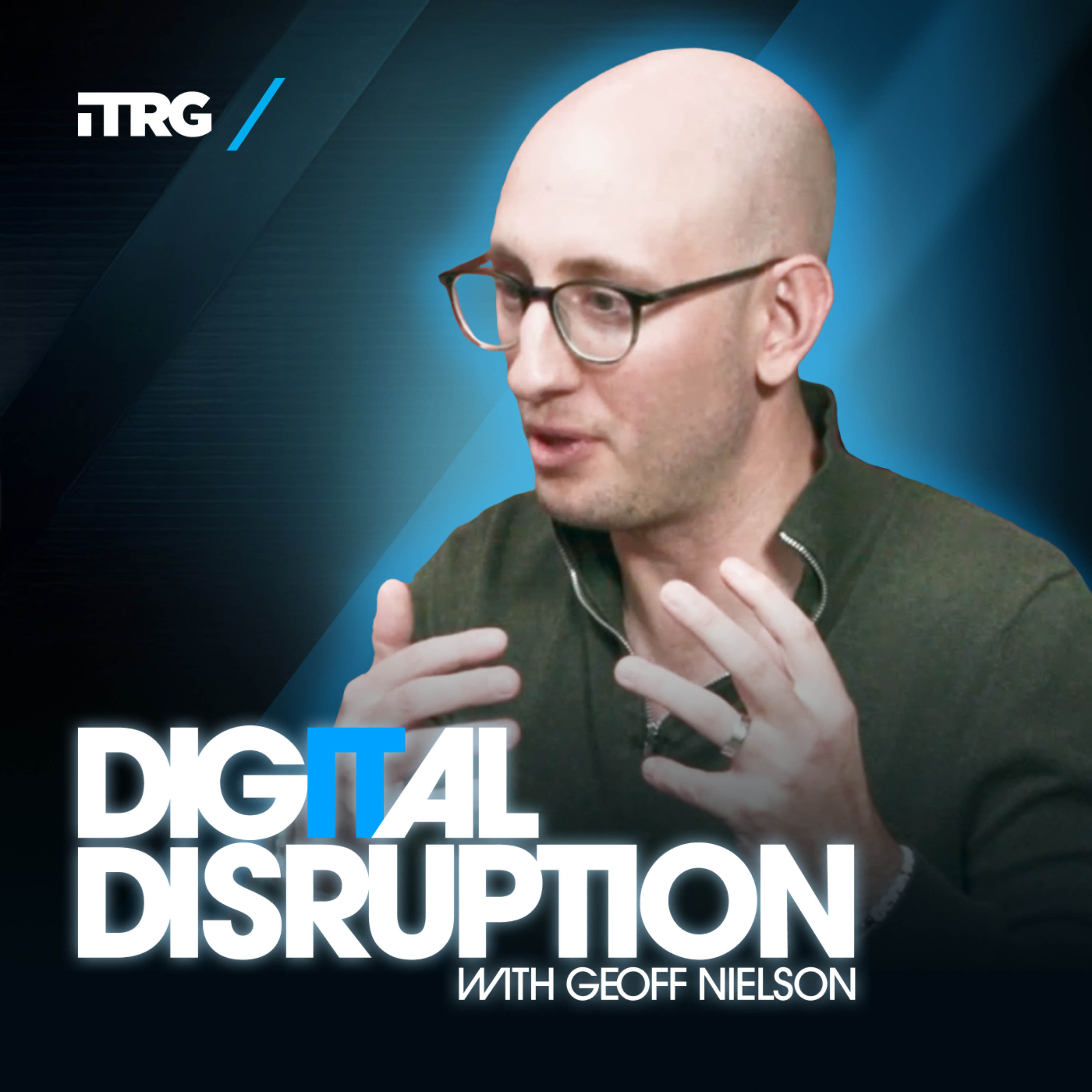
Robin Hanson: AI is probably the End of Humanity (and why that's OK)
Digital Disruption with Geoff Nielson
- 1h 43m
- Transcript
Summary
Written by a model from the transcript; not yet reviewed.
In this episode, Jeff Nielsen speaks with economist and futurist Robin Hanson about the long-term trajectory of civilization, artificial intelligence, and the concept of the great filter. Hanson argues that AI is not a separate alien rival but rather the inevitable descendant of human civilization, pointing out that historical transitions like agriculture and industry mirror this shift. The discussion explores why capitalism, competition, and money are likely to persist, why Hanson fears a future lock-down of growth rather than a sudden apocalyptic AI takeover, and how cultural evolution has broken down due to the rise of a global monoculture and falling fertility rates. They also debate the role of market competition versus regulation in AI development and how large language models might help integrate human knowledge across disparate fields.
- Instead of viewing AI as an alien invasion, frame it as a technological descendant that emerges naturally from human innovation. 33:25
- To protect yourself against future societal disruptions, diversify your assets and be willing to adopt new production methods early. 29:04
- A global monoculture and falling fertility rates signal that cultural evolution has stalled, threatening long-term civilizational growth. 49:15
- Rather than relying on speculative regulations, allow market competition to drive AI development and reduce the risk of industrial lock-in. 1:13:54
Chapters
- 0:32Podcast Introduction
The show opens with a brief host introduction and an overview of the episode’s focus on AI and humanity’s future.
- 1:37Host Meets Robin Hanson
Jeff Nielsen welcomes Robin Hanson and sets up the conversation about civilization’s trajectory and AI’s role.
- 8:06Capitalism’s Enduring Presence
Discussion of why capitalism and competition will persist even as AI reshapes society.
- 12:48Closing Reflections
The episode concludes with a summary of key themes and a hopeful outlook on humanity’s potential.
- 14:56The Great Filter and Fermi Paradox
Hanson outlines the concept of the Great Filter and its relevance to humanity’s future expansion.
- 33:25AI as Human Descendants
Hanson argues that AI should be viewed as a continuation of humanity rather than an alien threat.
- 41:24Future Challenges and Fixes
Hanson reflects on what humanity has broken in cultural evolution and the difficulty of repairing it.
- 43:01Cultural Evolution vs. DNA
The conversation contrasts biological evolution with cultural evolution and its impact on technological progress.
- 49:10Cultural Maladaptation and Rapid Change
The speaker explains how technology and capitalism accelerate change, eroding cultural evolution and creating maladaptive trends.
- 49:56Capitalism’s Uneven Influence on Society
The speaker contrasts areas governed by capitalism (e.g., markets) with those shielded from it (e.g., governance), arguing this mismatch fuels maladaptation.
- 52:34AI’s Role in Fertility and Cultural Drift
The discussion explores how advanced AI could solve fertility issues but may also exacerbate cultural drift if it inherits a single homogeneous culture.
- 1:12:00Regulation vs. Innovation in AI Development
The dialogue examines the pitfalls of over‑regulation, historical lessons from other industries, and the need for balanced approaches to AI governance.
Highlights
- 0:01
Civilizational Replacement Patterninsight
Hanson explains that just as industrials replaced farmers and foragers, AI is bound to dominate the world as a natural next step in civilizational evolution, requiring humans to join the new world.
- 2:21
The Age of M Scenarioinsight
Hanson discusses his book The Age of M, which outlines a plausible future where brain emulations of humans form a vast, highly capitalist civilization that many people mistakenly view as dystopian.
- 15:05
Redefining the Great Filterinsight
Hanson reframes Fermi's paradox, arguing that the great filter is not necessarily an apocalypse, but rather a stable world system that locks down further cosmological expansion.
- 24:52
Broken Cultural Evolutioninsight
Hanson argues that humanity has broken its evolutionary superpower by merging into a global monoculture with a 20-year doubling rate and celebrating cultural activism instead of retaining fragmented selection pressures.
- 26:56
Historical Transitions and Inclusiondata
Hanson compares the AI transition to farming and the industrial revolution, noting that past shifts recruited large coalitions rather than leaving only six people behind.
- 39:07
Darwinian Definition of Descendantsinsight
Using evolutionary theory, Hanson explains that AIs are literal descendants because they share features with us and are causally tied to human creation, making them distinct from coexisting rivals.
- 1:03:43
Capitalism and Orphanagesinsight
Hanson argues that declining fertility persists because capitalism does not run parenting; if capitalists could raise and sell children for a million dollars, population decline would reverse.
Quotes
“AIs would eventually be more capable than non-AIs and they would therefore have to run the world and they would dominate what happened in the world and then the rest of the world would be at their mercy.”
Unnamed speaker · 0:01 “And we furthermore made cultural activism a celebrated activity.”
Unnamed speaker · 49:56 “If you start to think about fixes, you realize it's really damn hard.”
Unnamed speaker · 50:06 “AI would solve that fertility problem. But remember, the fertility problem was a symptom of an underlying problem. It wasn't the problem itself.”
Unnamed speaker · 1:01:19 “We should set up robots took your job insurance as a thing, because that's long been the biggest concern people have had about a transition to AI is what if all of a sudden lots of people lose their jobs?”
Unnamed speaker · 1:12:57 “In a time of change, you just need to be flexible and search and look for the wins.”
Unnamed speaker · 1:29:17 “but I'm afraid that that may just get tossed, like the burning of the Library of Alexandria.”
Unnamed speaker · 1:39:51 “learn even more, but at least save it.”
Unnamed speaker · 1:40:25 “So with the axial revolution of like 3,000 years ago, a key thing that happened,”
Unnamed speaker · 1:41:16 “that kind of kills it. So that that could happen again.”
Unnamed speaker · 1:42:02
Sponsored segments
- InfoTech 10:42–11:13
About this episode
Robin Hanson believes the future of AI is far stranger than most people imagine. In this episode, economist, futurist, and The Age of Em author Robin Hanson explains one of the biggest questions humanity has faced: What happens after humans? Instead of viewing AI as humanity's greatest threat, Hanson argues we should think of AI as our descendants. The conversation looks at why AI replacing humans may be part of civilization's natural evolution, why capitalism and competition aren't disappearing, and how cultural evolution, not technology, may be humanity's biggest existential challenge. We also examine the Great Filter, the future of work, AI regulation, software engineering, technological progress, fertility decline, civilization collapse, AI governance, and why Robin believes our greatest risk isn't AI taking over, but humanity losing its ability to evolve culturally. If you're interested in the future of AI, artificial intelligence, AGI, economics, civilization, technology, and what comes after humanity, this conversation will challenge many of your assumptions. Subscribe and like this video for more conversations with the world's leading thinkers on AI, technology, innovation, and digital transformation. In this episode: 00:00 Intro 01:00 AI will eventually replace humanity 01:36 Robin Hanson’s background 02:20 The future of civilization 03:22 The Age of Em explained 06:03 Why brain emulation changes everything 07:24 Capitalism isn't going away 11:18 Is humanity actually progressing? 13:10 The Great Filter explained 18:17 Why AI isn't the Great Filter 22:02 AI, technological acceleration & the next 20 years 24:24 Will AI leave people behind? 29:04 How to survive technological disruption 33:08 Why AI is humanity's descendants 40:23 Cultural evolution is breaking 47:12 Why civilization is becoming maladaptive 55:06 Is modern society quietly declining? 01:00:45 Can AI solve civilization's biggest problem? 01:07:01 AI risk vs AI progress 01:12:00 Should AI be regulated? 01:17:03 The US, China & the AI race 01:22:26 AI's economic impact 01:25:19 Advice for business leaders 01:30:45 AI's biggest opportunity for humanity 01:38:48 What gives Robin Hanson hope 01:42:24 Final thoughts Connect with Robin: X: https://x.com/robinhanson Facebook: https://www.facebook.com/robin.hanson.754/ Our links: Visit our website: https://www.infotech.com/?utm_source=youtube&utm_medium=social&utm_campaign=podcast Follow us on YouTube: https://www.youtube.com/@InfoTechRG
Transcript
18,637 words · 2 speakers
Topics
- AI
- capitalism
- cultural evolution
- LLMs
- Great filter
- fertility
- AI as a tide that raises all boats
- China
- The Age of M
- Amish
Page updated · transcript and summary are machine-generated