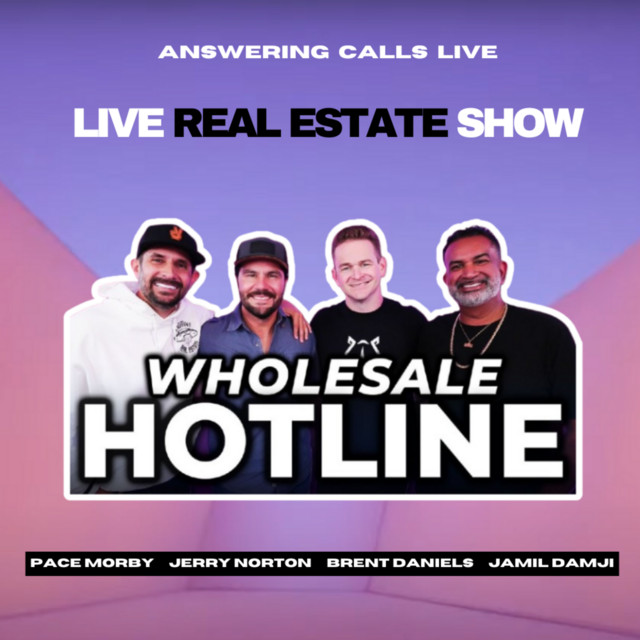
Pod Insights Wholesale Hotline This Is Better Than Wholesaling... (Double The Profit) | Flipping Mastery About this episode Welcome to the Wholesale Hotline Podcast Weekend Edition (Flipping Mastery Edition), where Jerry teaches how to master the art of house flipping, wholesaling, and new construction development.
Show notes -- in this episode we'll cover:
Straightforward, step-by-step training on making six and seven figures from real estate deals. Insider tactics for finding motivated sellers, analyzing deals, and raising private money. Learn how to flip houses virtually from anywhere—even with zero experience. Whether you're a beginner or scaling up, Jerry gives you the blueprint to build real wealth through real estate.
Please give us a rating and let us know how we are doing!
➖➖➖➖➖➖➖➖➖➖➖➖➖➖➖
☎️ Welcome to Wholesale Hotline & Flipping Mastery Breakout! ☎️
Jerry Norton went from digging holes for minimum wage in his mid 20's to becoming a millionaire by the age of 30. Today he's the nation's leading expert on flipping houses and has taught thousands of people how to live their dream lifestyle through real estate.
**NOTE: To Download any of Jerry's FREE training, tools, or resources…
Click on the link provided and enter your email. The download is automatically emailed to you. If you don’t see it, check your junk/spam folder, in case your email provider put it there. If you still don't see it, contact our support at: [email protected] or 888) 958-3028.
➖➖➖➖➖➖➖➖➖➖➖➖➖➖➖
💲 USE THIS LINK FOR DISCOUNTS AND FREEBIES TO USE IN YOUR BUSINESS: 💲
Make $10,000 Finding Deals:b https://flippingmastery.com/10kpod
Get 100% funding for your deals! https://flippingmastery.com/fspod
Mentoring Program: https://flippingmastery.com/ftpod
FREE 8 Week Training Program: https://flippingmastery.com/8wpod
Get Paid $8700 To Find Vacant Lots For Jerry: https://flippingmastery.com/lfpod
FREE 30 Day Quickstart Kit https://flippingmastery.com/qkpod
FREE Virtual Wholesaling Kit: https://flippingmastery.com/vfpod
FREE On-Market Deal Finder Tool: https://flippingmastery.com/dcpod
FREE Wholesaler Contracts: https://flippingmastery.com/wcpod
FREE Comp Tool: https://flippingmastery.com/compod
FREE Funding Kit: https://flippingmastery.com/fkpod
FREE Agent Offer Sheet & Scripts: https://flippingmastery.com/aspod
FREE Cash Buyer Scripts: https://flippingmastery.com/cbspod
FREE Best Selling Wholesaling Ebook: https://flippingmastery.com/ebookpod
FREE Best Selling Fix and Flip Ebook: https://flippingmastery.com/ebpod
FREE Rehab Checklist: https://flippingmastery.com/rehabpod
➖➖➖➖➖➖➖➖➖➖➖➖➖➖➖
🔌 PLUG IN & SUBSCRIBE 🔌
SUBSCRIBE: Jerry Norton and Flipping Mastery TV https://www.youtube.com/c/FlippingMasteryTV
FACEBOOK: http://www. Facebook.com/flippingmastery
INSTAGRAM: https://www.instagram.com/flippingmastery/
➖➖➖➖➖➖➖➖➖➖➖➖➖➖➖
🤝 #SQUADUP & GET MORE DEALS DONE in the Wholesale Hotline LIVE Facebook group: https://www.facebook.com/groups/759418414582645 🤝
‼️‼️Pro tip: Make a post with your market & what you need help with‼️‼️
Transcript 0:03 Speaker 00 Hey, it's Jerry Norton. Welcome to the Wholesale Hotline Podcast and the Flipping Mastery Breakout. We want to know how we're doing, so please leave a comment and give us a rating.
0:18 Speaker 00 If you're a real estate wholesaler, one of the fastest ways to double revenue is to do a takedown. Now, a takedown deal is not a fix and flip, and it's not a double close. It's where you buy the property with no predetermined buyer, then you turn around and list it on the open market and resell the property. Now, doing this, we're finding that we can make two to four times as much profit as we do doing a traditional assignment. Now, I'm going to show you exactly how this works. I'm going to break down all of the numbers for you using a real-life case study. This property right here that we just did a takedown deal on and made a $41,000 profit. All that and more, coming up. If you're new to wholesaling, and especially in the beginning, the assignment of contract is the best strategy to really build your business,
1:03 Speaker 00 because it requires no capital, it's the lowest form of risk in the deal, and there's no waiting to get paid. You make your money exactly at the closing from the cash buyer as a line item on the closing statement. So, the assignment's really great, but in time, as you develop your business, you don't want to be a one-trick pony in the wholesale game. There are double closes that you can do, that is another strategy. And then, there's also what I call a takedown deal. Now, some people call this a whole tail. Traditionally, that's what it's called, but I like to call it a takedown. And this is a strategy that I've been developing in my real estate business more and more during the past couple of years, especially as regulation rolls out and really just build the business,
1:44 Speaker 00 because there are certain types of deals that just make a whole lot of sense to buy the property. Instead of assigning it to a cash buyer, take title, take ownership of that property, fund it, purchase it.
1:58 Speaker 00 With no predetermined buyer, you're not pre-selling it to a cash buyer. And then obviously your net profit is going to be the difference between your sale price, all your closing fees, commissions, financing, any trash out or work that you did, less your purchase equals your profit. So in a minute here, I want to show you a deal where we just did this and made a $41,000 profit. But before we get into that, I just want to reiterate that having the option on certain deals that makes sense, where you can actually buy it and resell it, do a takedown, you can double to quadruple your profits. So it's something that you really want to start thinking about. It's something that should be a consideration in your business model.
2:41 Speaker 00 And so every deal we get, we go into the deal, we acquire the deal. And you know, our first strategy is let's do a dispo process. Let's see what kind of numbers we can get on a traditional assignment. Again, I'll take an assignment all day long because it's, it's a bird in hand, right? It's money now. But when I run my numbers, if we think we can double, triple or quadruple our profit, then we'll go ahead and do a takedown. And that's sort of our threshold, that's sort of our parameters that we have. Double to quadruple, then we'll go ahead, at least double, then we'll go ahead and probably take the deal down rather than do the traditional assignment. And so I want to show you this property right here. I'm going to share my screen and check this property out. I mean, this is just a beautiful home.
3:25 Speaker 00 This is in Owasso, Oklahoma. And as you can see here, I'll just kind of scroll through real quick. These, this is the resale, we just resold this property. But you can see here, look how clean this house is. I mean, this house is beautiful. This is how we acquired it. I mean, we did a, I'll show you the numbers. We did a $1,200 cleanup on this. That was it. We did nothing to this property. And we listed it for 399, within a couple of days, got, you know, multiple showings, got multiple offers, got a full price offer and accepted that offer. So you could see here that this is retail ready. How did we get this deal? This was a true motivated seller in a retail property, you know, most motivated.
4:08 Speaker 00 Sellers also have distressed property. They have a property that's in poor condition or original condition. And in this case, this is a seller who, for whatever his circumstances are, we don't really know a lot of the details. He's going to jail. And he's basically out of time. He's cleaning up his life. He's preparing for time in jail. And he reached out to us through our marketing. And he said, I need to sell this property and I need to sell it quick. So we came in and we committed to buy the property, obviously at a discount in exchange for speed and convenience. We said we can close really quickly. And so we closed this property within a couple of weeks. He did not have time to list it on the market and have showings and appraisals and financing and
4:48 Speaker 00 buyers and all of that. So he took our discounted cash offer. And so I'm going to show you these numbers here in a minute, but that is how we acquired this deal. Okay, so here's this property. We closed on the purchase on January 16. And we bought this for 322,000. I mean, can you believe that? Look at this property. Look how beautiful this brick home is for 322,000. Welcome to Oklahoma. We bought this for 322,000. And if you look at all of our closing fees on the purchase, they came to $3,724. I financed this with 10% interest only financing. I'll talk about that again in a minute. And then on the resale here, you can see that we sold it and closed a
5:32 Speaker 00 couple of days ago from this recording. And that was on February 27. So it was a 42 day turn. So from when we bought it to when we resold it, took 42 days. Literally, we closed on it. Within a couple of days, we had it cleaned up and back on the market. Couple of days after that, we had a full price offer. You know, 30 days later, we closed. So it was a very fast turn. They don't all go that fast, but this one was a 42 day turn. And you can see here that we sold it for 399.9. That was our list price. So we bought it for 322, resold it for 399. And then let's do some breakdowns. Our biggest expense was the commissions. We paid a total of $20,000 in commissions between listing broker and the buyer's agent.
6:18 Speaker 00 Then we had about $6,800 in closing fees. Now, 3,000 of that was a seller credit, which is very common when you do these takedowns. Because, you know, the buyer comes in and, you know, they do their inspection and usually they're going to find a bunch of things and we don't want to rehab. That's the point of this is we're not rehabbing. So we usually will just settle on a credit to the seller. So in this case, it was $3,000. Then all our other closing fees came to, you know, another 3,800 for a total of $6,800 in closing fees on the resale. Now, let's go through these numbers. So we sold it for 399. We bought it for 322. We paid $1,292 for the trash out and the cleanup.
7:03 Speaker 00 We had $20,000 in commissions. We had 10,500 in total closing fees. Now, that 10,500 was including the closing fees when we bought it. Remember, you pay closing fees when you buy and closing fees when you sell. And then we had $3,700 in financing. Now, that's cheap financing. I paid 10% interest on the money and we only had the money out for 42 days. So I only paid 42 days worth of interest at 37.46 as total interest on the deal. And when you subtract all of this out, that gives us a 41,338 net profit. So now let's go through and look at this from a percentage of sale price, which is
7:44 Speaker 00 how I like to think about it because then I can run a formula and have a standardized way of looking at this. So if you think about it, you know, my trash out was next to nothing. That came to 0.3% of my sale price. My biggest expense, like I said, was commissions. That was 5% of the sale price came to commissions. My total closing fees, and again, this was the fees I paid when I purchased it and the fees I paid when I sold it. That came to 10,500 or about 2.6% of the sale price. And then financing, that was really cheap financing, came to just under 1%. So roughly my cost between trash out commissions, closing fees and financing was about 10%. And that's what I like to factor in about 10%.
8:27 Speaker 00 One way or another, it seems to come around 10%, which means my profit was of 41,000 was also about 10% of the sale price, which means I bought this at about 80% of the as is resale price. And again, no rehab. We did not rehab this property. We turned it in 42 days. So that's why this is a comparable strategy to wholesaling. You got to fund it. You got to sit in the deal a minute, not very long. We try to be in and out of them in under 60 days, typically around 45 days if we do everything right. In this case, we ended up buying it at 80% of its current as is fly off the shelf. You know, we call it a fire sale price. We bought it at 80%, 10% went to cost, 10% went to profit.
9:11 Speaker 00 So why did this make such a good takedown deal? How would this have compared? Well, first of all, when you looked at the pictures of this property, there really wasn't a rehab opportunity, not to still get the deal done, because he was willing to sell it at a discount, but not at a discount where a flipper would need to come in. And he would need to do, you know, new cabinets or new light fixtures, paint carpet, like do a value add. Maybe you could have done carpet and paint and got a little more money, but it wasn't really that type of play. We bought it at 80% of its as is value for the idea of just reselling it. So I don't even know if I could have assigned this for $10,000 or $20,000 to a cash buyer. There, I don't think that was a really a play there. Really, the best move here was exactly what we did, which was to take it down and resell it.
9:56 Speaker 00 Now, some deals, they make a whole lot of sense for a flipper still, or even a buy and hold investor like a cash buyer. And in that situation, what we do is we run our numbers on both ways. We'll actually do a dispo process. We'll see what our highest buyers are, our highest offers are. And then we'll run that as a comparison against these numbers on what we think we can make doing a takedown. And then we'll kind of do an analysis. We'll say, okay, well, what's better? You know, the bird in hand or wait and see if we can get more money later. And that analysis for us is typically if we can make twice as much doing the takedown or more, we'll go ahead and do the takedown. Like I said earlier. So going back and looking at this, let's go back and look at these numbers again. Like I said, we bought this
10:41 Speaker 00 at 80%. We factored in 10% in cost. I broke down all those numbers. We made about 10% of the sale price as a net profit. Now, that is a pretty aggressive formula. And part of the reason why is we have very cheap capital. You know, I can only cost me 10%. I don't have to pay points or really much of anything. It's just straight interest on the capital. I have access to that type of capital. If you don't, and you have more expensive capital, then you know, your, your financing costs may go up a little bit. But if you really understand your market, you really know your values, this will work at 80%. So you take the as is resale value. Again, that number is not to sit on the market for very long. We want to have showings and multiple offers within the first couple
11:26 Speaker 00 of days. Cause again, we want in and out of the deal. We don't want it sitting around and competing. We want to move it quick. It's got to be a fire sale price. But a more conservative, or if you have more expensive capital is probably 70%. This is what I recommend people do. Buy it at 70%. If you're not really, really confident. Now, in Tulsa, Oklahoma, with my business partner, Mark Gabriel, we dominate that market. We understand the values really, really well. So we can be a little bit more aggressive and go to 80% and still hit our numbers. But at 70%, you're super safe. You've got yourself a buffer zone. You even can pay for more expensive capital if it costs you more for the money. And you just give yourself a little more wiggle room there. So if you're thinking
12:08 Speaker 00 about this, you want to be careful that you don't price yourself out of the deal and you end up making as much or less than you would doing an assignment. If it's apples to apples, and you're going to make as much doing a takedown as you are an assignment, always take the assignment. It's just faster and easier. Again, the general rule that we follow is if we can make at least twice the assignment, then we're going to go ahead and take down that deal. I hope that's really helpful for you to kind of see this deal as a breakdown. Now I've got a really cool resource here for you guys. If you want to learn how to do this more, it's an entire kit where I show exactly how to do it. It's got the calculators, the formulas, it's got how to raise the capital, how it all fits together, your strategies on acquiring it,
12:52 Speaker 00 your strategies on selling it, you know, all the things with the agents and everything involved in the deal. If you go to freetakedownkit.com, you can download that for free. It's just a really awesome resource for those of you that are really moving in this direction. And finally here, what I want to talk about a little bit is this is the future of our industry. And I've been talking quite a bit about this for several years now. As regulation rolls forward and as the assignment becomes either extremely difficult or even not allowed in some states, as we're seeing, then this will be the way that we actually transact. We'll have to just buy the darn thing and resell it. So one of the things that I continually are
13:33 Speaker 00 telling, I'm telling people is in order to do this, you have to get capitalized. You have to get access to funding. Funding is the secret ingredient. I mean, think about it. Every single wholesaler I talk to, if they're honest with me, if I say to them, what would be easier? Acquiring the property, going through all the regulation, all the disclosure, all the things that you need to do on the front end to acquire real estate. In most markets, there's now 20 states that have some form of regulation, some states even licensing requirements. You know, you got all of that to do the assignment for the ability to do the assignment. But if you had access to cheap capital or even expensive capital, if you had access to capital and you could buy it, would that be easier to just buy it? No disposal process, finding the buyers, none of
14:17 Speaker 00 that, and just put the thing back up on the MLS and let a buyer's agent come and sell it? What's easier? And everybody will say, well, man, that's so much easier, but I don't have the funding. I don't want to take the risk. I'm not confident enough in my numbers. I get all that. But if you were confident in your numbers, you knew what you were doing, you knew your market, and you could get the capital, imagine sitting down with a seller at the kitchen table and saying, I am the buyer. I'm not a wholesaler. I don't need to disclose any of that stuff. I don't need a license. I'm just a buyer. And here's my track record. Here's my proof of funds. I'll come in aggressive. I'll waive inspections. I'll put down big earnest money because I am the buyer. When you can be the buyer in the transaction,
15:00 Speaker 00 then you now have so much more control. You have such a competitive advantage in the marketplace because now you are one leg up from all the other wholesalers that only have the assignment as their strategy. And so that just gives you such a stronger position in the marketplace. And again, what if now you could have that positioning and you could make double, three times or four times as much money than you would do in the assignment? It's just a no brainer. Like it's where you want to be going towards in this business. By the way, it still falls into the bucket, if you will, the category of wholesaling, because we're not rehabbing. You know, the minute you go in there and you put a new furnace in and you put a new water heater in there
15:42 Speaker 00 and you paint this room or that room or new countertop, now you're rehabbing, even if it's light, you're rehabbing. That's fix and flip. That's a whole nother thing. This is not fix and flip. This fits into the wholesaling strategy. You have assignment, you have double close and you have the takedown. None of those involve value add. None of them involve doing work to the property to make your profit. You're buying at a discount and you're selling at a discount and you're making a spread on the difference. Just like wholesaling, it's just now you're in the deal a little longer and you're, and you're getting the capital to fund and purchase it. So that's the big difference there. But why I love this so much is because you can scale a takedown business, the takedown model. You can scale that and you remove entirely your dispo department. There is no dispo department.
16:28 Speaker 00 Why? Because you're relisting it on the MLS and you're letting the market come and buy it. A buyer's agent is going to come and sell your house. No dispo process, no timeline, no crunch, no inspection contingencies with your sellers so that you can find your buyer, none of that. All of that goes away. So it just makes the process a lot easier. And like I said, I foresee in, in my business, especially with my partner, Mark Gabriel in Tulsa, we're buying more and more of our deals and doing less and less assignments. Now, having said that, we still do a lot of assignments. Last year we did like a hundred assignments in that market. So we'll continue to do the assignment. It's an awesome strategy. It has a place. It's all it is. It's a strategy and it has a place.
17:09 Speaker 00 But open your mind and your opportunities up to bigger deals and more deals and more opportunities. And that's what this provides. And just so you know, I have a program where we'll buy your takedown deals if they fit the formula. Now, for me to buy it, it does need to be at that 70% of the as-is value. But if you go to my10kcheck.com, you can register for free training, you can learn all about the program, but I will buy your deals and pay you $10,000 if they're at that 70% of the as-is value, then I'll buy those. Okay, so you can check that program out. It's really cool. Again, just go to my10kcheck.com to register for that training and get set up for being a finder for me and bringing either fix and flips or these takedown strategy deals. Okay, thanks, guys.
17:55 Speaker 00 Hey, thanks for listening to this podcast. To get more free tips, check out my YouTube channel. Just search Flipping Mastery TV on YouTube, where I have over 1,000 videos teaching you how to make more money with real estate. On my channel, I also give away free stuff like my Quick Start Kit with everything you need to flip your first house in the next 30 days. Or my deal finding software called Data Cruncher, which finds discounted houses in any zip code in a matter of seconds. You can get those for free at myquickstartkit.com and mydatacruncher.com.
Previous $250K Profit Per Deal (Not Fix and Flip) | Wholesaling Inc Show Next Breakdown: New Wholesaler Closes $137K Deal | Wholesaling Inc Show Page updated November 10, 2026 · transcript and summary are machine-generated