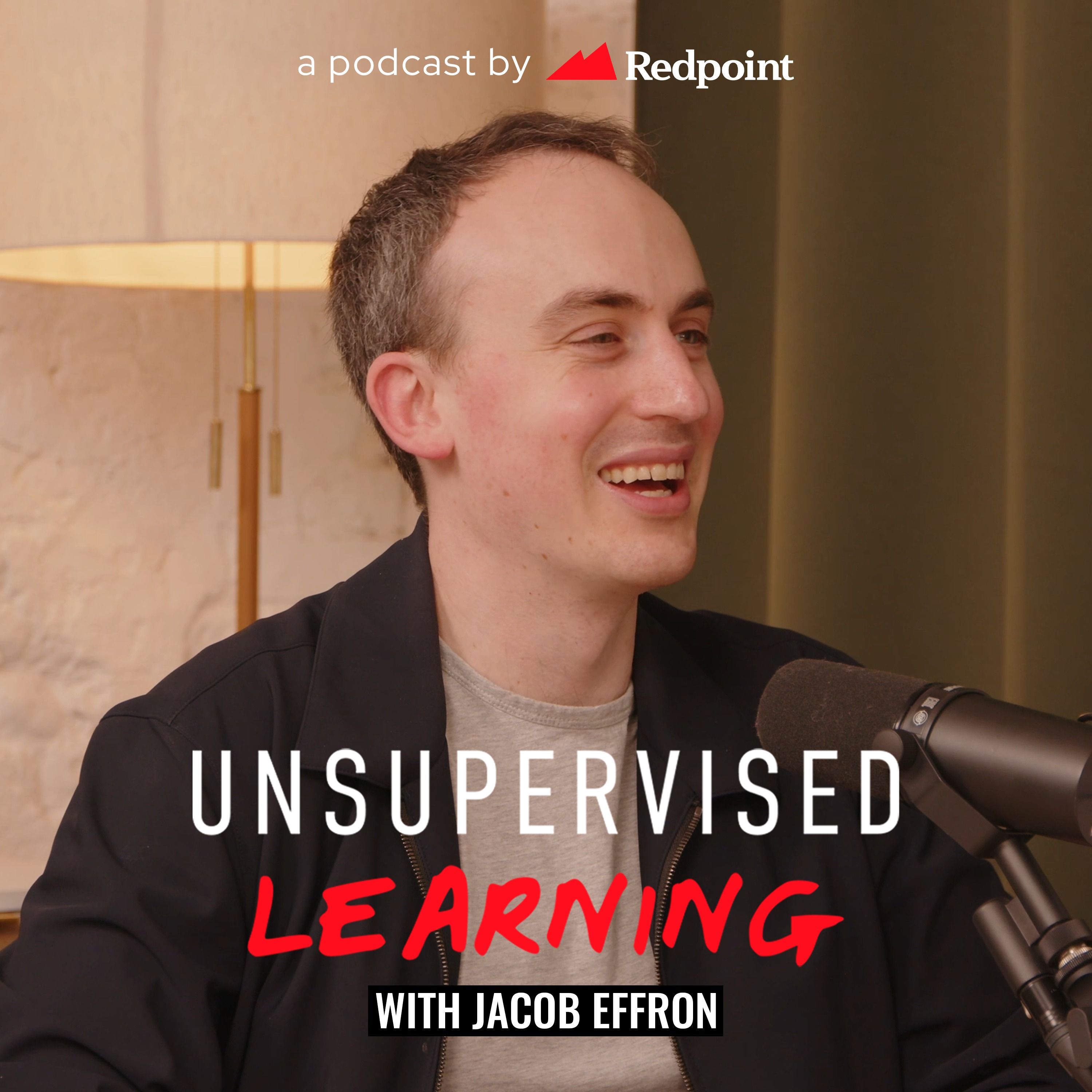
Ep 92: xAI Co-Founder Unpacks the Future of Model Development
Unsupervised Learning with Jacob Effron
- 1h 4m
- Transcript
Summary
Written by a model from the transcript; not yet reviewed.
In this episode of Unsupervised Learning, host Jacob Efron speaks with Igor Babushkin, former researcher at DeepMind and OpenAI, co-founder of xAI, and founder of River AI. Babushkin unpacks his journey across the forefront of AI development, detailing the monumental sprint to build xAI's Colossus cluster and why closed-source model providers face a difficult economic and regulatory squeeze. The conversation explores the technical and philosophical challenges of moving beyond verifiable domains like coding into complex scientific discovery and personal AI.
Throughout the discussion, Babushkin and Efron examine the necessity of distributed AI architectures and local hardware to preserve user privacy and human agency. Babushkin explains River AI's three core bets: an RL and fine-tuning enterprise API, hyper-personalized consumer agents optimized for human flourishing, and local hardware to bring frontier model inference directly to the edge. The episode offers a rare, ground-level perspective on the scaling limits of massive data centers and why decentralized, user-controlled model development may represent the most viable path forward for the AI ecosystem.
- Engineers and researchers can leverage coding agents to rewrite projects and explore complex non-verifiable domains. 2:27
- Companies can utilize reinforcement learning and fine-tuning APIs to customize models on proprietary internal data. 12:55
- Bringing inference compute locally to edge hardware allows users to maintain data privacy and personal control. 14:47
- Training agents end-to-end to optimize personal rewards like user happiness helps align models with individual preferences. 19:21
Chapters
- 0:00Podcast Introduction and Host Overview
The host welcomes listeners and introduces guest Igor Babushkin, outlining his background and the episode’s focus on AI future.
- 3:59The Rise of Coding Agents and Future Domains
Igor discusses how coding agents have transformed software engineering and the potential for agents to impact non-verifiable domains.
- 12:40Closing Reflections on AI’s Societal Impact
The episode concludes with Igor’s thoughts on AI’s future, policy implications, and the importance of keeping intelligence local and open.
- 15:10Hardware Local Inference and Privacy Benefits
The conversation turns to bringing inference to local devices, reducing latency, and enhancing privacy for personal AI agents.
- 21:30Personal AI as a New Recommendation System
Igor envisions personal AI agents as hybrid recommendation systems that adapt to individual preferences and contexts.
- 22:41Open Models vs Proprietary Models Debate
Igor contrasts the advantages of open models with proprietary ones, exploring how enterprises can balance speed, cost, and privacy.
- 24:58AI Progress, Diminishing Returns, and Future Directions
Igor reflects on the slowing pace of capability gains, regulatory pressures, and the need for distributed, open‑source AI innovation.
- 29:00Post-Training and Distributed AI Models
Igor outlines River AI’s strategy to enable local post‑training, giving users control over their own models and data.
- 44:33Founding XAI with Elon Musk
The conversation explains how Jacob met Elon at Tesla, leading to the creation of XAI and the recruitment of a talented team.
- 46:01Rapid Growth and Data Center Strategy
Jacob describes the swift development of XAI’s models, the construction of a custom data center, and the focus on speed and efficiency.
- 50:26Cursor Acquisition and Coding Models
The discussion covers XAI’s acquisition of Cursor, the value of real‑world coding data, and how it accelerated model performance.
- 52:29Challenges of Long‑Term Training and Non‑Verifiable Rewards
Jacob outlines the bottlenecks in training agents over long horizons, the need for new RL techniques, and the potential for LLM judges.
Highlights
- 2:27
Coding Agents Transform Software Engineeringinsight
The sudden explosion of capable cloud coding agents in late 2024 fundamentally transformed software development, inspiring researchers to rethink how agents might automate every area of computing.
- 3:49
The Modern Sorcerer's Apprenticeinsight
As LLMs and agents grow increasingly capable, software engineers find themselves playing the role of the sorcerer's apprentice, unleashing tools whose impact will soon transcend coding entirely.
- 12:55
River AI's Three Core Betsstrategy
River AI focuses on three strategic pillars: an optimized enterprise RL and fine-tuning API, hyper-personalized consumer AI agents, and local hardware to run frontier models at the edge.
- 26:56
Proprietary Model Providers Squeezedinsight
Closed-source model providers face a difficult squeeze as scaling laws encounter diminishing returns, regulatory scrutiny increases, and open-source models rapidly close the capability gap.
- 34:44
The Importance of Open Modelsinsight
Having top-tier open models developed in the U.S. is critical for lowering barriers to entry, enabling safety research, and ensuring researchers worldwide can experiment with alignment.
- 46:16
Building Colossus in 120 Daysstory
Driven by Elon Musk's first-principles thinking and decision to act as the general contractor, xAI successfully built a massive data center and brought the Colossus cluster online with extreme speed.
Quotes
“I think we’re seeing generalization in the sense that these models have such incredible knowledge of the world and they have such a wide set of skills that they can now go into any domain and bring in all the knowledge from everywhere, everywhere else.”
Unnamed speaker · 29:55 “So the Sorcerer’s Apprentice is very fascinated with magic and, you know, starts to use it, but then it kind of runs away from him.”
Unnamed speaker · 3:35 “I think it’s not the best place to be as a proprietary model builder. So I think the way out for OpenAI and Anthropic is to innovate.”
Unnamed speaker · 27:09 “I think it just requires tremendous focus and thinking outside of the box.”
Unnamed speaker · 46:27 “And I think there's a big inertia and there's a big energy barrier to getting these things to work.”
Unnamed speaker · 52:43 “So I think what we should try to do is figure out how to keep this symbiosis going.”
Unnamed speaker · 57:55 “I think open models that are close to the threshold of where they might be start to become dangerous are really, really valuable, because it allows anybody in the world to try out their ideas for how to align these models, control them.”
Unnamed speaker · 1:00:49
Sponsored segments
- the show 12:02–12:07
About this episode
Igor Babuschkin, co-founder of River AI and formerly a co-founder of xAI, joins to unpack a career that spans nearly every major AI lab: he led the StarCraft and AlphaCode work at DeepMind, joined OpenAI's reasoning team years before o1 shipped, and co-founded xAI, where he helped stand up the Colossus data center in roughly 120 days and reflects candidly on what it's actually like working with Elon Musk day to day, plus what the Cursor acquisition actually unlocked for Grok's coding models. He also discusses why he left xAI to start River AI, the three bets behind it, and why he's betting on local hardware, not just software, for personal AI. On the enterprise side, he tackles whether companies will actually train their own models or if it's just a cost play, and makes the case that proprietary labs like OpenAI and Anthropic are facing a real business squeeze. He's skeptical that stacking specialized RL domains generalizes the way pre-training scale did, and is candid about the uncomfortable reality that today's frontier open-weight models are almost entirely Chinese. He closes on what's actually needed to push model progress beyond coding into non-verifiable domains, and the broader implications of where AI is headed next.
Transcript
12,771 words · 2 speakers
Topics
- OpenAI
- reasoning
- DeepMind
- XAI
- Cursor
- reinforcement learning
- large language model
- StarCraft
- personal AI
- River AI
Page updated · transcript and summary are machine-generated