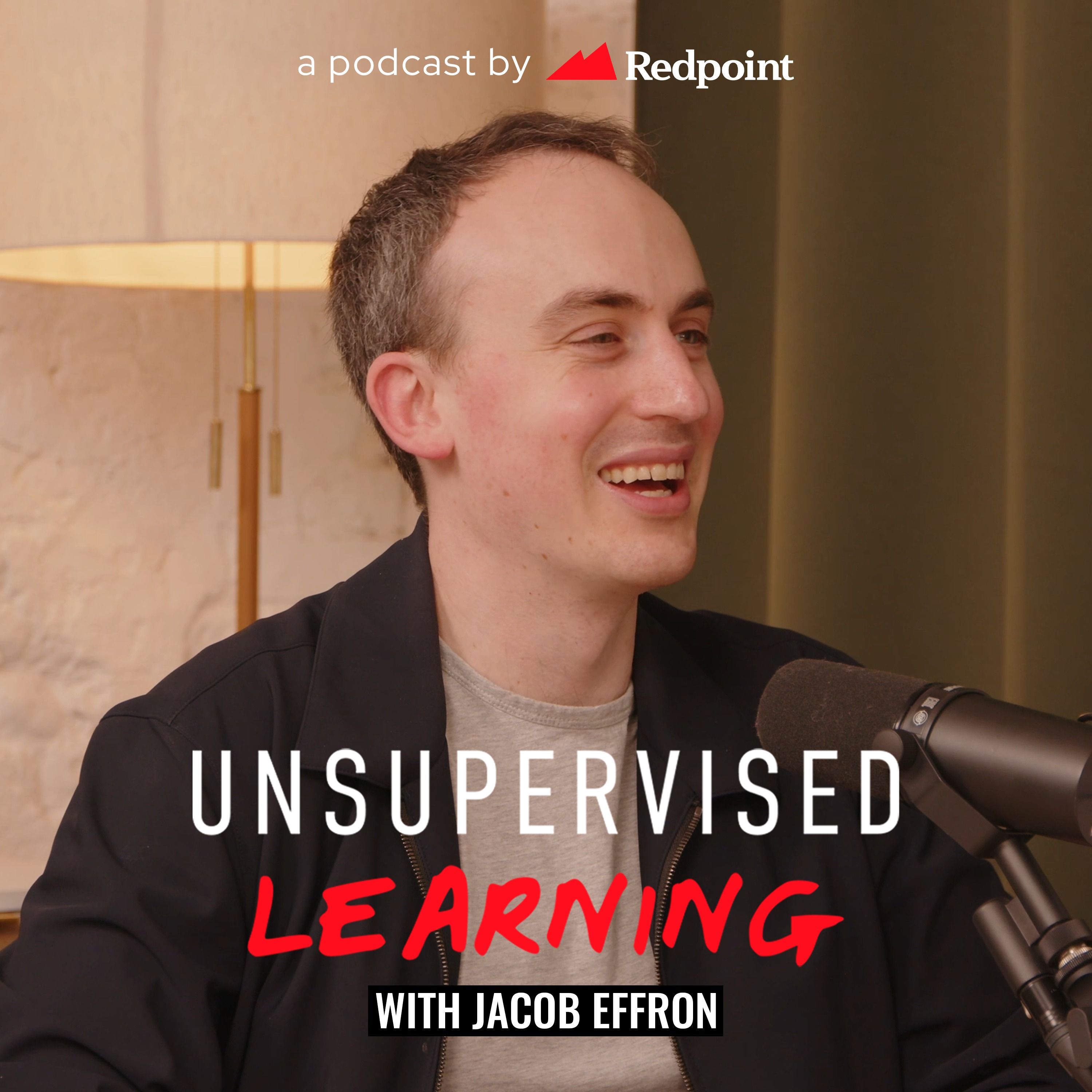
Ep 78: Jordan Schneider, Host of China Talk, on AI Race, Key Policy Decisions & Unpacking Geopolitical Chip Tension
Unsupervised Learning with Jacob Effron
- 1h 13m
- Transcript
Summary
Written by a model from the transcript; not yet reviewed.
Jordan Schneider, host of China Talk, joins Jacob Effron to walk through the Chinese AI ecosystem and US chip policy. Schneider traces how China's long-standing 'hardware over software' philosophy meant the 2023–2024 wave of AI labs was funded almost entirely by private VCs rather than state money. Roughly 15 labs spun up but have since consolidated to five or six, mostly aligned with Tencent or Alibaba. He argues the Western compute advantage is roughly 15-to-1 over the next three years, and that the real constraint for China is manufacturing capacity, not design talent.
The conversation covers the evolution of US export controls from September 2022 through the Trump administration's more chaotic approach, including the H20 saga and the debate over whether to sell Nvidia chips to China. Schneider also addresses Taiwan risk (putting invasion probability in the single digits over five years), the robotics ecosystem as a potential Chinese strength, and recommends John Ellis's 'The Social History of the Machine Gun' as a framework for understanding how organizations adapt to technology shocks.
- The Chinese government's 'hardware over software' philosophy meant AI labs were funded by private VCs, not state money, creating a protected domestic market after Western closed models were banned. 3:47
- The Western compute advantage over China is roughly 15-to-1 for the next three years, with some knobs that could shift it to 10-to-1 under different assumptions. 45:36
- Censorship is not a meaningful barrier to Chinese model quality: if you can make a model not racist, you can make it avoid politically controversial content, which is a tiny fraction of queries. 17:43
- The Chinese government's hundred-billion-dollar semiconductor fund had its top seven people disappeared for corruption, signaling a shift toward lower-touch governance of the AI sector. 18:27
- Chinese firms are still training their models on Nvidia chips, just doing it in Malaysia or with hardware they already smuggled, because Nvidia remains far superior to Huawei's offerings. 40:28
Highlights
- 6:51
DeepSeek's Hedge Fund Originstory
DeepSeek is described as a hedge fund founder who bought Nvidia chips before they became unobtainable, then pivoted his team from high-frequency trading models to large language models.
- 17:43
Censorship Is Not a Barrierinsight
Schneider argues that politically controversial queries are 0.0001% of total traffic, so the same alignment techniques that reduce bias can handle political sensitivity without degrading model quality.
- 24:33
ByteDance Founder's 5 AM Apologystory
The ByteDance founder, a self-described liberal frustrated with censorship, was forced to post a 5:12 AM apology letter saying his team failed to serve the party and uphold socialist values.
- 35:08
Trump's Air Force One Chip Decisionstory
Before the Seoul summit, the stock went up 10% on the expectation Trump would sell chips to China. Lutnik, Rubio, and others huddled on Air Force One urging him not to, and he ultimately did not.
- 39:33
No Independent Expert on Chip Salesinsight
Schneider says he has tried to find an expert not financially tied to Nvidia's upside who would argue for selling chips to China, and has not been able to find one.
- 45:36
Fifteen-to-One Compute Gapdata
Schneider presents a 15-to-1 ratio of Western to Chinese compute production capacity for the next three years, with some assumptions that could narrow it to 10-to-1.
- 56:02
Xi Unlikely to Invade Taiwaninsight
Schneider puts the probability of a Chinese invasion or blockade in the single digits over five years, noting Xi has been in power over a decade without such a move and understands the severe economic downside.
- 1:06:09
Machine Gun as Tech Shock Analogystrategy
Schneider recommends John Ellis's 200-page book on the social history of the machine gun as a framework for understanding how organizations adapt to technology shocks, drawing parallels to AI and drones.
About this episode
This week on Unsupervised Learning, Jacob Effron is joined by Jordan Schneider, host of China Talk, who challenges widespread assumptions about US-China AI competition. China's AI development is driven by private capital and market competition—not central government planning—with companies like DeepSeek, Alibaba, and ByteDance operating more like Silicon Valley startups than state projects. The critical bottleneck is compute: the West maintains a 10-15x advantage in advanced chips, and US export controls implemented one month before ChatGPT created a structural edge favoring America for years. Chinese companies aggressively open-source models from strategic necessity—they couldn't establish a quality gap justifying paid access like OpenAI. Jordan explains why the "Goldilocks strategy" of controlled chip dependency fails, why expert consensus opposes selling advanced semiconductors to China despite Nvidia's lobbying, and how Taiwan's invasion risk is driven more by domestic politics than AGI scenarios. China's real advantage may emerge in robotics manufacturing at scale, where they're already deploying while the US debates strategy.
Transcript
13,310 words · 2 speakers
Topics
- Chinese AI Ecosystem
- US-China Chip Policy
- Export Controls
- Semiconductor Manufacturing
- Geopolitical Competition
- AI Open Source
- Taiwan Risk
- Robotics
Page updated · transcript and summary are machine-generated