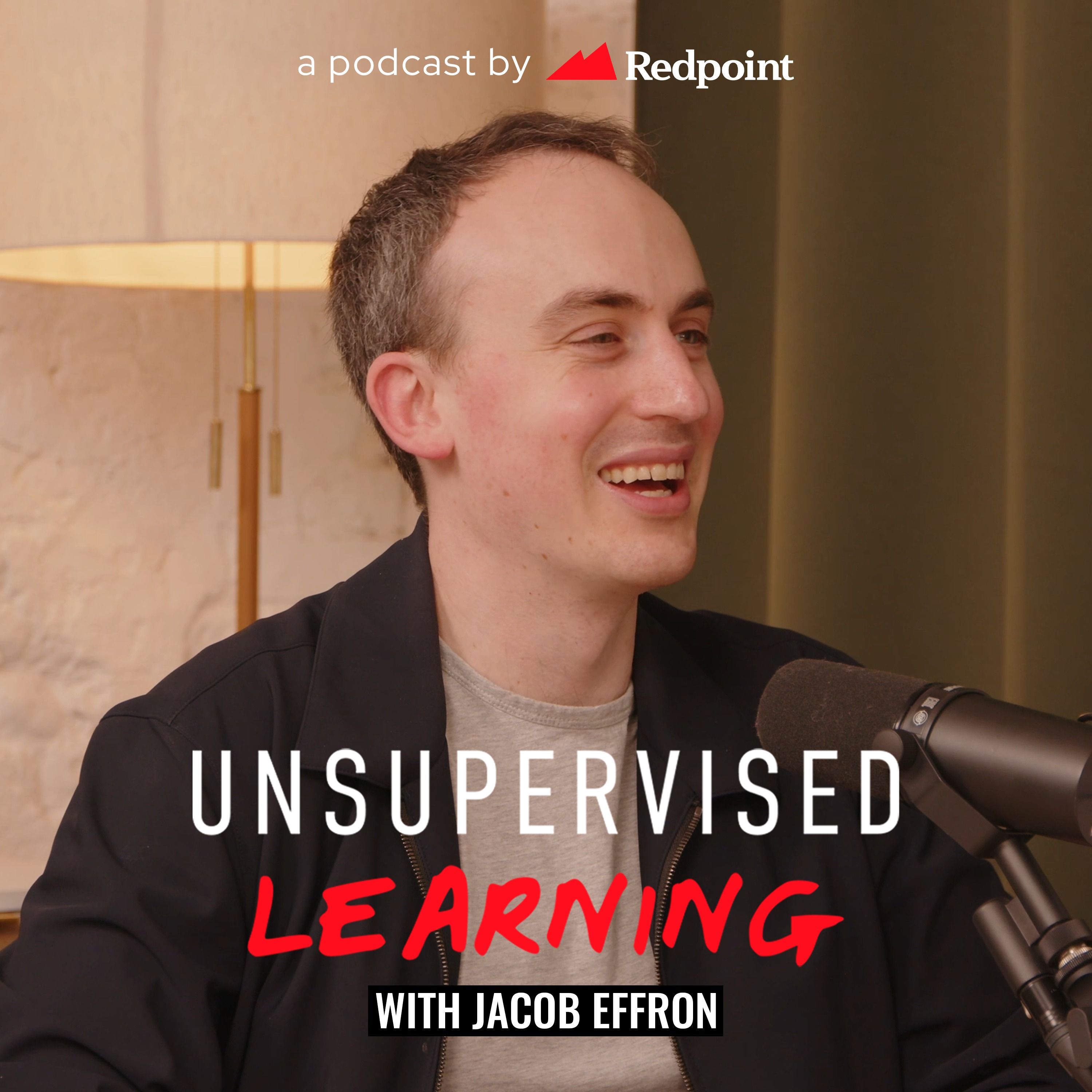
AI Vibe Check: The Actual Bottleneck In Research, SSI’s Mystique, & Spicy 2026 Predictions
Unsupervised Learning with Jacob Effron
- 1h 18m
- Transcript
Summary
Written by a model from the transcript; not yet reviewed.
Jacob Effron hosts Rob and Ari for a year-end AI discussion covering model progress, lab dynamics, and 2026 predictions. Rob argues that LLMs are plateauing, pointing to the diminishing slope from GPT-4 onward, while Ari distinguishes between consumer LLMs plateauing and AI broadly not plateauing, citing video models and enterprise gaps. Ari explains that RL works in a Goldilocks zone where models are at the edge of capability, and that the real bottleneck for AI research is compute rather than ideas, making the AI researcher concept less transformative than assumed. The conversation covers SSI's extreme secrecy, OpenAI's Code Red and its $150 billion projected burn before profitability, China's chip strategy as a long-term bet, and Amazon's Nova Forge as validation of enterprise model customization. Rob predicts Sam Altman will no longer be CEO of OpenAI by end of 2026, while Ari predicts a Chinese open source model will be the best in the world at least once that year.
- RL works best in a Goldilocks zone where the model knows enough to produce on-policy guesses but not enough to solve the task effectively, which is why it has succeeded in coding but not yet in most enterprise domains. 12:17
- The practical bottleneck for AI research is GPU compute and experimentation cost, not the generation of ideas, so an AI researcher only accelerates progress if its hit rate is dramatically higher than human researchers. 20:52
- We are in the hand-juicing era of data extraction; synthetic data and better curation can yield three times more from existing datasets, and Ilya's claim that pre-training is dead due to data exhaustion was proven wrong by Gemini 3. 27:16
- OpenAI is projected to burn $150 billion before becoming profitable around 2029, making it dependent on capital markets in a way that Google, with hundreds of billions on its balance sheet, is not. 44:24
- Ari predicts 2026 will be the year enterprise AI beyond document search, coding, and customer support starts to genuinely work and take off at scale. 1:03:29
Highlights
- 2:07
NeurIPS Grew 15x Since 2015data
Ari notes NeurIPS attendance grew from 2,000 in 2015 to 30,000 this year, a 15x increase. He observes that students at the conference feel they've missed the field, mirroring his own 2015 anxiety, which he now considers ridiculous in hindsight.
- 12:17
RL Goldilocks Zone Explainedinsight
Ari explains that RL only works when the model is at the edge of capability: not too easy (no learning signal) and not too hard (no on-policy guesses). Coding has reached this zone; most enterprise domains have not.
- 20:52
Compute Is the Real Bottleneckinsight
Ari argues the AI researcher concept assumes the bottleneck is idea generation, but in practice it is GPU compute and experimentation cost. An AI researcher only helps if its hit rate is orders of magnitude higher than human researchers.
- 27:16
Hand Juicing Orange Data Analogyinsight
Ari compares current data extraction to hand-juicing an orange versus using a juicer: we are getting pitiful yields from existing datasets. Synthetic data and better curation can triple output, and Ilya's data-exhaustion thesis was proven wrong by Gemini 3.
- 33:50
Rob shares an anecdote about someone who interviewed at SSI and was told by Ilya that two words would reveal what SSI is building, but he couldn't share them. Ari jokes the answer is 'continual learning.'
- 44:24
OpenAI Projected $150B Burndata
Rob notes OpenAI is telling investors it will burn $150 billion before profitability around 2029, compared to Uber's $40 billion and Tesla's $10 billion. This makes OpenAI uniquely dependent on capital markets versus Google's self-funding position.
- 58:31
China Is Innovating, Not Copyingdebate
Ari pushes back on the Western view of China as a copycat factory, arguing Chinese labs are innovating in both model and infrastructure layers. He believes chip restrictions have accelerated China's domestic chip development by five to ten years.
- 1:11:19
Sam Altman CEO Predictiondebate
Rob predicts Sam Altman will no longer be CEO of OpenAI by end of 2026, citing the company's shift from charmed darling to facing real competition, Sam's scattered focus on BCI and space, and the need for a more operational leader ahead of an IPO.
About this episode
Ari Morcos and Rob Toews return for their spiciest conversation yet. Fresh from NeurIPS, they debate whether models are truly plateauing or if we're just myopically focused on LLMs while breakthroughs happen in other modalities. They reveal why infinite capital at labs may actually constrain innovation, explain the narrow "Goldilocks zone" where RL actually works, and argue why U. S. chip restrictions may have backfired catastrophically—accelerating China's path to self-sufficiency by a decade. The conversation covers OpenAI's code red moment and structural vulnerabilities, the mystique surrounding SSI and Ilya's "two words," and why the real bottleneck in AI research is compute, not ideas. The episode closes with bold 2026 predictions: Rob forecasts Sam Altman won't be OpenAI's CEO by year-end, while Ari gives 50%+ odds a Chinese open-source model will be the world's best at least once next year.
Transcript
15,844 words · 3 speakers
Topics
- AI Model Plateauing
- Reinforcement Learning
- AI Research Bottlenecks
- OpenAI Strategy
- China AI Chips
- Enterprise AI Adoption
- SSI Secrecy
- 2026 Predictions
- Data Efficiency
- NeurIPS
Page updated · transcript and summary are machine-generated