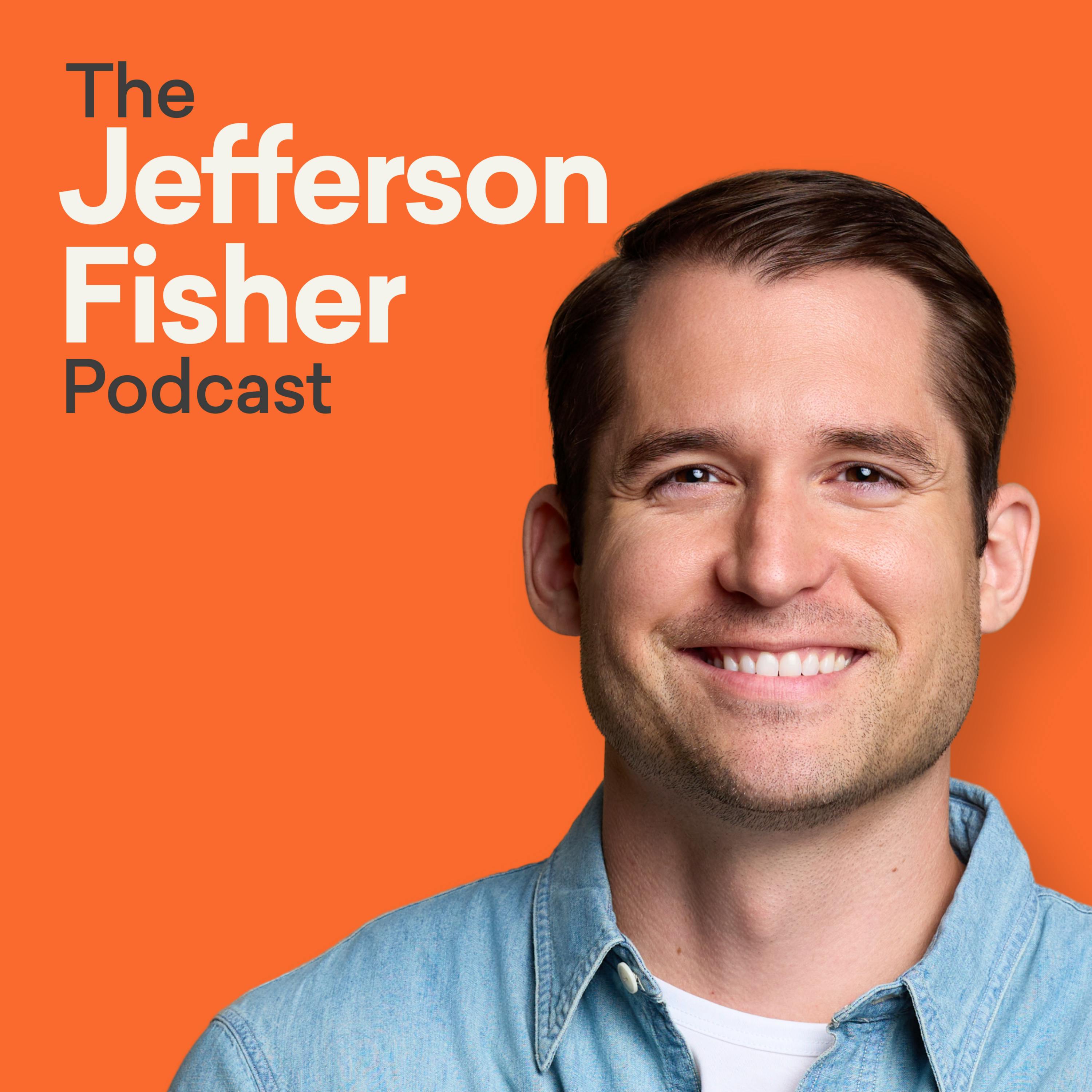
Pod Insights The Jefferson Fisher Podcast How to De-Escalate a Shouting Match About this episode You ever been in a conversation that wasn’t really a conversation—more like words flying at your face at full volume? Yeah, I’ve been there too. In today’s episode, I’m giving you three super practical ways to hold your ground and keep your cool when someone else is losing theirs.
This episode is sponsored by Cozy Earth. Upgrade Your Every Day. Get 40% off at cozyearth.com/jefferson or use code JEFFERSON at check out.
Order my new book, The Next Conversation, or listen to the full audiobook today.
Like what you hear? Don’t forget to subscribe and leave a 5-star review!
Suggest a topic or ask a question for me to answer on the show!
Want a FREE communication tip each week? Click here to join my newsletter.
Join My School of Communication
Watch my podcast on YouTube
Follow me on Instagram
Follow me on TikTokFollow me on LinkedIn
Learn more about your ad choices. Visit megaphone.fm/adchoices
Transcript Speaker names marked ? are inferred from speaking time and the show’s known hosts — they are not voice-verified.
0:00 Speaker 00 I love football season. The games, the rivalries, the food, getting everyone together. No game day feels complete without a trip to Total Wine & More. I can find everything from cold beer and canned cocktails to wines and spirits for the whole crew. And if I want to bring something different to the watch party, the Total Wine team always has ideas. Plus, it's nice knowing I'm getting the lowest prices. Get your game day lineup ready at Total Wine & More. Spirits are not sold in Virginia and North Carolina. Drink responsibly. B21.
0:27 Jefferson Fisher? How do you stay calm when they're not? When somebody is yelling at you, they're mad at you, they're angry, they're shouting? What do you do in that moment? In today's episode, I am going to teach you. I'm going to teach you, number one, how to get them to lower their volume. Two, we're going to add space into the conversation. We're going to talk how to do that to regulate our emotions and theirs. And three, I'm going to give you phrases that you can use that is going to help calm and smooth out the situation for a much more productive conversation. You ready? Welcome to the Jefferson Fisher Podcast, where I'm on a mission to make your next conversation the one that changes everything. If you enjoy learning communication tips, I'm going to ask you to please subscribe,
1:11 Jefferson Fisher? like, follow this podcast wherever you're listening. And my promise in exchange is that I will make you a better communicator. If you listen to this podcast, even for five minutes, every time we put out an episode, it's going to make you a better communicator. And that's my promise, to deliver good, quality content to help improve your life. This episode is brought to you by Cozy Earth. I love Cozy Earth because I use their products. If you're somebody like me and you use bamboo sheets on your bed, you know exactly what I'm talking about when the summer gets hot. Down here in Texas, it is so scorching hot and humid. And there's one thing that helps keep me cool at night, and it's the sheets from Cozy Earth. They're on our bed right now.
1:55 Jefferson Fisher? You can go to cozyearth.com/jefferson. Use the code Jefferson for 40% off. Use the code Jefferson. That's cozyearth.com/jefferson. Use the code Jefferson for 40% off. Even if it's hot at night, you can use those sheets to keep you cool. And most of all, cozy. You didn't ask for it, you didn't plan for it, but you're in it now. The other person across from you talking is not talking as much as they are, throwing their words in your face. They're shouting, they're yelling, it's hurting your ears, you're scared, you don't know what to do. How do you handle the situations when somebody is yelling at you? Number one, this is what I want you to do.
2:36 Jefferson Fisher? Number one, you are going to refuse to raise your voice. When somebody's yelling at you, one of the worst things you can do is start to turn up the volume on your voice. That's what our default wants to do. When somebody's yelling, what do you do to try and talk over them? You have to yell over them. You have to, if they're at a level 10, you have to crank it up to a level 18. Then it becomes a play for dominance. Who is the one who can out yell the other? Who is the one who can scare the threat away? That is a weak position, and I'm going to tell you why.
3:17 Jefferson Fisher? The people who yell, it tells the other person that they're winning. It tells the other person that they've got you. Gives them that sense of control, gives them that hit of dopamine. It is telling them that, hey, I am now pushing their button so badly that they are in this state of fight or flight, this fear, where they are yelling and I now have the control and the emotion. I'm the one that's still in it. It's a bad game to play. I want you to think of like a music that's really loud in the room. What do you kind of have to do? Maybe you're in the car, maybe you're at the house. You have to yell over it. Nobody can really hear what you're saying because there's this really loud undertone that's filling all the space. Yeah, that's the other person's voice in this instance.
4:02 Jefferson Fisher? You're not listening to them, and they're definitely not listening to you. All right, so the yelling matches, you know, you have experience with this, we all do. The yelling matches, don't do anything except tire out our systems. They, I mean, they just tire us out. Eventually, the yelling has to stop. And now you're kind of out of breath, and now you're tired. And now you feel not just emotionally drained, you also feel physically drained because you gave away your power. You gave away that control. You exerted that energy rather than protecting it and conserving it. So how do you do that? How do you do that in the moment? You refuse to raise your voice. That means if somebody's yelling at a 10, you're gonna stay right here at a 1. Maybe you're at a 3. Maybe you're at a 1.
4:48 Jefferson Fisher? It's... The reason why it works so well is because people will mirror what they see. Naturally. They don't even know what's happening. If you're yelling and I'm staying right here, you're gonna do one of two things. One, you're either gonna get frustrated at me because you're realizing that you can't control me, and that's frustrating. Or two, you're naturally going to pull down your voice because you're gonna hear the discrepancy. That's kind of a bigger word. It's the difference. You can hear the difference, the discrepancy, the big... From the gap between where they're at and where you're at. And they're gonna feel like they're overexposed.
5:31 Jefferson Fisher? Like, there's a reason why people don't just yell in a quiet room because it's calling all the attention to them. They feel overexposed. In a big gym, when it's... If everybody's quiet, or maybe it's at church, or wherever it is. Now, there are places that are preserved because they are religious places, or whatever it is. Nobody yells at these because it is calling all the attention. They're gonna feel overexposed. Whatever they said, everybody's gonna hear it. People don't like that, even in one-on-one settings, because they feel like what they're saying is being overexposed and nobody's listening. Just a yell... The yell doesn't do any good. So they'll naturally start to pull their volume down. That's how you do that.
6:15 Jefferson Fisher? Doesn't matter how high they go. You stay at a 3. You stay at a 1. I know that's hard to do. And it's really hard to do in the moment. But I promise you, it is telling them that you are the one in control. You are the one that is unbothered. That you're the one that is not threatened by their behavior. You know how much of a power move that is? This is huge. Two, it's not just the volume I want you to be able to turn down. It's the regulation of emotions. How do you get people to naturally start to go, "Phew, okay, yeah, alright, now I'm getting back into the mode. Now I'm feeling like my normal self. Instead of being the Hulk, they're now Bruce Banner. They're back to
6:59 Jefferson Fisher? normal." Alright, that's a Marvel reference, in case you're wondering. Yeah, how do you do that? You inject time into the conversation. There's one thing that will help regulate people's emotion more than anything there is, and that is time. What matters right in this instant probably doesn't matter so much later tomorrow. You ever got an email that you read and you get really upset about it? You look at it again and read it the next day? It hardly has the same effect. Time has a way of solving things out. You had a bad argument with someone, three years later, you're like, "What did we even argue about? Why did we... I don't remember what we argued about." It doesn't matter. Time has a way of sifting out what is truly important and essential and valuable in your life.
7:43 Jefferson Fisher? So, we're gonna do that in the conversation. And you do that by what I teach, and anybody who's a fan of this podcast knows, and anybody who's read the book, The Next Conversation, knows, let your breath be the first word that you say. Wherever a first word would be in your response, use a breath. So, instead of this, like when people snap, ever been in a conversation with somebody and somebody snaps, and they say something like, "You know what'd be really, you know what'd be really nice? You know what'd be really nice?" And all of a sudden, you go, "Okay, here we go. Lights are on." Now, now they're really ratcheted up in the conversation. The snap happens. Whenever you inject time as a way of slowing things down, and it keeps the emotional aspect of your mind from taking
8:28 Jefferson Fisher? a hold of the steering wheel, keeps your logical side in place, where you're very aware, you're much more aware of your emotions, aware of what you're saying, you're more intentional, and you choose your words more wisely. When you're emotional, you don't really care about your word choice. You just, you just say things. It doesn't even matter to you if they make sense. Ever been in an argument where y'all are both just being so ugly that you're saying things that don't even really make sense? You're throwing words, and you don't even care what they mean. I don't care if it's logical or not. They're just words. They're just getting out. You're gonna do time, inject time. Use your breath and slow things down. Here's a comparison. Here's a comparison. Which one of these people? I say people. It's still me. Hey, it's Jefferson.
9:14 Jefferson Fisher? Which one of these voices sound more in control to you? Sound more calm to you? Somebody you want to listen? Somebody you want to follow? Somebody you want to mirror? Here's voice one. Already, already told you, I'm not going to do that. Already told you, I'm not going to do that. Okay?
9:34 Jefferson Fisher? I already told you. I'm not going to do that.
9:43 Jefferson Fisher? One or two? And put it down there in the comments, wherever you're listening. One or two? Number one says, I'm grasping for control. Listen to me, I need all the control. I've given it all up. Now I'm trying to get it back. Already told you, I'm not going to do that. Second voice says, nah. I never lost control. I'm not losing it. Never let it go. Already told you.
10:09 Jefferson Fisher? I'm not going to do that. Not going to do that. The second voice is always the one that sounds more centered, more grounded. Why? Because you're using time. So I slowed my words down. Yeah, I, I turned down the volume of my words, so I'm not yelling. But I slowed my words down. Yeah? Much better. Using time to your advantage. Number three. We're going to use phrases. I'm going to teach you some phrases that are going to help dissolve the tension, especially when things are really heated like this. And I'm, I'm going to give you a frame to do it in. I say frame. I'm going to give you a few little
10:53 Jefferson Fisher? techniques. I don't think it's the best word for me to put this. And this is a technique that I learned from one of my very good friends. He's always been a big role model of mine. And we've since become very good friends. Chris Voss, he has, he has his book, Never Split the Difference. Great book. And what he does, one of the FBI techniques is people don't like to say yes to things. They love to say no. No is their default. We would like to say no to things. So you turn a question. To get a no in exchange for them opening up, getting more of what you want. So what we're gonna do is use a frame, begin the question to get a no answer out of this. And how you get a no is you begin with a negative in the part of your sentence.
11:37 Jefferson Fisher? I know I'm kinda getting weird and technical here, but this is the fun stuff that I like. I'm sure there's a button where you can skip it 15 seconds and we'll get there. Alright, so if you wanna add, let me rephrase that. If you want to get the other person to calm down, you're gonna ask a question to them that's going to get them to say no, because they're not gonna wanna tell you yes. They're going to wanna say no. How we're gonna do that is, at the beginning of your sentence, begin with a negative. Here are some options that I like to use. Are you against? Are you opposed? And is it unreasonable? Those are the three that I like to mix up. So, instead of saying, "Can you please calm down?", you want them to say yes, right?
12:22 Jefferson Fisher? But they won't. They definitely don't wanna say yes to that. "Can you just calm down, please? Can you just lower your voice?" Yeah, they're not gonna wanna say, "Oh, yes, yes, I will. I will calm my voice. I just had a moment, didn't I?" No, it's gonna just ratchet them up. They're gonna get more angry. "You're gonna tell me to calm down? Calm down!" Not gonna go well. Instead, when you get the no, it's a whole lot easier. So, it sounds like this. "Are you against us talking just at a normal tone? Or is it unreasonable to ask us to talk without yelling? Are you opposed to having a conversation without us raising our voices?
13:06 Jefferson Fisher? Are you opposed to having a conversation in a normal voice?" They're gonna say naturally no to that. They're not gonna say yes. If I were to say, "Are you, is it unreasonable for us to have a conversation in a normal voice? Are they gonna say yes? No, they're not gonna say yes. They're gonna say no. Naturally, they're gonna just kinda calm, they're gonna melt in that second. They're gonna come down several steps to meet you more where you are, more in the 1 to 3 range, where they were up in the 10s and 12s. "Is it unreasonable for us to have a conversation in a normal volume?"
13:46 Jefferson Fisher? Probably they're not even gonna answer you, most likely. They're gonna naturally just start to come down and talk in a normal tone. Cause they don't wanna tell you yes, they wanna say no. Whenever you start with, "Are you against?", "Are you opposed?", "Is it unreasonable?", it's getting to the no response. That's what you want in this instant, because that's what they're wanting to say. And now they're hearing you, when you combine it with you lowering your voice, your volume, and slowing down your words and adding time to help regulate, and then use a question that gets a no, like, "Are you against us having a conversation just without the yelling? Is that something you're against?"
14:28 Jefferson Fisher? They're not gonna say no, or they're not gonna say yes to that. Alright? That's how you stay calm when they aren't. It happens in every relationship, in every facet of life, I feel like. There's always going to be that, because it's the emotional, it's the emotion out of every human. It's natural. So, and sometimes, you know what? That person is us. I'm the one that is having the big emotional reaction. I'm the one that is yelling. I'm the one that's doing that. And sometimes, if somebody across from me is mirroring what good communication sounds like, if the person across from me is slowing down their words and not yelling, and not
15:10 Jefferson Fisher? biting what I'm, the bait that I have, by yelling at them, it's going to calm me down too. So, it's part of all of us. Cool? If you enjoy communication tips, I have a newsletter where I send out one piece of communication tip right to your inbox every week for free. You can find the link down there in the show notes. My book, The Next Conversation, has been out several months now, and it's the best part of, it's beaten every expectation I could think in terms of what value and joy it's brought to me to help other people. If you are looking to buy it, you can. The link's down in the show notes, anywhere where you like to pick up and read books.
15:53 Jefferson Fisher? And if you're wanting to learn more, the School of Communication is always open to help you practice and improve your next conversation. As always, you can try that and follow me.
16:04 Speaker 02 Welcome to the 50th Hunger Games!
16:06 Speaker 03 Witness the beginning of the revolution.
16:08 Speaker 02 Hey Mitch, you've been trying to take down these games from the start.
16:11 Speaker 03 Filmed for IMAX.
16:13 Speaker 02 Make them remember you.
16:15 Speaker 03 The Hunger Games: Sunrise on the Reaping, November 20th, made in PD13.
Previous Outsmarting Narcissists: The Praise or Provoke Trap Next 3 Keys to Shut Down the Silent Treatment Page updated November 3, 2026 · transcript and summary are machine-generated