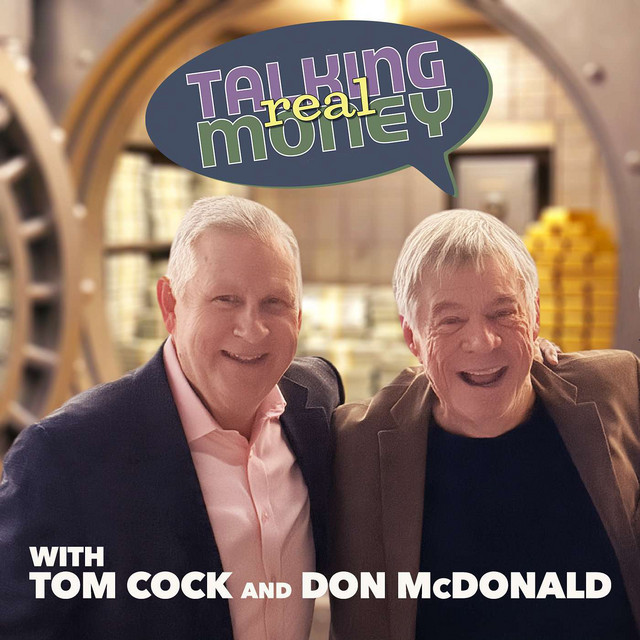
Pod Insights Talking Real Money - Investing Talk Oracle of Omaha Timing? About this episode In the first hour from Saturday's show: 1:31 Is Buffett Sends a Message? 18:20 The Perils of Timing the Market 19:42 The Mystery of Warren Buffett 20:04 Analyzing Investment Strategies 20:13 Understanding Portfolio Diversification 20:15 Managing Retirement Income 20:20 The Importance of Proper Planning 20:23 The Fight Against Financial Misinformation 20:33 Navigating Social Security Concerns 37:14 Preparing for the Future at RetireMeet Learn more about your ad choices. Visit megaphone.fm/adchoices
Transcript 0:04 Speaker 00 Reality radio for a really great future. We're talking real money.
0:11 Speaker 01 Welcome to Talking Real Money. We're here every Saturday answering your questions, your calls, coming up with some comments about what's going on today. I'm Tom Cox. Tom McDonald is still plugging everything in and he'll be along here in just a moment. I guarantee it. I think in the old days he used to call this technical difficulties, but for me it would be for him, not so much. So, all right, anyway, the show really, while we are the hosts, is about you, your questions, your concerns, things you want to know about. So you can kind of put money in its place. You know, that's one of the themes of Talking Real Money is, I know, we spend a lot of time on it, but it really shouldn't be at the core of your being. I know a lot of people that get up every morning
0:55 Speaker 01 and check all their bank accounts. They check all their investment accounts. They look at everything and try and figure out what they should do that day. And that is honestly, as someone who really does do this every day, that is no way to live. So, we want to help you avoid that. We want to help you build a future with less worry and less concern about money. How do you do that? Well, one way is to call us and chat. Pretty easy. 855-935-8255. 855-935-TALK. That is, yeah, that's a toll-free number. And your calls always come first. So let them rip. But you know, one of the things
1:36 Speaker 01 that we've noticed lately, speaking of ripping, is Warren Buffett. Warren Buffett, the Oracle of Omaha, the guy who runs Berkshire Hathaway, oh, he's been selling a lot, selling a lot of stock, piling up a lot of cash. And people that watch these things on a day-by-day basis are sort of scratching their heads because Warren has been the definition of a long-term buy-and-hold investor. I mean, he is- Done this for decades and he has publicly stated buy great companies and keep them, keep them for a long time. Now he has a slight advantage that many of them he gets involved in the management of, but he's been making some moves lately that have been a little
2:19 Speaker 01 bit of a head scratcher. Gotta say, um, he's cut his stake in Apple from 175 billion dollars to 70 billion. That's a pretty significant sell off. Um, he still does, it still does represent Apple, uh, a quarter of the Berkshire 266 billion dollar equity portfolio. He's also sold, uh, Bank of America. Yeah. I've been selling a lot of that stock. He sold 235 shares, 235, 235 million shares of Bank of America, BAC. Um, that's created this huge, as I mentioned, cash pile. It's remarkable. It's, it's 320 billion dollars, Don, that he's, that he's built up.
3:04 Speaker 02 That's enough money to buy like 25 of the biggest companies in the world.
3:08 Speaker 01 It's crazy. So when I read this though, and I think he's kind of older, right? Warren Buffett?
3:14 Speaker 02 Yeah. He's what? Like 900 years old?
3:16 Speaker 01 Okay. So maybe he's figured out that.
3:19 Speaker 02 Cause he's got a lot of money. He's figured out how to live longer.
3:21 Speaker 01 No, he's figured out that you can take it with you. Maybe he's cashing it out his chips to be able to pile it up for the next. That's just my take when I read this. I think, wait, what? Maybe that's the thing. I don't know.
3:31 Speaker 02 Yeah. And you know, the thing is that Warren Buffett is different than us though. This is the thing. Warren Buffett, we, we have to stop comparing how we invest with how he invests. We can't buy entire companies. We just can't do it. We don't have that kind of money. So we just buy a bunch of companies.
3:55 Speaker 02 In aggregate. And so what Warren is saying right now is I have standards for the companies I buy and they are not meeting my standards, but he only, he doesn't have a lot of options because when he buys a company, one, he, he, his, his presence causes the price to rise.
4:15 Speaker 01 He's all in.
4:16 Speaker 02 The other thing, exactly. He's going to be all in. The other, the other problem is, um, he, he has all kinds of regulatory requirements if he owns big chunks of companies. So he's not, when we compare our style of investing to his, it's really mistaken. It's a huge mistake because if you buy the whole market in good times and bad, even in those times when Warren was more heavily in cash, waiting long enough, made your money.
4:48 Speaker 01 And let's, we'll continue on this, but I think when people hear this in a general sense, they think markets set a record, high stocks have gone up a lot. Maybe I should be taking some of my winnings off the table. That's what they think, I believe.
5:01 Speaker 02 Yeah. And, and, and that is a problem. And I'll tell you why in just a minute. 855-935-TALK is our number.
5:08 Speaker 00 Tom and Don are talking real money. Your guides to a really great financial future. Tom and Don are talking real money.
5:19 Speaker 02 Hey, I'm Don. That's Tom. We're talking real money. What a coincidence. 855-935-TALK is the telephone number that you use to get to us. It's so very easy and it's available to you this week. Now, bear in mind, next week, you will not be able to call us.
5:37 Speaker 01 That is, show is done. It's in the can. It's ready to go, right?
5:40 Speaker 02 We'll be here, but we won't be live because both of us will be traveling at the same time.
5:47 Speaker 01 It's a new show, but we will not be on the air at that time.
5:50 Speaker 02 So if you want to call, it's this weekend or it's after Thanksgiving. 855-935-TALK, 855-935-8255. So has Warren Buffett become a market timer?
6:02 Speaker 01 I'm gonna say no, but it does sound a little bit with the market now at the markets worth $58 trillion. The S and P 500.
6:12 Speaker 02 It sounds like a lot of money.
6:13 Speaker 01 It does sound like a lot. The S and P 500 is up 24.1% year to date. There's all kinds of indicators that suggest that things are too expensive when you look at them like stocks are way out over their skis or whatever expression you wanted to use. But does that mean anything?
6:32 Speaker 02 Well, the only thing I can think that it means is that part of the market might be overpriced. Part, but only.
6:42 Speaker 01 I can think of a couple of stocks.
6:44 Speaker 02 Yeah. And the part of the market that we're talking about is the part that's the most popular. As a matter of fact, if you look at the international markets, if you look at the developed or the developing markets, the emerging markets out there, if you look at small cap value stocks, these have all been laggards over the past several years. While the big growth, big name stocks have powered almost all of the return in the stock market. And those are the kind of stocks that Warren Buffett has tended to own. He's had a lot of Apple or Bank of America.
7:23 Speaker 01 Was a value guy and then he kind of, I don't know. It seems like he abandoned some of that a few years ago, especially with Apple. You can't call that a value stock.
7:30 Speaker 02 Apple hasn't been a value stock since Steve Jobs was alive.
7:33 Speaker 01 Yeah. And a long time, decade plus. So now, no.
7:38 Speaker 02 So should you be doing what he's doing? No.
7:40 Speaker 01 Good question. No, you shouldn't be. Well, okay. With the one possible suggestion that you do always rebalance when things get out of whack. That's what I think. I think he's doing that here, right?
7:52 Speaker 02 I think so. And here's the other thing is that we know, and Tom particularly knows this because he looks at your portfolios like every day. We know that you could probably stand.
8:06 Speaker 02 A bit of proper balance to begin with. I'd be willing to bet that most of you, because they've been hot, have most of your portfolio in the S and P 500. I bet you.
8:18 Speaker 01 Oh, it's
8:19 Speaker 02 The vast majority of your portfolio.
8:21 Speaker 01 Bet you're gonna win. I mean, that's because again.
8:23 Speaker 02 Maybe, maybe it's not a matter of timing, but it's a matter of starting to do the right thing with the money. It's like, well, you know, I haven't wanted to move it because it's doing so well. Okay. Well, good for you. Good for you. You got lucky. But maybe if you don't have 10% of your equity portfolio in small cap, if you don't have 10% of your equity portfolio in value, or maybe 15, maybe even 20.
8:48 Speaker 01 And
8:48 Speaker 02 If you don't have 30% of your portfolio in international stock, minimum.
8:54 Speaker 01 And if you have, and this is more and more portfolios I see, 20% of your portfolio is made up by five companies. Because if you own the S and P 500, that's 20%, I mean, 20% of your money's in five stocks. That is not diversification. So, yeah, you might want to clean that up.
9:11 Speaker 02 Maybe the answer is to actually get diversified. My guess is you're not. And this, you should take this, take this as not, not a timing signal. Don't, oh, I should get out of the market and I'll wait to get back in. Because here's the problem with doing that. Let's assume for a minute that this, we're at the top right now. And it's going to go down from here. I'm not saying it's going to happen. This is hypothetical. This is a thought experiment. Let's say it's going to go down from here. You get out, whoa, good for you. When will you get back in? You will not know.
9:51 Speaker 01 I'll get back in when it hits the bottom.
9:53 Speaker 02 When it feels better. When, yeah, when I, when I know it's at the bottom. We know you don't know when the bottom is. Actually, the top is often feels a little bit easier to predict. Bottoms are hard because bottoms are, are, they're, they're so depressing. Nobody wants to invest when they're depressed.
10:11 Speaker 01 Yeah, we've been there, seen that, talked to many of you. So I will say if Warren is right, if he's right, I'm glad that the old guys are going to win one because after what happened to the old guy last night in the ring, I'd like to see an old guy have a victory. So.
10:29 Speaker 02 Why did anyone waste their time on that?
10:32 Speaker 01 I watched it.
10:33 Speaker 02 Why?
10:34 Speaker 01 Well, first of all, it was on at a reasonable hour here on the West Coast. For you, you would have to, you know, be awake in the middle of the night.
10:40 Speaker 02 But again.
10:41 Speaker 01 Number two, it's the curiosity. It's a oddity. Here's a nearly 60 year old man in the ring with somebody, you know.
10:48 Speaker 02 28.
10:49 Speaker 01 His age, yeah, 27, 28 years old, so.
10:52 Speaker 02 No, it's not a third his age, it's half his age.
10:54 Speaker 01 Okay, whatever.
10:55 Speaker 02 Half.
10:56 Speaker 01 I heard 20 and 60 in there.
10:57 Speaker 02 This is like.
10:58 Speaker 01 A third along the way.
10:59 Speaker 02 This is the dumbest thing. And it turned out to be an utter disaster, which made me feel even better.
11:05 Speaker 01 Yeah, we were watching and it started blip and I was of course blaming our internet provider thinking, oh, thanks, I live in the middle of nowhere. The internet doesn't work and no.
11:14 Speaker 02 No, that was Netflix.
11:15 Speaker 01 Yeah, it was Netflix because they had 100 million people or something tuned in for it.
11:18 Speaker 02 They just didn't, there aren't, there aren't enough servers in the world to handle that kind of flow to one feed.
11:28 Speaker 01 Yeah, and for those of you who have been, you know, outside of the realm of news for the last, gosh, two months, we're talking about Mike Tyson's fight last night. Who's he? I don't even remember the name of the guy who's fighting. I don't even know who that is.
11:41 Speaker 02 Jake Paul.
11:42 Speaker 01 My daughter knew him, so, but I didn't know.
11:45 Speaker 02 Yeah, his claim to fame is he's a YouTube influencer.
11:49 Speaker 01 Oh, okay. Well, that's something. Everybody's got to be known for something, I guess. So, way to go, Jake.
11:53 Speaker 02 Yeah, yeah, I mean.
11:54 Speaker 01 Now you're known for beating up old men. So, well done.
12:00 Speaker 02 Well, okay, I have to admit, I'm gonna, I'm gonna come clean. I'm gonna come clean with all of you. I hate boxing as a sport.
12:07 Speaker 01 Well, it's a brutal.
12:08 Speaker 02 I just hate it as a sport.
12:10 Speaker 01 I know, it is.
12:10 Speaker 02 It just doesn't seem sporting to beat someone to a bloody pulp on the floor, literally bloody pulp.
12:17 Speaker 01 Yeah, well, you should have seen the fight right before it. The women, they were literally, I mean, it was, it was.
12:23 Speaker 02 I just have no interest. I. I don't have any, I'll watch football because at least those guys go in and there, there, there's a sport.
12:32 Speaker 01 Oh, you can't see their injuries there, right?
12:33 Speaker 02 Right, and they're in uniforms and they've got padding and they've got helmets and, you know, you hit some.
12:39 Speaker 01 By the way, there's a concussion problem in football, too.
12:41 Speaker 02 Yeah, but if you punch someone in the head in football,
12:44 Speaker 01 Doesn't do a whole much.
12:44 Speaker 02 You're gonna break your hand.
12:45 Speaker 01 Yeah, hurts you more than them, yeah.
12:47 Speaker 02 Which seems fair.
12:49 Speaker 01 Yeah.
12:49 Speaker 02 855-935-TALK is our phone number, 855-935-8255. And, um, Gene, welcome to Talking Real Money.
12:59 Speaker 03 Well, I see you two guys are getting in the ring. Who should have put my money on?
13:04 Speaker 02 Yeah, yeah.
13:06 Speaker 01 We're not betters either.
13:07 Speaker 02 We're not betters either, that's, yeah.
13:10 Speaker 03 All right, I don't know if you have pencils and papers there, but I have a
13:13 Speaker 02 Always.
13:14 Speaker 03 A couple of figures to go over. Um, all right, first of all, I have a net worth of $7 million. Plus a $600,000 house that's paid for. The problem I have, good, good, good, I guess, is I have too much money.
13:33 Speaker 01 I can give you, off the air, I can give you my wiring instructions. I don't like to give them on the air, but that's, that's fine. That's not a problem.
13:39 Speaker 03 My wife and I have no pensions. We live off of 40, about $45,000 of taxable to 85% figure on social security. Uh, my portfolio generates between 70 and 80,000 dollars in dividends and interest a year. Another 70 or 80,000 dollars in, um,
14:04 Speaker 02 Cap gains?
14:05 Speaker 03 Capital gains.
14:07 Speaker 02 Okay, and hold that thought right there, Gene, and we'll continue taking our notes here after we do this.
14:19 Speaker 00 For your real life and real future, Tom and Don are talking real money.
14:24 Speaker 02 To help Gene out with the terrible problem he has, poor guy.
14:28 Speaker 01 Too much money.
14:29 Speaker 02 Way too much money, way too much money. Got about 7 million in assets and coming in, you've got about $195,000 in taxable income per my math here during the break. Is that about right?
14:40 Speaker 03 Plus, yes, plus another $100,000 required minimum distributions between my wife and I were both above 73.
14:49 Speaker 02 So 295 altogether.
14:51 Speaker 03 Right. Now, the problem is about, oh, I'd say about 2.5 million of this is in taxable investments, basically mutual funds. But they've been there so long that some people say, well, why don't you just start getting into ETFs? And I figured if I liquidated the 2.5 million, I'd have a $600,000 capital gain.
15:19 Speaker 02 Yeah.
15:20 Speaker 03 Because some of the funds, the money has been in those funds since 1995.
15:25 Speaker 02 Yeah. No, you probably don't want to do that.
15:28 Speaker 01 Okay, but let's, but these are, you're down, you're step 80 for me, not step 2. What's the purpose of all this money if you're not going to spend it?
15:36 Speaker 02 Right. That's the best question.
15:38 Speaker 03 I don't have, well, I have 1 million, part of this whole bath, I have 1 million of my taxable assets in CDs.
15:47 Speaker 02 Okay, no, let me ask you a question, though.
15:49 Speaker 03 I don't, I don't have a mortgage.
15:51 Speaker 02 What about that 2.5 million? Let's start with that. The 2.5 million that's in a taxable account. If you died tomorrow, what would happen to that money? Where would it go? What would it do?
16:02 Speaker 03 My wife will go on a worldwide trip.
16:05 Speaker 02 Okay.
16:07 Speaker 01 Okay, but assume you're both gone.
16:09 Speaker 02 To where will that go?
16:10 Speaker 03 Well, wouldn't yours? I mean, you know.
16:12 Speaker 02 No, I, you know, yeah, you're right. Mine probably would.
16:16 Speaker 01 Mine wants to go while I'm still alive, so.
16:18 Speaker 02 Is there a purpose for this life, for this money after your lives? Is it going to children? Or is it going to charity? Or what's going to happen to it?
16:27 Speaker 03 Well, that's part of it too. I have a son and a daughter and they're both in their late 40s. They got $2. Uh, one who just entered college and I'm, I'm there in the background, gonna help out with college if it's need to, you know, a hundred percent. And, um, you know, I'm just thinking, well, if I sell this stuff now, I'm going to get a capital gain hit.
16:49 Speaker 02 No, no, no. That's why I'm saying, that's why I was asking this question, Gene, because there's no reason for you to sell money that's in decent investments right now to move it to ETFs. That's just goofy advice because it, it, it, it incurs a big tax hit. If you let, leave this money, if you don't need it, and if it's going to go to your kids, your wife, and then to your kids, then the wonderful thing about the tax law is that the cost basis steps up to whatever it's worth at your death. So, don't mess with it. Don't, it's providing you with enough income.
17:23 Speaker 01 Here's another idea. If you're charitably inclined, you could do a donor advice fund with the money that's in the mutual funds that would allow you to reduce your tax bill. You could also do, uh, QCD with the, uh, the RMD. So the money goes directly to a charity there so that you don't have to pay tax on that. Other than that, there's no.
17:43 Speaker 02 How much of your money, how much of your, of that income, of that $295 before tax, do you use in a year? Do you guys spend that?
17:52 Speaker 03 Well, um, let's put it this way. I live, I live, uh, I only have no pension, $45,000 of social security. My adjusted gross income last tax year was $288.
18:06 Speaker 02 Okay.
18:07 Speaker 01 He's saying out of that though, how much do you really need?
18:09 Speaker 03 I'm paying almost $60,000 just in federal tax.
18:12 Speaker 02 Okay. I think we're focused too much on the tax, though. The question is, how much of that $288,000, uh, after, okay, they take the 60 out, 228, how much of that, do you, do you live on all of that during the course of the year? Do you spend that amount?
18:31 Speaker 03 I think I spend about a hundred thousand a year plus sixty thousand to pay the taxes.
18:36 Speaker 02 Okay, then that, see, that goes back to Tom's point of the qualified charitable distributions. If there, if you are charitable, if you plan to be charitable with this money after you're passing, then it might be a very good idea to set up a qualified charitable distribution. That'll take that hundred K a year in RMDs and eliminate the tax liability.
18:59 Speaker 01 That, and then, as I said, also with the taxable portfolio, you could set up a donor advised fund, move some of those highly appreciated assets into that. That would allow you to still have control of the money, but would give you the deduction. Get a tax break to do that. So there'd be some ways to do this, but yeah.
19:18 Speaker 02 You need, you are at the point in life where you have more than enough assets. You don't need all the income. You gotta, you've gotta figure out both an estate plan, a tax plan, and a financial plan, which says you need a really good advisor. 855-935-TALK. Call us.
19:34 Speaker 00 Tom and Don are talking real money.
19:43 Speaker 00 Reality radio for a really great future. We're talking real money.
19:48 Speaker 02 We're going all over the place. Let's see, from Florida to Seattle over there to DC with Gene, and then, well, Massachusetts with Bob. Hey, Bob, welcome to Talking Real Money.
20:00 Speaker 04 Hi, how you doing?
20:02 Speaker 02 We're doing well. Thanks for calling.
20:05 Speaker 04 I'm calling about a, a, my brother-in-law and his wife asked me to look at their portfolio. Great people, I'm happy to do it. They're sixty-seven and sixty-four. Both are still working. Their portfolios mostly in IRAs. Total about four hundred forty thousand dollars.
20:24 Speaker 02 Okay.
20:25 Speaker 04 Their advisors have them in relatively expensive funds, weighted expense ratios of sixty-nine basis points and eighty-two basis points.
20:33 Speaker 02 Sorry, yeah.
20:34 Speaker 04 And, but the portfolio is almost entirely US and not well diversified there.
20:40 Speaker 02 I'm betting it's all American funds.
20:43 Speaker 04 Almost, almost entirely.
20:45 Speaker 01 Oh, shocker there. Wow. Thanks, Bob. Yeah.
20:48 Speaker 04 My main... My main concern is that their equity fixed income ratio is about 90 10. And remember, they're in their mid 60s. I think the logic is the feeling that the portfolio may not be adequate and that they need to take extra risk, even though they're that close to retirement.
21:12 Speaker 01 How long until they're going to quit, though? How long, how much longer are they willing to work?
21:17 Speaker 04 In the next one to three years, I believe.
21:19 Speaker 01 Oh, yeah, then they're two.
21:20 Speaker 04 And the other one may want to work longer. But, you know, even if the portfolio is inadequate at that age, is being 90 10 an okay thing to do?
21:32 Speaker 01 No, because, no. Yeah, because you're going to, if you need to pull on it in the next year or two and the market's down considerably, which it definitely could, could be, and if you're 90% in stocks, no, you're going to want to have more fixed income at that point.
21:45 Speaker 02 I would suggest that, and this is not a pitch, but go, have them go over to talkingrealmoney.com, take the risk quiz. That will help them determine, because it's not just age, it's also inclination. The other thing that has to be a part of that, though, is determining how much money this portfolio is going to need to generate for them in retirement, in addition to their social security and any other sources of income they might have.
22:10 Speaker 04 Yeah, I've asked them to think about how much they really need to, for the portfolio to generate, because even with the 4% guideline, between that and social security, they'll be saying about $80,000 a year, which is probably going to be enough for them.
22:26 Speaker 01 But just then, that tells you everything you should know. Why would you drive at 90 miles an hour when 60 will get you there? I wouldn't do it.
22:33 Speaker 02 Exactly. This is telling you that their portfolio, this, this is telling you, and this should be telling a lot of our listeners the same thing, that when you get one of these people who holds themselves out to be a financial advisor, but is really a commissioned salesperson, and I'm guessing this person is with that company that has somebody in every tiny town in America, because they sell American funds like they were going out of style. And builds a portfolio that is not well diversified and that does not talk to their clients about their risk profile or risk tolerance that they've been a huge disservice has been done to them while the broker has made a lot of money off of them.
23:11 Speaker 01 Yeah, I like what Don said. I would go back, figure out what income they're going to need from the portfolio that will be added to social security and other sources of fixed income. Then, once I knew that number, you could work backwards. You could say, okay, so if you retire with half a million dollars, that will supply you. Then you could continue to work backwards and say, with that in mind, you don't need to be so aggressive. You could be far more moderate, not get the ups and downs and not potentially face a sequence of return risk, which could be harsh if you retire soon and the market is down. That could be ugly.
23:45 Speaker 02 I mean, they should probably have like a 60-40, maybe 50-50 portfolio.
23:51 Speaker 01 Hard to know.
23:52 Speaker 02 It could be so simple. It could be as simple as VT and BND. That's simple conceivably, which would be a net expense ratio of less than point one.
24:04 Speaker 01 And the other, the other aggressive part, the risk they're taking is having most of their securities in one type of stock.
24:12 Speaker 02 U.S. growth.
24:13 Speaker 01 That is risky too, because those are the ones that have gone up the fastest. What we want to do is balance that between many asset classes, so that you sort of the yin and the yang with all this whatever is ahead, you're not focused so much on one part of the market. But yes, you're really doing a great service there, as the brethren lied to say, for sure.
24:30 Speaker 02 Absolutely.
24:31 Speaker 04 Well, I think I've been listening to you guys too long, because what you're saying is exactly what I've been telling them. So I really appreciate all you've done. Thanks so much.
24:39 Speaker 02 Well, we appreciate what you're doing too. Thank you so much, and I wish them the best. But it's time for a major change. And I know this is probably a good friend or a family member or a close associate, but they, this is business. They need to terminate this relationship and start investing the way they should for their needs and wants. 855-935-1111.
25:04 Speaker 00 Your guides to a really great financial future. Tom and Don are talking real money.
25:11 Speaker 02 While we're here to talk about real money, we really like to answer your questions more than anything else. So which is why we plug the number a lot on our Saturday show where we do take live calls. 855-935-TALK is that number. We are on the radio in the Seattle area on news radio, Northwest News Radio from noon to 2 Pacific time. It's 3 to 5 Eastern and you can call us. You can also though, ask us questions at talkingrealmoney.com. Going to the contact form. You can speak them or you type them and then Tom gets this piece of paper.
25:48 Speaker 01 Yeah.
25:48 Speaker 02 That's right there in his hand.
25:50 Speaker 01 You go to a printer and it prints it out.
25:52 Speaker 02 I, you know, I don't understand. I mean, let me just share a little.
25:56 Speaker 01 You don't print anything. I know you don't.
25:58 Speaker 02 Yeah, let me share a little. My wife is like, she gets emails from people. She only, the only computer she has that she, well, she has an iPad, but she never uses it. What she uses as her computer is her iPhone.
26:11 Speaker 01 Yeah.
26:11 Speaker 02 That is all she uses. So she has no idea how to print from an iPhone. So she's always.
26:17 Speaker 01 By the way, it's not that hard.
26:18 Speaker 02 Which you can do, but she just sends them to me and wants them printed. And I go.
26:22 Speaker 01 Good Lord.
26:22 Speaker 02 Why do you want them printed? Because I need paper. Oh, you should talk.
26:28 Speaker 01 I don't make my wife print my stuff. I print my own stuff.
26:31 Speaker 02 Okay, but you print it and you want it on paper.
26:33 Speaker 01 Yes, I do. I do like.
26:34 Speaker 02 What is that like sheepskin hanging over your face?
26:37 Speaker 01 Let's not go there. By the way, by the way, for those of you playing along at home today, I'm taking anything to put in the washer. So no limitations. We're not doing like whites on layer colors. It's.
26:46 Speaker 02 Oh, you're just mixing them all together.
26:47 Speaker 01 We're throwing in there.
26:48 Speaker 02 This is the wild.
26:49 Speaker 01 Cold water, it'll be good. Yeah.
26:51 Speaker 02 It's the wild card load.
26:52 Speaker 01 I, before we go to the question, I got another, I got another thought around Bob's question too, because this is important thing to think about.
26:58 Speaker 02 Oh, Bob in mass. Yes.
26:59 Speaker 01 Yeah.
26:59 Speaker 02 The nice guy helping his family. Yes.
27:00 Speaker 01 Where it might be tight with the money, right? With the savings, right? Here's something to think about. How long are you willing to work? Many people, they don't think about the fact that if I go one more year, it makes a lot of difference because I'm pulling on it later. It gets more chance to not just to grow, but also to add to it. So, worth the work.
27:22 Speaker 02 And, and something else, Bob, that I, you know, I thought of this too, after the fact is one of our. Favorite ways to take income from a portfolio is in the flexible withdrawal method.
27:32 Speaker 01 Yeah.
27:33 Speaker 02 So you said 4%, but if they had a 50 50 portfolio or 60 40 and they took 5% per year, they would have some years where they did very, very well and had big, nice big checks. And as Tom says, they're, they're going to Hawaii. They'd have other years when they're not vacationing, but.
27:51 Speaker 01 They come to our place during the winter.
27:53 Speaker 02 The, the lake house.
27:54 Speaker 01 It's got, it's got waterfront, kind of cold, but you know.
27:58 Speaker 02 Well, in the summer, the, the three weeks of summer, you can go.
28:02 Speaker 01 No, no, I was talking about now, come now.
28:03 Speaker 02 Oh, yeah. Anybody can go now. 855 935 TALK is our number, but Tom has a question that came in from talking realmoney.com.
28:10 Speaker 01 This came in from Jenny in Indianola, Indiana.
28:14 Speaker 02 Florida. Oh, Indianola, Indiana. There's an Indianola, Florida.
28:16 Speaker 01 Exactly. Says, my husband and I retired in January of this year. That's awesome. Many thanks to your podcast to help us achieve that goal. Well, that, and then she added, we can't, couldn't have done it without you. That is very kind. Um, our rollover IRAs are at Vanguard. We've been taking 4% distributions from his individual retirement account this year. I turn 59 and a half next month. My rollover IRA is substantially larger than his. Should we change to pull distributions from my IRA next year? Is there any reason to take distribution from one or another account, split distributions, alternate years or whatever? So, um.
28:53 Speaker 02 Well, apparently we, we drove you from the workforce or something it sounded like. It was our fault.
29:01 Speaker 01 Oh, they did so well that they can afford.
29:02 Speaker 02 Yeah, they retired. We drove from the workforce. All right. So, uh, well.
29:07 Speaker 01 The question really is she has a bigger retirement account than he does. Where should the money come from to live on?
29:12 Speaker 02 Well, he's older than you, apparently.
29:14 Speaker 01 She doesn't say how old.
29:15 Speaker 02 Oh, you bet. She's just turning 59 and a half. So she's just becoming eligible to tap it.
29:21 Speaker 01 Well, she can tap it anytime, but you're going to pay a 10% penalty.
29:24 Speaker 02 Yeah. Right. So, um, but I, okay. Go, I'm going to say you take his, but go ahead.
29:31 Speaker 01 No, I'm gonna say you balance it between the two because you wanna, this will work later when you get into RMDs.
29:39 Speaker 02 Yeah, but that's why I'm saying go after his more than after hers because if his draws down faster than hers, she's got a lot more time to RMDs. As a matter of fact, at her age, RMD should be what?
29:51 Speaker 01 Seventy-five.
29:52 Speaker 02 Seventy-five.
29:52 Speaker 01 Yeah, seventy-five.
29:53 Speaker 02 So, wow, I mean, she has a very, very long time, much longer for those dollars to grow before they have to be withdrawn. I'm assuming he's older. I think I'm right.
30:04 Speaker 01 Yeah.
30:04 Speaker 02 If he's substantially older, a few years older, several years older, then I would just, if you're doing fine on his, drain his.
30:12 Speaker 01 I want to make sure she's clear on one thing, though, because I'm feeling this a little bit from her is about the amount you have to take out as an RMD. Once the participant reaches the required age, and it is a bit of a moving target, as Don just said, because those of you born after 1960 can wait until they're 75, those of us older than that have to take them at 73, whatever. But it's not a household number. That's the number, I'm getting that a little bit from her here. This is per individual.
30:42 Speaker 02 Per person, yeah.
30:43 Speaker 01 Yeah, so there's no, you don't get to put things together and then say, where's it come from? Each person has to take the required amount out.
30:49 Speaker 02 Right, but she has a long time before she gets there.
30:52 Speaker 01 You're right.
30:53 Speaker 02 In his case, the fact that he's taking already, and if it's sufficient for their needs, then I don't see any reason to switch. I'd let hers accrue longer, tax-deferred.
31:07 Speaker 01 And if her household is like mine, where everything I have is ours, everything she has is hers, then it works out.
31:16 Speaker 02 It doesn't sound like that's her family.
31:18 Speaker 01 My family or her?
31:19 Speaker 02 No, her family. I know it's your family, it doesn't sound like it.
31:22 Speaker 01 And it's yours too, so what are you gonna?
31:24 Speaker 02 I know, but I don't know if she's listening or not, so I'm trying to be
31:27 Speaker 01 You gotta be real quiet upstairs.
31:29 Speaker 02 Less critical.
31:29 Speaker 01 Yeah, let's see if we can get along, because you and I'll be doing the show from there in a couple of weeks, so let's. Keep things calm until then. What do you say?
31:37 Speaker 02 Okay, I got your mic right here. Here you go.
31:39 Speaker 01 Is that my mic? I have to hold it over the side there?
31:41 Speaker 02 No, I have a stand right here.
31:43 Speaker 01 We did it once before. I think it was fun.
31:45 Speaker 02 Yeah, this is, this is a lovely Neumann BCM 705.
31:50 Speaker 01 Wow, everybody knows how great that is. So.
31:53 Speaker 02 Yeah, I mean, not an electro voice. Mine's an electro voice. They're great mics. This is a great mic.
31:59 Speaker 01 I got the same thing. It doesn't.
32:00 Speaker 02 It's the RE20. It's a great mic.
32:03 Speaker 01 Anyway, Jenny, thank you for your question.
32:04 Speaker 02 I'm a mic fiend. I love.
32:06 Speaker 01 Yes, you do know your mics. That's true.
32:08 Speaker 02 I do love me microphones. But here's the funny thing. Here's the funny thing. I'm on, this is, I do the show on an RE20. I do my voice work on an Austrian Audio OC818. I used to do it on a Sennheiser MKH416.
32:26 Speaker 01 Okay, I gotta ask, how do you, before buying these things, how do you know it's gonna sound different on a different microphone? How would you have any idea?
32:33 Speaker 02 I have no idea. So.
32:34 Speaker 01 Would you go online and test it or something?
32:36 Speaker 02 Well, no, I check reviews. Now, what everybody told me when I got started was that I needed a U87, which is the Neumann state of the art.
32:44 Speaker 01 Which I don't think survived World War II, if I remember. I think it got, I think it went down. No, the U87.
32:51 Speaker 02 Do you know that Neumann made, they made all the mics for like the Nazi party.
32:56 Speaker 01 Okay, I was making a joke there, but let's not bring the Nazis into it. What do you say?
33:01 Speaker 02 Well, you said it was a World War II joke.
33:03 Speaker 01 Reference, okay.
33:04 Speaker 02 But anyway, I now, I think.
33:06 Speaker 01 So you don't even like that one anymore?
33:08 Speaker 02 Well, it sounds good, but the other ones just sound better. So I think I may be getting rid of my Neumann.
33:15 Speaker 01 Yeah, all right.
33:16 Speaker 02 But I'm gonna keep my Sennheiser.
33:19 Speaker 01 I think it's so important to know that.
33:23 Speaker 02 Do you have any other questions? We can take another one after the break. Do you have a short one?
33:27 Speaker 01 Yeah, I got some shorties.
33:29 Speaker 02 Okay, so what we'll do is we'll take a break here.
33:31 Speaker 01 Okay.
33:31 Speaker 02 We'll just get it out of the way. And then when we come back, we're gonna take a quick question. And then we're gonna end this hour.
33:38 Speaker 01 We're also gonna tell you about something pretty exciting that's now available, too, by the way.
33:41 Speaker 02 Something available for a limited time?
33:44 Speaker 01 Well, probably, yeah.
33:45 Speaker 02 Kind of, yeah. So our number 855-935-TALK and we'll do this and then we'll come back and do that, which is what we do here on this show. We call talking real money.
33:58 Speaker 00 Tom and Don are talking real money. For your real life and real future, Tom and Don are talking real money.
34:07 Speaker 02 See, that was relatively painless. And now let's go to another little quick question before we end the hour.
34:13 Speaker 01 Rich from Hot Springs Village, Arkansas writes, we keep hearing that social security will begin paying reduced benefits on or about 2035. I plan to start collecting social security after that date. Does the social security calculator factor all that in? If not, then is it right to plan for a 20% decline in what the calculator is telling me?
34:36 Speaker 02 Oh, nobody, except the news media is saying that and, and, and people who have a political agenda of some sort, nobody knows what is going to happen for sure.
34:47 Speaker 01 I do know.
34:48 Speaker 02 To social security.
34:49 Speaker 01 It's not going to go down. It will not go down.
34:51 Speaker 02 You do not know that for sure. You do not know that.
34:54 Speaker 01 Because, because it's such an integral part of the world society, etc.
34:58 Speaker 02 Believe, you strongly believe.
35:00 Speaker 01 I can't guarantee it, but I'm pretty close.
35:03 Speaker 02 No, you can't even come close to guaranteeing it, but you can be highly confident as I am.
35:09 Speaker 01 Yeah, don't factor that into your calculations.
35:11 Speaker 02 No, no, factor in what we know.
35:13 Speaker 01 Yeah.
35:14 Speaker 02 What we know is that social security has been sacrosanct since it's, uh, since it began in the 1930s.
35:23 Speaker 01 That's right.
35:24 Speaker 02 It is unlikely that it will change. Therefore, why would social security factor that into the numbers except to scare the living daylights out of people?
35:35 Speaker 01 Yeah.
35:36 Speaker 02 Which is what it would do.
35:38 Speaker 01 A 20% cut would be very harsh to many people in this country, many, many, many.
35:43 Speaker 02 And, and, and I would suggest, just from a political standpoint, that those who believe that social security should remain as is.
35:54 Speaker 02 Get in touch with their congresspeople and let them know how strongly you believe that.
36:01 Speaker 01 And that you'd prefer not to wait until the day before to solve it. Okay, so don't factor that in.
36:06 Speaker 02 Yeah, but it is, it is an uncomfortable, it's an uncomfortable problem for Congress. Because we, none of us like increased taxes, and that's what it will take to
36:18 Speaker 01 Yes.
36:19 Speaker 02 Make social security.
36:20 Speaker 01 I believe there will be some combination of that and some change.
36:23 Speaker 02 And changing of the age maybe.
36:24 Speaker 01 Yeah, there'll be something there.
36:25 Speaker 02 And think about it. Think about it for a minute. What's the, the, the full retirement age these days is rising to 67.
36:33 Speaker 01 67, correct.
36:35 Speaker 02 You're sick, I, I'm 68 years old.
36:38 Speaker 01 Whoa.
36:38 Speaker 02 I do not feel, well, you're 67 almost.
36:42 Speaker 01 No, I'm, I'm only 66, dude.
36:44 Speaker 02 I almost.
36:45 Speaker 01 I'm way younger than you.
36:46 Speaker 02 Two months.
36:47 Speaker 01 I get back in the ring. I'm feeling good.
36:49 Speaker 02 Yeah, you're not going to be boxing anybody. Anyway, now you distracted me.
36:55 Speaker 01 You distracted me. I'm supposed to be promoting what we're doing in February, but you're maybe running out of time.
36:59 Speaker 02 We're gonna get to that in a minute, but I want to tell people that, you know, 67 is young. Maybe it should be 70, if that could solve the problem.
37:06 Speaker 01 There's the argument that if you're carrying bricks around your contract, whatever, that that's 67, eight young. Anyway, we're not gonna get into that.
37:13 Speaker 02 Robots to carry stuff.
37:14 Speaker 01 Yeah, we're not gonna get into that. What we will get into is inviting you to the 11th Retire Meet. It's now, you can now buy tickets, and yes, this I can say with certainty, it will sell out. It's February 8th in Bellevue, retiremeet.com. That I can guarantee.
37:28 Speaker 02 You are setting a terrible precedent on this show by pretending to predict the future. No, because you're pretending to predict the future.
37:36 Speaker 01 I see. I'm not pretending. So, there are early bird tickets available now. Don will be speaking, I will be speaking, Paul Merriman will be speaking, we have Joe from Stacking Benjamins speaking. We got, and we got people talking about social security, Medicare, everything you need to know about retirement at Retire Meet, Saturday, February 8th. Go to retiremeet.com to register right now. Do not wait.
38:00 Speaker 02 That's retire M E E T dot com.
38:02 Speaker 05 The opinions and views expressed on this podcast were current on the date recorded. Opinions, estimates, forecasts, and statements of financial market trends that are based on current market conditions constitute our judgment and are subject to change without notice, including any forward-looking estimates or statements which are based on certain expectations and assumptions. Although information and opinions given have been obtained from or based on sources believed to be reliable, no warranty or representation is made as to their correctness, completeness, or accuracy. Information presented on the podcast is not personalized investment advice from Appella Wealth. The views and strategies described may not be suitable for everyone. This podcast does not identify all the risks, direct or indirect, or other considerations which might be material to you when entering any financial transaction. Past performance does not guarantee future results, and profitable results cannot be guaranteed. We hope you realize that the information provided on Talking Real Money
38:45 Speaker 05 is for informational, educational, and hopefully enjoyable purposes only. The podcast is not trying to get you to buy or sell any financial products or securities. Instead, the program is provided as a public service by Appella Wealth, a fee-only registered investment advisor. Please see Appella Wealth ADV Part 2A on our website for information regarding Appella's fees and services. Appella Capital, LLC, DBA Appella Wealth, is an investment advisory firm registered with the Securities and Exchange Commission. The firm only transacts business in the states where it is properly registered or excluded or exempt from registration requirements. Registration with the SEC or any state securities authority does not imply a certain level of skill or training. Appella does not provide tax or legal advice, and nothing either stated or implied here should be inferred as providing such advice. Thanks for listening, and please visit TalkingRealMoney.com for more information and important
39:29 Speaker 05 disclosure related to performance of any specific index or fund quoted in this podcast. And the lawyers get richer.
Previous What's in Your Wallet? Next Even Bad Ones Worked Page updated November 15, 2026 · transcript and summary are machine-generated