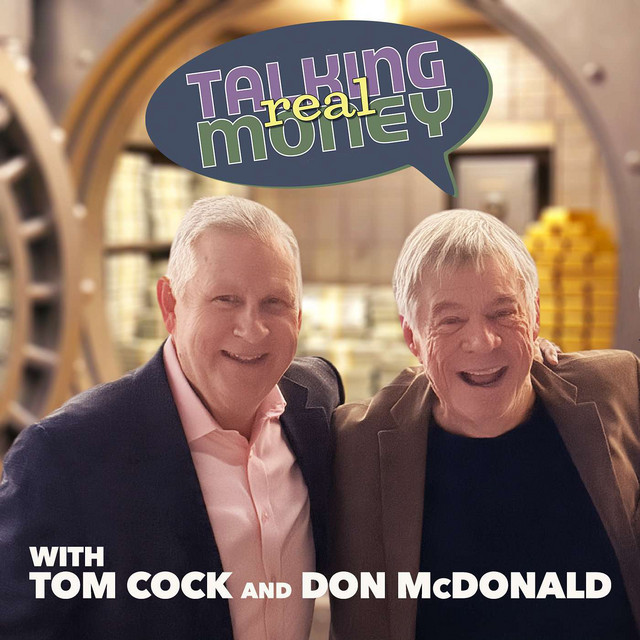
Pod Insights Talking Real Money - Investing Talk Ep. 1931: Tom Tests Don About this episode In what may be our last quiz, ever, Tom turns the tables and puts Don in the hot seat with a Wall Street Journal high-school personal finance quiz—covering the Magnificent Seven, Roth IRAs, TIPS, efficient markets, yield curves, market risk, and dollar-cost averaging. Don does reasonably well, but not without protesting a dubious “debt avalanche” question and getting tangled up in a couple of accounting and risk terms. After the quiz-show nonsense, the guys tackle a listener question from Jos...
Transcript 0:05 Speaker 00 Your guides to a really great financial future. Tom and Don are talking real money.
0:15 Speaker 01 Ladies and gentlemen, welcome to another exciting game show on Talking Real Money. Thanks for joining us as we ask pertinent financial questions of you, the audience, and one of the hosts of Talking Real Money. And today, filling in as the quiz show host, ladies and gentlemen, please welcome Mr. Tom Cock.
0:43 Speaker 02 You almost got the FIFA goal thing going there for me. Oh, that was really good. That was really good. Just in time for the World Cup. This is a high school personal finance quiz from the Wall Street Journal. Testing your knowledge against...
0:56 Speaker 01 See, I did the adult quizzes, and Tom is doing the child quiz.
0:59 Speaker 02 That's about more appropriate.
1:00 Speaker 01 Does that tell you anything?
1:01 Speaker 02 Exactly. Uh, test your knowledge against 20,000 students.
1:08 Speaker 02 That's a lot of students, so...
1:10 Speaker 01 Okay, so you're quizzing me today?
1:11 Speaker 02 Yes, this time we're turning it around.
1:13 Speaker 01 I'm the one who has to be smarter than a 18-year-old?
1:17 Speaker 02 I always get everything wrong. Yeah, exactly. So, um, and there's actually some pretty hard questions.
1:21 Speaker 01 I have not read this quiz. I do not know the answers.
1:23 Speaker 02 This is, there's some pretty hard questions here.
1:25 Speaker 01 Do you have the correct answers there?
1:27 Speaker 02 I have no idea. One of them, I differ with their answer, so we'll see what you do. Are you ready, Don?
1:34 Speaker 01 I am ready, Tom.
1:36 Speaker 02 Okay.
1:37 Speaker 01 No small talk, no introducing our contestant.
1:40 Speaker 02 I heard you're from Celebration, Florida.
1:42 Speaker 01 I hear you keep bees.
1:45 Speaker 02 How, how long have you been married? How long you been married?
1:49 Speaker 01 I hear you live in a swamp.
1:51 Speaker 02 How long you been married?
1:53 Speaker 01 I've been married for 35 years.
1:55 Speaker 02 And they said it would never last. Thank you, Don. Let's get to the questions, huh?
2:01 Speaker 02 Okay. How's that? Is that better?
2:03 Speaker 01 No, that was not better.
2:04 Speaker 02 All right. Question number one.
2:06 Speaker 01 I'm just gonna give you a pass on that one.
2:07 Speaker 02 Do I get the music and all the rest of the stuff? No?
2:10 Speaker 01 That's in post? Oh, no, we, okay, wait, I do have the.
2:14 Speaker 02 Usually we do it live with the.
2:15 Speaker 01 I do have some of the music. I just don't, the game show music will, will have been added in post. But, no, no, no, no, no, wait, I've got, okay, go ahead. I've got all the buttons now, except I'm not gonna know if I have the right answer. You're gonna have to tell me that before I can do the ding ding ding.
2:28 Speaker 02 So, no dings. So, but, question number one. Which of these is not in the magnificent seven group of tech stocks? Not in.
2:38 Speaker 01 The not. See, if, this is a negative question.
2:41 Speaker 02 And you gotta pick A, B, C, or D. Which of those is not in the, in the magnificent seven?
2:47 Speaker 01 C. I'm just guessing.
2:49 Speaker 02 That's a good guess.
2:51 Speaker 01 I don't know what the answers are.
2:53 Speaker 02 Oh, I thought, I gotta give the names of the companies.
2:55 Speaker 01 Yeah, that'd be a good idea.
2:56 Speaker 02 I'm really bad at this.
2:57 Speaker 01 You're a terrible game show host. I'm doing this from now on.
3:00 Speaker 02 This is why.
3:00 Speaker 01 Tom, you're fired.
3:02 Speaker 02 A is Alphabet.
3:03 Speaker 01 You and that guy on Jeopardy, I don't like.
3:04 Speaker 02 B is Apple. C is Palantir, and D is Tesla.
3:10 Speaker 01 Oh, I was right.
3:11 Speaker 02 You were right.
3:14 Speaker 02 That's kinda scary. Don McDonald was right on the first one. Palantir is not a member of the magnificent seven. I don't think I can name them all. And Microsoft's in there, Meta's in there.
3:24 Speaker 01 Alphabet.
3:25 Speaker 02 They already had that one. Alphabet, Apple, Tesla.
3:28 Speaker 01 Nvidia?
3:30 Speaker 02 Yeah, I think we got it now. All right, number two. He's one for one, ladies and gentlemen, working on a special, what do you get for winning this, by the way?
3:39 Speaker 01 The chance to end the podcast early.
3:41 Speaker 02 Go home and do something useful.
3:43 Speaker 01 Go home and do something positive.
3:44 Speaker 02 Exactly. Uh, all right, number two. Which of the following retirement accounts doesn't, does not have a requirement to begin withdrawals at a certain age? Is it A, Roth IRA, B, traditional IRA, C, traditional 401K, or D, all of the above? Does not have a requirement to begin withdrawals at a certain age?
4:07 Speaker 01 The correct answer is... A, Roth IRA.
4:12 Speaker 02 That is absolutely 110% correct.
4:16 Speaker 02 Well done. Don McDonough, where are you from? Where do you hail from?
4:20 Speaker 01 I hail from various places around the country.
4:23 Speaker 02 No, but I mean, as a kid, where'd you grow up? Come on, tell us.
4:26 Speaker 01 Well, I didn't. I didn't. I grew up a year here. I didn't. Actually, I'm still not grown up, even at almost 70. I lived a year here, a year there. Colorado Springs, I guess. Okay, we'll go with that.
4:37 Speaker 02 Lot of snow in Colorado Springs. Thanks for the answer, Don.
4:39 Speaker 01 No, there really isn't. There really isn't. It's kind of dry. There's not that much snow.
4:43 Speaker 02 Lot of fancy airplanes in Colorado Springs. Isn't that the home of the US Air Force?
4:47 Speaker 01 It's the Air Force Academy.
4:48 Speaker 02 I'm the host. I don't like to be corrected on my own show.
4:51 Speaker 01 Air Force Academy cadets, just, they get to fly trainers. That's all. There aren't any good jets there.
4:56 Speaker 02 I don't like to be interrupted on my own show, if you don't mind.
4:58 Speaker 01 Colorado Springs really doesn't have any of the things you think it has, apparently.
5:03 Speaker 02 Can you see the Rockies? The Rockies are right next door.
5:06 Speaker 01 Yes, you can see Pike's Peak right from your front door.
5:09 Speaker 02 Beautiful place.
5:10 Speaker 01 If it faces west.
5:11 Speaker 02 I love it. All right, number three. US government bonds whose principal value adjusts based on the Consumer Price Index are known as?
5:20 Speaker 01 Ooh, I know this one.
5:21 Speaker 02 A, Treasury Inflation Protected Securities, or TIPS. B, Separate Trading of Registered Interest and Principal Securities, Strips, which I favor over drip. Anyway, C, Series I Bonds.
5:34 Speaker 01 Do we have tips, strips, and drips?
5:35 Speaker 02 That's, no, we don't. Series I Bonds, or D, Linkers, which should not be confused with stinkers either, by the way. Is it?
5:45 Speaker 01 What was the question? Because there must be a trick in the question.
5:47 Speaker 02 US government bonds whose principal value adjusts based on the Consumer Price Index are known as? A, Treasury Inflation Protected Securities, or TIPS. Separate Trading of Registered Interest and Principal of Securities, Strips, Series I Bonds, or Linkers?
6:05 Speaker 01 I may get this one wrong, because there are two that are inflation-driven.
6:12 Speaker 01 But I think, I think that the one that adjusts its principal, I think that's the key word in there, means A-tips.
6:21 Speaker 02 That's exactly right, Don. Well done, well done. By the way, when did you formulate your interest in money? How, how did you decide to be, you know?
6:29 Speaker 01 I always enjoyed spending it.
6:31 Speaker 02 Enjoyed spending it. Very great answer, Don. That's a great answer. Thank you for that. All right.
6:36 Speaker 01 You don't have to do one between every question. It's not the way. They kind of do it at the commercial break in the middle.
6:42 Speaker 02 Oh, we'll be right back.
6:43 Speaker 01 We don't have one of those.
6:44 Speaker 02 Oh, okay.
6:45 Speaker 01 Because we are now the commercial free podcast. Have you noticed, by the way, listeners, have you noticed, we're commercial free?
6:51 Speaker 02 Yeah, you could write a nice review for that, if nothing else. All right, number four.
6:56 Speaker 01 Four, got it.
6:57 Speaker 02 Yeah. Sarah wants to pay down her debt.
7:01 Speaker 01 Good for Sarah.
7:02 Speaker 02 She chooses to start paying off the debt with the highest interest rate first, then moving to the next highest interest rate. What is the method of this debt repayment called? Number one, or number one, A, sorry, pardon me, um, the debt snowballing method, B, the debt avalanche method, C, the zero interest down method, or D, the high to low method? Is it debt snowballing, debt avalanche, zero interest down method, or the high to low method? What is it, Don?
7:30 Speaker 01 I have no idea. I think the debt snowball is where you pay off your smallest first. I'm pretty sure that's what it is.
7:37 Speaker 02 Because think about it, the snowball gets rolling.
7:38 Speaker 01 Yeah, so I'm gonna go with, uh, D.
7:41 Speaker 02 You're wrong there. It's the debt avalanche method, which I've never heard of before.
7:46 Speaker 01 Never heard of it. Okay. When it's something you've never heard of, and you're in the financial industry, wait a minute, hold on. I am going to challenge the judges on that one.
7:57 Speaker 02 You're gonna ask for, ask for an appeal. We're gonna go to New York, and when we come back from the break, we'll ask if...
8:03 Speaker 01 With the debt?
8:05 Speaker 02 Avalanche.
8:06 Speaker 01 Avalanche.
8:07 Speaker 02 Which is now avalanching down on your perfect score.
8:09 Speaker 01 I, I, I just, I, I think somebody made that up. I think the quizzer made that up.
8:13 Speaker 02 I think you're right.
8:17 Speaker 02 Doesn't say who we're, oh, let's see, uh, National Personal Finance Challenge hosted by the Council for Economic Education. Some very smart person. I've never heard that expression. I've only heard of debt snowball, which is what you said earlier.
8:30 Speaker 01 Yeah. The debt snowball is Dave Ramsey. Debt's...
8:36 Speaker 02 Debt avalanche.
8:37 Speaker 01 Oh, okay, wait a minute. What were the four choices?
8:40 Speaker 02 Snowball, avalanche, zero interest down method, or high to low method.
8:45 Speaker 01 Okay. Actually, the debt avalanche, somebody, they, and no one, no one knows who, but the only, it's not in, necessarily in the common vernacular. It's actually more often called debt stacking. So, I'm sorry, but I, I think, I think that question is, is disqualified.
9:06 Speaker 02 Wrong. You're wrong, Don. We're going to go to the next question. Number five, I'm sorry. Uh, this is my show, it's not your show. What hypothesis states that all publicly available information is already available in a stock's price? Is it A, efficient market hypothesis? B, adaptive market hypothesis? C, market sentiment hypothesis? Or D, fractal market hypothesis?
9:31 Speaker 01 Fractal market hypothesis.
9:34 Speaker 02 That's a pretty good one. I like that.
9:36 Speaker 01 That's pretty creative.
9:37 Speaker 02 Yeah, very creative, but not creative enough. You've got this one.
9:40 Speaker 01 No, I know this one.
9:41 Speaker 02 What, and?
9:42 Speaker 01 I could just drag this out for a while. A...
9:45 Speaker 02 You're correct. It is A. Very good, very good, very good. Well, tell us a little bit about your family, Don.
9:50 Speaker 01 So I have 100% on this quiz so far.
9:52 Speaker 02 We're not giving you 100%.
9:53 Speaker 01 100%.
9:54 Speaker 02 Tell us a little bit about your family.
9:56 Speaker 01 I challenge this. I'm sorry.
9:58 Speaker 02 Tell us a little bit about your family.
9:59 Speaker 01 I'm not, no, no, I'm not talking anymore until you change the rules.
10:01 Speaker 02 Talking. All right, let's go to the next question.
10:04 Speaker 01 I'm not sharing any private information with you because I don't trust the quiz.
10:07 Speaker 02 Don't trust, therefore, the host either. Uh, next question. What does a downward sloping, sloping, sloping yield curve usually indicate about expected future interest rates?
10:19 Speaker 01 Wait a minute, isn't that a yoga position?
10:20 Speaker 02 I think it is. Downward slope.
10:22 Speaker 01 The downward sloping? Yeah.
10:24 Speaker 02 If I start, you don't want to go. Uh, what is, what is a downward sloping yield curve usually indicate about expected future interest rates? A, nothing, rates will stay the same. B, rates will fall. C, rates will rise. Or D, rates will fall and then quickly rise again from the ashes like a phoenix.
10:41 Speaker 01 Okay, two of those are just plain old dumb.
10:44 Speaker 02 Dumb, yeah. But is it?
10:47 Speaker 01 It's a downward sloping.
10:48 Speaker 02 Downward sloping yield curve.
10:50 Speaker 01 They called it the yield curve.
10:52 Speaker 02 That's right.
10:53 Speaker 01 Okay, well then that means expectations are for lower rates in the future. So it's lower rates.
11:00 Speaker 02 Rates will fall, is that your final answer?
11:02 Speaker 01 Yes.
11:03 Speaker 02 And you are absolutely 100% correct. Rates will fall. Now, they're not going to fall for you and I, but they're going to fall in this silly quiz. Uh, this one's kind of hard, so you gotta listen carefully.
11:15 Speaker 01 Oh, I don't want to.
11:16 Speaker 02 Telling you right now, a lot of pressure.
11:18 Speaker 01 Cause I'm mad about the whole quiz.
11:18 Speaker 02 And you're, it's only missed one, which is pretty good.
11:20 Speaker 01 I've missed zero.
11:22 Speaker 02 The argument continues. Um, a company has a capital structure of 80 million dollars in debt and 20 million dollars in equity. 80 million in debt, 20 million in equity.
11:33 Speaker 01 Ooh, that's bad.
11:34 Speaker 02 This year, the company reported a net income of 17 million. What is the company's return on equity? 17 million on 20 million dollars in equity and 80 million in debt. 85% is A, B is 24%, C is 17, D, none of the above.
11:53 Speaker 01 Well, they have no equity. I mean, they have no equity. They're in debt, there's no equity. They have no-
12:00 Speaker 02 They're calling you 20 million in equity.
12:01 Speaker 01 Huh?
12:02 Speaker 02 They have, you can have equity and then you're in debt.
12:04 Speaker 01 They have 20 million in equity, but they got 80 million in debt, so they're, they're net negative.
12:08 Speaker 02 They're leveraged up, yeah.
12:10 Speaker 01 They're way too leveraged up.
12:11 Speaker 02 Yeah.
12:12 Speaker 01 But the problem is, is I don't know all this accounting stuff, so.
12:15 Speaker 02 Okay, so you're going with A, 85, B, 24, C, 17, or D, none of the above?
12:22 Speaker 01 Hmm. I must ponder.
12:26 Speaker 02 Then he's going to argue about these wrong anyway.
12:28 Speaker 01 The music has a certain amount of time, so I'm just going to ponder for the length of time the music runs.
12:32 Speaker 02 There's a limit here, this is network television, sir.
12:34 Speaker 01 I'm probably going to get my first one wrong now.
12:36 Speaker 02 Oh, finally, okay.
12:37 Speaker 01 Yeah, but I'm going to go D.
12:39 Speaker 02 That would be incorrect. It is A, eighty-five percent, eighty-five percent, seventeen million on twenty million.
12:45 Speaker 01 Oh, it's so it's eighty-five percent of the twenty million.
12:48 Speaker 02 The eighty million.
12:49 Speaker 01 Even though, even though they really don't have any net equity because they're broke.
12:53 Speaker 02 Yeah.
12:53 Speaker 01 This company's broke.
12:54 Speaker 02 All right, uh, the next one. What does it mean when an investment's NPV or net present value is equal to zero?
13:04 Speaker 01 You know, I had to study this when I took the seven and the sixty-five. But what am I, I'm supposed to know? I don't remember what net present value even is anymore. Go ahead.
13:14 Speaker 02 You can use your landline and call your charming wife.
13:18 Speaker 01 Oh, wait, I'll just ask ChatGPT.
13:21 Speaker 02 Net present value, what does it mean when an investment's NPV or net present value is equal to zero? Is it A, the investment's value has dropped to zero? B, the investment will incur a loss? C, the investment will break even? Or D, the investment is a bad one? A bad one there, Don.
13:39 Speaker 01 Did you try to do a Scottish accent because you failed?
13:41 Speaker 02 A bad one.
13:42 Speaker 01 A bad one. Uh, let's see.
13:44 Speaker 02 Bobby Charles who did soccer on TV and he would say that. That was a bad one.
13:48 Speaker 01 That was a bad one. We got to bad one.
13:51 Speaker 02 I always love that one.
13:52 Speaker 01 Let's see. Uh, so I, we, we got a.
13:54 Speaker 02 This is kind of hard, actually. I, I didn't know.
13:57 Speaker 01 Net present value of what?
13:59 Speaker 02 Zero. What does it mean when an investment's net present value is equal to zero? Does it mean that the value has dropped to zero? The investment will incur a loss.
14:08 Speaker 01 It's correct. Wait, here's the correct answer. Wait, let's do this again. Let me think about that, Tom. Okay, here's the, the correct.
14:15 Speaker 02 It doesn't matter.
14:16 Speaker 01 Net present value of zero is, what was C's, what was the answer for C?
14:22 Speaker 02 Breaking even.
14:23 Speaker 01 What was the answer for B?
14:26 Speaker 02 Incur a loss.
14:28 Speaker 01 It doesn't have a present value. It's net present value is zero. Is that one of the answers?
14:33 Speaker 02 Final answer. What's your, no, what's your final answer?
14:35 Speaker 01 It's not worth anything.
14:37 Speaker 02 It's, no, it'll break even.
14:42 Speaker 01 Okay.
14:44 Speaker 02 All right.
14:44 Speaker 01 What is it?
14:45 Speaker 02 See how I feel?
14:45 Speaker 01 All right, I don't even care. This is a stupid question.
14:48 Speaker 02 Okay, let's try one more that I think you can get. All right, yeah.
14:52 Speaker 01 No, I'm not, I have no hope now. I'm depressed and I don't want to do the show anymore.
14:56 Speaker 02 Question number eight. An individual invests their entire emergency fund in equities, those are stocks, to maximize their returns. I'm trying to help you here a little bit, so don't put me down. This strategy exposed them to what kind of risk? Is it A. Investment risk? B. Market risk? C. Credit risk? Or D. Interest rate risk?
15:19 Speaker 01 Wait. A was?
15:22 Speaker 02 Investment risk. B is market risk. C is credit risk. Or D is interest rate risk.
15:28 Speaker 01 Well, it's B. Duh.
15:30 Speaker 02 That's absolutely 110% correct.
15:35 Speaker 01 Well, yeah. I mean, that's what it's called.
15:37 Speaker 02 I know.
15:38 Speaker 01 That's the risk you take when you go into the market. It's called market risk.
15:41 Speaker 02 You and your wife were once stockbrokers. Why did you decide to leave that business?
15:48 Speaker 01 Because I didn't like the ethics of it.
15:52 Speaker 02 Okay.
15:52 Speaker 01 That's why.
15:53 Speaker 02 This is from the game show. We're just having a little discussion here. That's what they do.
15:55 Speaker 01 Because, I mean, because I was stupid. I went from six figures to, uh...
15:59 Speaker 02 I know.
15:59 Speaker 01 To four.
16:00 Speaker 02 The radio business? What a clown.
16:02 Speaker 01 Literally, I went from six figures to four a year.
16:05 Speaker 02 Okay, all right. Thank you.
16:06 Speaker 01 Because I'm stupid.
16:07 Speaker 02 Clearing that up. Um, so you know nothing about money, basically. All right, the 10th question. This, by the way, if you get this one wrong...
16:13 Speaker 01 I was the financial editor of the Business Radio Network.
16:16 Speaker 02 That's true. Um, I can verify that. Uh, but here's the, the bad news.
16:20 Speaker 01 From the financial desk at the Business Radio Network, I'm Don McDonald.
16:23 Speaker 02 You're gonna have to go back to the 10th grade and retake this whole program again. So this is very...
16:29 Speaker 01 That's what I had to do in 10th grade. I had to retake all of 10th grade again.
16:32 Speaker 02 You're about to find out. You gotta get this one right. So focus, please.
16:35 Speaker 01 Okay, I know. I wasn't very focused in 10th grade. Go ahead.
16:38 Speaker 02 This is it.
16:39 Speaker 01 This is it? This is the last one?
16:41 Speaker 02 No, listen, there's only nine. There's one more. Uh, which of the following does not describe unsystematic risk?
16:51 Speaker 01 A pigeon does not describe.
16:54 Speaker 02 A company specific risk. Company specific risk. Idiosyncratic risk. C diversifiable risk or D broad market risk.
17:06 Speaker 01 I didn't even pay any attention to what the question was.
17:08 Speaker 02 This is why you're gonna be stuck in 10th grade.
17:11 Speaker 01 What was the question again?
17:12 Speaker 02 Which of the following does not describe unsystemic risk? Is it A company specific risk? B idiosyncratic risk? D diversifiable risk or D broad market risk?
17:27 Speaker 01 That one seems blatantly obvious once you pay attention.
17:30 Speaker 02 Yes.
17:31 Speaker 01 And I think I may have paid attention this time. As opposed to 10th grade.
17:37 Speaker 02 Yeah.
17:37 Speaker 01 When I did not.
17:39 Speaker 02 And?
17:40 Speaker 01 I'm gonna go with A.
17:42 Speaker 02 And your answer is 100% wrong. It's D broad market risk. Which is something I think you studied a lot in 10th grade, but that's a whole other thing.
17:53 Speaker 01 Yeah, well, no, it wasn't so much broads then. It was, uh, give me, give me the question again.
18:00 Speaker 02 Which of the following does not describe unsystemic risk?
18:05 Speaker 01 Oh, unsystemic.
18:07 Speaker 02 Unsystemic risk. It's kinda confusing.
18:09 Speaker 01 I, I honestly was thinking systemic risk.
18:12 Speaker 02 All right, here's, this is number 10. I, I was incorrect when I was counting your score. If you get this one right, you move on to 11th grade. Econ A.
18:23 Speaker 01 I don't think we even had econ in high school, but go ahead.
18:25 Speaker 02 So, didn't they call it like, uh?
18:28 Speaker 01 No, they didn't. We didn't have it.
18:29 Speaker 02 The young ladies had to take, you know, what was it?
18:32 Speaker 01 That was home ec.
18:33 Speaker 02 Home ec.
18:33 Speaker 01 That was home economics.
18:35 Speaker 02 You're gonna go back to home economics.
18:36 Speaker 01 The young ladies. Whoa, and the boys did metal shop.
18:40 Speaker 02 They did, and I was terrible. I should've done home ec instead. All right, here we go. Making that metal box, did you have to make one of those?
18:47 Speaker 01 No, I did wood shop instead.
18:49 Speaker 02 I would've been bad, I would've been bad.
18:51 Speaker 01 I did wood shop and I, I still have like the scars.
18:54 Speaker 02 I would've had no fingers. All right, here we go.
18:57 Speaker 01 When I hit myself with the hammer.
18:58 Speaker 02 Number 10, very important. An investor contributes a fixed dollar amount into an index fund every month regardless of market conditions. What investment strategy is this?
19:08 Speaker 01 Dollar cost averaging, final answer.
19:11 Speaker 02 And he's absolutely right. It was dollar cost averaging or fixed contribution method, momentum investing or value investing. You got that one right. Congratulations sir, you move on to the 11th grade and you win behind what's door. Hey, would you like to pick that or stick with what you've already won?
19:28 Speaker 01 We're moving on to questions.
19:31 Speaker 02 That's the end of the fun times.
19:33 Speaker 01 We wasted 19 minutes on that.
19:36 Speaker 02 I feel bad. That was not a very good quiz.
19:38 Speaker 01 No, no, no, it was okay. It just had hard.
19:40 Speaker 02 There's some things in here though for a high school kids.
19:42 Speaker 01 I'm telling you, the dead avalanche, I disagree with. I'm sorry.
19:46 Speaker 02 I think that's legit disagreement. I've never heard of it.
19:48 Speaker 01 The last answer, which was the high to low, I mean, that's as, makes as much sense in, in common usage because who calls it the dead avalanche? Honest to God, there is no evidence online that anybody calls it that. None.
20:02 Speaker 02 It's a snowball. Yeah.
20:03 Speaker 01 Nobody.
20:06 Speaker 02 Should I go to the questions over your protestations?
20:08 Speaker 01 I would, I would tell the Wall Street Journal that you're very unhappy.
20:11 Speaker 02 We'll see what they say.
20:13 Speaker 01 All right. Uh, now here's the thing.
20:15 Speaker 02 Yeah.
20:16 Speaker 01 The best part of the show, you have to wait 19 minutes for, or now at this point, over 20.
20:20 Speaker 02 Yeah.
20:20 Speaker 01 And that's your questions and, uh,
20:23 Speaker 02 I thought it was the end.
20:25 Speaker 01 Our answers, which precedes the end. It's the part before the end.
20:31 Speaker 02 So get to it.
20:33 Speaker 01 We're running low. It's summer. It's the summer doldrums.
20:35 Speaker 02 I know. We need the un-doldrum.
20:37 Speaker 01 We're becalmed in the warm southern waters. Um, oh my gosh, speaking of warm southern, I did a, an interview for a thing today.
20:45 Speaker 02 Yeah.
20:46 Speaker 01 And we did it outside. Do you know, it's really hot and humid in Florida in June.
20:52 Speaker 02 But only until July, late September.
20:56 Speaker 01 No, until the middle of October. The, you know, when the weather turns in central Florida? October, right around October 15th.
21:02 Speaker 02 Ugh.
21:02 Speaker 01 Until then.
21:03 Speaker 02 I came there that one time in July and I'm never going back in the summer.
21:06 Speaker 01 Sticky. All right. Let's, let's, let's see. Send your questions into talkingrealmoney.com. You type them in or you speak them in. And if you type them in, then Tom somehow gets involved like this.
21:17 Speaker 02 And the question comes from State College, Pennsylvania, Joseph. He writes, Dan and Tom.
21:25 Speaker 02 Apparently he heard the quiz. He's changed your name. Normally, the allocation of stocks to bonds is stated in terms of percentage portfolio, 80, 20, 70, 30. My question, should the allocation consider your yearly expense? Meaning, should you have an amount in bonds that gives you a five to seven year spending buffer if stocks go down? So if I spend $100,000 a year, should I limit my bond exposure to 500,000 to 600,000? So what this means as my portfolio grows, the bonds become a smaller percentage of the following, not a fixed percent. Hope my question is clear. In other words-
21:58 Speaker 01 Yeah, no, I get it.
21:59 Speaker 02 I think, yeah, I think-
22:00 Speaker 01 It's again, the argument, and it's just a variation on the argument. If I have social security or a pension, should I have less in fixed income?
22:09 Speaker 02 Yeah, because then you have the buffer technically-
22:12 Speaker 01 That's only a portion of the overall equation. And that's why we try to talk in risk, a term called risk profile, as opposed to just risk tolerance. If we were talking just purely risk tolerance, then no. That doesn't, whatever your income is, does not matter. Risk tolerance is about your psychological ability to withstand the outrageous slings and arrows of massively declining prices in the stock market. You need a fixed income portion of your portfolio to enable you to perceive your portfolio as being less volatile, because it actually reduces the overall portfolio volatility. Even if your stock portion goes down a lot, your bonds tend to, or your fixed income,
22:57 Speaker 01 boy, the value of the portfolio. So the income really doesn't accomplish that. If you had a huge income and 100% of your money in stocks, and the market went down 50%, you're going to see your portfolio as declining by half.
23:12 Speaker 01 That hurts people. So, your risk profile includes your need for income, your need for growth, and your ability to stand it. And so those all have to be taken into account, making this- Only part of, only a partial solution to the problem.
23:27 Speaker 02 Yeah, I think it's a partial solution. I think during the withdrawal phase in your retirement, it's a good idea. I like the idea of having five years of something stable there in case the market has a very difficult stretch so that you can draw from that. That's not an unreasonable thing. What you're saying is really, at the end of the day, most of these decisions are made, I hate to admit it, about feelings, about how you feel about your money and watching it go up and go down. And that's why we do stuff like the risk quiz. That's why when we do work for people, we spend a lot of time getting to know them. It's absolute 100%, yeah.
24:01 Speaker 01 Given the nature of human beings, the emotions must always be factored in. You are not a Klingon or whatever Spock. What was Spock? He was a...
24:19 Speaker 02 I should know that, but I...
24:20 Speaker 01 I can't remember now.
24:21 Speaker 02 He wasn't a Klingon, no.
24:22 Speaker 01 No, Klingons were the bad guys. The Romulans were bad guys, too. What was Spock? How can...
24:28 Speaker 02 That's gonna drive me nuts.
24:29 Speaker 01 No!
24:30 Speaker 02 You just failed another quiz question.
24:32 Speaker 01 Oh, no, no. Why did I... I was a huge Star Trek fan when I was younger. Vulcan! Like Vulcanized rubber. I thought of tires. Vulcan. Vulcan. Okay, I'm sorry. I'm old.
24:46 Speaker 02 Before we go, I just heard from New York about your appeal, and they give it a snowball's chance in hell that you'll be able to overcome that, so sorry.
24:55 Speaker 01 How about an avalanche?
24:57 Speaker 02 They'd love to bury you in an avalanche for your criticisms, but they're not going to.
25:03 Speaker 01 I don't like the quiz. I'm done. Do we have any more questions, or is that it?
25:06 Speaker 02 No, that's it, man.
25:07 Speaker 01 Okay, so send your questions in at TalkingRealMoney.com.
25:09 Speaker 02 We'd love an avalanche of them. We'd take an avalanche of them.
25:12 Speaker 01 We need an avalanche. If you want some help, we'll give it to you for free. Promise. All you have to do is just click on the button that says meet an advisor and set up an appointment with an advisor, except for Tom who's gonna be on vacation all summer.
25:25 Speaker 02 Basically, yeah, that's right.
25:27 Speaker 01 And you know, that's the funny thing. Okay, here's the thing.
25:29 Speaker 02 What's funny about it? It's very serious.
25:31 Speaker 01 No, it's hysterical because you're leaving the Puget Sound area
25:36 Speaker 02 Yes.
25:37 Speaker 01 during the only period when it's nice.
25:39 Speaker 02 I know. I'm leaving my lake place just in time for the weather.
25:41 Speaker 01 Shouldn't you schedule your vacations when the weather is like me? I'm going away in the summer.
25:47 Speaker 02 I know. I have this kid, as you know, that's been tying me down here for 18 years. She is now out, so I can change my vacation schedule.
25:56 Speaker 01 Oh, you've booted her?
25:58 Speaker 02 No, she booted us. And she, by the way, she not only booted us, she said she ain't coming back. She said, I'm never returning from California, so that's that.
26:04 Speaker 01 Well, and who can blame her?
26:06 Speaker 02 Both reasons, personal and weather and all those things related, I wouldn't come back.
26:11 Speaker 01 All right. So what's she studying in college? Speaking of personal.
26:14 Speaker 02 Psychology or psychiatry?
26:16 Speaker 01 Oh, maybe MD?
26:18 Speaker 02 At least advanced degree, yeah.
26:21 Speaker 01 Wow.
26:22 Speaker 02 I gotta keep working.
26:23 Speaker 01 You gotta keep working for a long time.
26:26 Speaker 02 Exactly. Which doesn't make you happy, but still.
26:28 Speaker 01 My daughter just got her masters and it was not cheap.
26:31 Speaker 02 No, it's not cheap.
26:32 Speaker 01 Not at NY flipping you, jeez.
26:35 Speaker 02 But anyway.
26:35 Speaker 01 Of course, she had to pick a, she had to pick a high-end school. Well, yours did too.
26:39 Speaker 02 Oh, you think?
26:40 Speaker 01 Yeah. Hey Dad, can I go to the most expensive undergrad program in America, please?
26:45 Speaker 02 She's not there, but it's close.
26:46 Speaker 01 Close.
26:47 Speaker 02 It's very close. It's very close.
26:48 Speaker 01 All right, everybody. Thanks for listening. Thanks for being a part of it. Please tell a friend or two. And please, please let us avoid future quizzes. Pray for no more quizzes, okay? No, quizzes are fun. It's just better when I give them to Tom than Tom gives them to me.
27:03 Speaker 02 I know.
27:05 Speaker 01 Because he asks all these personal questions. It's none of his damn business. Really?
27:10 Speaker 02 Thanks, Don, for the great answers.
27:12 Speaker 01 Think about it. What are we supposed to be doing here? What are we supposed to be doing? I'll tell you. I'll give you the answer.
27:17 Speaker 02 And?
27:18 Speaker 01 Talking Real Money.
27:20 Speaker 03 The opinions and views expressed on this podcast were current on the date recorded. Opinions, estimates, forecasts, and statements of financial market trends that are based on current market conditions constitute our judgment and are subject to change without notice, including any forward-looking estimates or statements which are based on certain expectations and assumptions. Although information and opinions given have been obtained from or based on sources believed to be reliable, no warranty or representation is made as to their correctness, completeness, or accuracy. Information presented on the podcast is not personalized investment advice from Appella Wealth. The views and strategies described may not be suitable for everyone. This podcast does not identify all the risks, direct or indirect, or other considerations which might be material to you when entering any financial transaction. Past performance does not guarantee future results, and profitable results cannot be guaranteed. We hope you realize that the information provided on Talking Real Money is for informational,
28:04 Speaker 03 educational, and hopefully enjoyable purposes only. The podcast is not trying to get you to buy or sell any financial products or securities. Instead, the program is provided as a public service by Appella Wealth, a fee-only registered investment advisor. Please see Appella Wealth ADV Part 2A on our website for information regarding Appella's fees and services. Appella Capital LLC, DBA Appella Wealth, is an investment advisory firm registered with the Securities and Exchange Commission. The firm only transacts business in the states where it is properly registered, or excluded or exempt from registration requirements. Registration with the SEC or any state securities authority does not imply a certain level of skill or training. Appella does not provide tax or legal advice, and nothing either stated or implied here should be inferred as providing such advice. Thanks for listening, and please visit TalkingRealMoney.com for more information and important
28:47 Speaker 03 disclosure related to performance of any specific index or fund quoted in this podcast. And the lawyers get richer.
Previous Ep. 1930: The Right Withdrawal Rate? Next Ep. 1932: Question Onslaught Page updated November 14, 2026 · transcript and summary are machine-generated