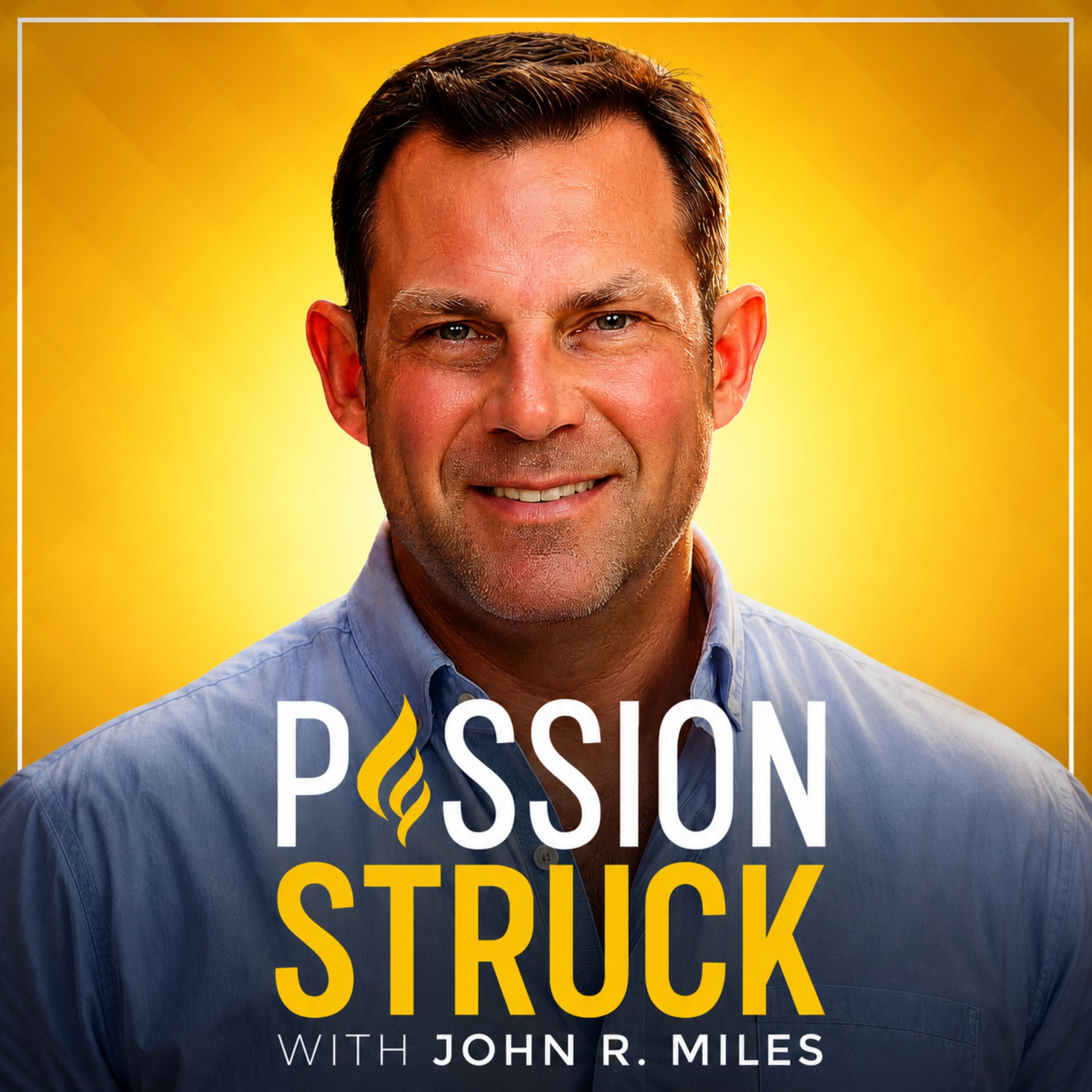
Pod Insights Passion Struck with John R. Miles What Are The Hidden Attachments Running Your Life | John R. Miles - EP 783 About this episode Why do you keep repeating the same patterns—even when you know they're holding you back? In this solo episode, John explores the hidden emotional attachments and survival strategies that quietly shape your relationships, decisions, and sense of identity—and how to finally begin letting them go.
Transcript Speaker names marked ? are inferred from speaking time and the show’s known hosts — they are not voice-verified.
0:00 John R. Miles? Coming up next on Passion Struck. We often think our lives are shaped by the people we're attached to. But the deeper truth is that our lives are shaped by the identities, the beliefs, and the protective strategies that we attach to ourselves long before we ever knew we had a choice. Because the version of you that learned how to survive your past is not necessarily the version of you that is meant to lead your life. Today, we're exploring the hidden attachments running your life and how you can finally choose who you want to become. Welcome to Passion Struck. I'm your host, John Miles. This is the show where we explore the art of human flourishing and what it truly means to live like it matters.
0:42 John R. Miles? Each week, I sit down with changemakers, creators, scientists, and everyday heroes to decode the human experience and uncover the tools that help us lead with meaning, heal what hurts, and pursue the fullest expression of who we're capable of becoming. Whether you're designing your future, developing as a leader, or seeking deeper alignment in your life, this show is your invitation to grow with purpose and act with intention. Because the secret to a life of deep purpose, connection, and impact is choosing to live like you matter.
1:20 John R. Miles? Imagine I handed you a backpack. I told you that you would have to wear it every single day for the rest of your life, but you wouldn't get to choose what went inside. Other people would. Every criticism you received, every rejection you endured, and every quiet moment you felt completely unseen would add to the weight. Every time you were made to believe that love had to be earned, another stone was slipped inside. One more weight, one more thing to carry. At first, the backpack wouldn't seem very heavy because you were young and adaptable. But after 20, 30, or 40 years of carrying that invisible weight, something remarkable happens. You forget you're carrying a backpack at all.
2:05 John R. Miles? You simply call the heavy burden on your shoulders, quote unquote, "me." But what What if the heaviest things that you're carrying were never actually meant to define you? What if they were only meant to help you survive a specific chapter of your story? And what if the very coping strategies that once protected your heart have quietly become the primary barriers preventing you from truly connecting, not just with other people, but with yourself? Today, we're going to unpack that backpack. Welcome back to Passion Struck and welcome to episode 783. Over the past month, we've been exploring a defining challenge of modern life: this deep pervasive sense of disconnection.
2:47 John R. Miles? This goes far beyond a disconnection from our technology or our institutions. It's a disconnection from one another and increasingly from our own inner lives. This week, therapist Katie Morton helped us to understand the root cause of why we repeat the exact same painful emotional patterns. And yesterday, Adam Lane Smith showed us precisely where many of those relational blueprints begin in our early family dynamics. Today, I want to go one step further because simply understanding where your patterns came from isn't enough to change the trajectory of your life. The real question we have to confront today is much larger: which of those patterns are still running your life right now?
3:32 John R. Miles? Before we dive in, if this series is giving you the language to understand your own experiences with connection and belonging, please share it with someone who might benefit from hearing it today. Taking a moment to leave a rating or review on Apple Podcasts or Spotify is one of the most powerful ways you can support our mission to help people live intentional lives. Make sure you're subscribed on YouTube so you never miss a step in this journey, and you can download the companion workbook for this episode right now at my Substack at theignitedlife.net. Beneath nearly every human pursuit lies the exact same question: do I matter? Let's look inside the backpack to find out how we answer it. Thank you for choosing Passion Struck and choosing me to be your host and guide on your journey to creating an intentional life that matters.
4:16 John R. Miles? Now, let that journey begin.
4:24 John R. Miles? Think about how you and I learned to make sense of the world when we were kids. If you want to know why we're still carrying all this hidden baggage, that's exactly where it starts. The reality is, when you're young, you just don't have the tools to understand the hidden storms the adults around you are walking through. A child doesn't look at a distant, completely checked-out parent and say, "You know what? My parents are under immense financial pressure, and they're just burning out from their corporate careers." A kid can't comprehend that. Instead, they look at that cold distance, turn it completely inward, and ask a simpler, heartbreaking question: "What is wrong with me?" And because a child can't change the adults who control their world,
5:08 John R. Miles? they do the only thing they have the power to do: they change themselves. To bring some kind of stability to a world that feels completely unpredictable, a child's brain writes a silent script just to stay safe and get noticed. If love feels like it only shows up when you perform or stay perfectly quiet, you internalize that as a rule. You pack that heavy strategy right into your backpack, deciding right then and there that if you're completely flawless, if you never ask a single soul for help, or if you just keep yourself entirely invisible, you will finally be safe from the pain of being rejected. We carry those early adaptations straight into our adult lives on complete autopilot.
5:53 John R. Miles? And the real tragedy is that so many of us spend our entire adult lives protecting a version of ourselves that a frightened child invented. Because here's what most people never realize: we don't look back at our past clearly. We live through adaptations our past installed.
6:14 John R. Miles? When we finally step into adulthood, the scenery around us changes completely, but the contents of the backpack stay perfectly intact. We tend to think we're attached to specific people in our lives. But the deeper reality is that we are actually attached to the rigid identities and emotional strategies we adopted back then just to get by. Honestly, we don't cling to our relationships nearly as tightly as we cling to the versions of ourselves those relationships allow us to be. Because identities often feel safer than intimacy. And that's exactly where so many of us get stuck. We turn our old protective strategies into lifelong emotional contracts.
6:58 John R. Miles? And we completely forget that these roles were originally meant to be shields, not our actual skin. Think about how this plays out in normal, everyday life. You probably know someone who's completely attached to the idea of being needed. They are the ones answering every single phone call at midnight, solving every family crisis, and willingly carrying everyone else's heavy burdens while totally ignoring their own exhaustion. Somewhere along the way, they signed a silent contract with themselves that says, "If no one needs me, maybe no one will love me." Or maybe you know someone who's obsessively attached to achievement.
7:39 John R. Miles? They're running on a relentless corporate treadmill, constantly chasing the next promotion, the next award, and the next metric of success. They look incredibly driven from the outside, but their entire hustle is fueled by a quiet belief that their value is tied strictly to what they produce. They think if they can just accomplish enough, they will finally prove they belong in the room. I know exactly what that trap feels like because for years, I carried my own heavy backpack into every single boardroom I entered. Early in my career, I was on an absolute rocket ship of corporate advancement. I became the youngest vice president at Lowe's, and later stepped into a global executive role at Dell.
8:24 John R. Miles? The outside looking in, my life was the perfect blueprint of success. I was outperforming and outworking everyone around me, constantly running on the frantic fuel of hundred-hour work weeks and nonstop global travel. But during a routine leadership evaluation, an organizational psychologist handed me a copy of Marshall Goldsmith's book, "What Got You Here Won't Get You There." She looked at me and directly challenged my style, telling me that my intellectual ability to outwork people was actually masking a total lack of deep relational connection. I remember being furious because I couldn't see what she meant at all. I thought to myself, "She's completely wrong.
9:09 John R. Miles? My relationships are fine. My results speak for themselves." I couldn't look past my own ego. What I couldn't see back then was that I had become so attached to the identity of being indispensable that I'd completely forgotten how to simply be present. I had substituted professional utility for personal significance, and it took a brutal encounter with burnout in a gray, empty landscape of total exhaustion before I finally woke up to the fact that I was running an old script I had never consciously chosen. Then there are those of us who become fiercely attached to hyperindependence.
9:51 John R. Miles? We build an entire identity around the pride of never needing a single soul, entirely unaware that our emotional armor is actually just a calcified fear of being let down. Whether we attach ourselves to being the fixer, the strong one, the person who's always right, or even staying safely in the role of the victim, the mechanism is exactly the same. We exhaust our lives and our relationships defending these manufactured masks, completely blind to the fact that we are protecting the exact identities that keep us disconnected from ourselves and the people we love.
10:31 John R. Miles? Why do our minds fight so hard to hold on to these identities? Even when they cause us so much personal loneliness and exhaust our relationships? The reality is, your brain is far less interested in making you happy than it is in making tomorrow look exactly like yesterday. To that deep, primitive part of our wiring, whatever is familiar feels safe, while the messy, volatile uncertainty of true intimacy gets flagged as an immediate crisis. That's exactly why we keep repeating the patterns that hurt us. And you can see it playing out in tiny, human moments all around us every single day.
11:13 John R. Miles? Picture a high-level corporate executive who leads hundreds of employees with total confidence. Yet, he physically cannot ask his own partner for emotional support when he's drowning under stress because his system tags needing help as a total weakness. Or look at a mother who constantly apologizes just for taking up space in a room, overexplaining her choices and managing everyone else's comfort because her biology convinces her that keeping the peace is the only way to avoid being abandoned. The faces change, the stories change, but the backpack stays remarkably the same. The moment an interaction touches an ancient childhood wound,
11:58 John R. Miles? your survival brain completely hijacks your body, taking all your communication skills and your best intentions entirely offline. Your system drives you to protect the trap because opening your fist and letting go of that protective identity feels like stepping off a cliff. We settle for a predictable, isolated routine because our primitive wiring would honestly rather keep us lonely than allow us to risk the vulnerability it takes to be truly seen. If you and I want to break free from these hidden attachments, we have to completely change the questions we ask ourselves when we look in the mirror. Real self-reclamation doesn't happen just because you label your behavior with an attachment
12:41 John R. Miles? style and treat it like some kind of permanent life sentence. Instead of driving yourself crazy, asking, "What's my attachment style?", you need to ask a far more powerful question. "What identity am I absolutely terrified to lose?" You know, more than a century ago, psychologist William James offered an insight that still completely shapes how we understand ourselves today. He argued that each of us has two very different dimensions of self. There's the "me", which is basically the collection of roles, achievements, disappointments, beliefs, and all that protective emotional armor we've piled up through our lives. It's the story we've built and told everyone else about who we are.
13:25 John R. Miles? But he said, "There's also the 'I', the observing self. This is the quiet awareness deep within us that is entirely capable of stepping back, noticing these old stories, and deciding whether they actually still serve us today." That's exactly why the backpack matters so much. Everything you've been dragging around, the perfectionism, the hyper-independence, the exhausting need to be indispensable, or that deep fear of ever asking for help, all of that belongs to the "me". But the person who's capable of sitting down, opening the backpack, looking inside, and asking, "Does this still belong to me?", that's the "I",
14:11 John R. Miles? and that's exactly where your internal freedom begins. To find your way back to a life of real, authentic connection, you have to realize that setting the backpack down is completely different from throwing it away. Putting it down takes a little bit of self-compassion and small, deliberate micro-choices. It's never about making those massive, overwhelming resolutions that just cause your survival brain to Freak out and freeze up. True ownership starts when you stop trying to think your way out of an emotional storm and instead use simple physical techniques to calm your body down. When you soothe your nervous system and you steady your biology,
14:55 John R. Miles? your logical brain finally comes back online. Suddenly, you can communicate honestly. You can just state your needs directly instead of sitting there expecting everyone else to read your mind. And when you start approaching your old habits with curiosity, instead of beating yourself up with judgment, you begin to discover something remarkable. The version of you that learned how to survive your past is not necessarily the version of you that's meant to lead your future.
15:27 John R. Miles? As we pull up to the end of our time together today, I want to leave you with a few simple questions that I've been wrestling with myself this week. Try to ignore that natural instinct to rush out and find a fast solution. Instead, just let these reflections sit quietly in your mind while you drive or while you walk and see what surfaces. First, what is inside your backpack right now that you have mistakenly called your personality? Second, what emotional strategy once kept you safe as a child, but is now actively standing in the way of intimacy in your adult relationships? Third, where in your life are you completely exhausting yourself
16:12 John R. Miles? trying to earn a sense of worth that is already fundamentally true? And finally, just imagine setting that backpack down on the floor for one single day. Who would you actually be if you didn't have to perform anymore? Maybe today isn't about unpacking the entire backpack all at once. Maybe today is simply the day you realize it was never supposed to become a part of who you are. Open it, look inside, pick up one belief you've been carrying for decades. Turn it over in your hands, look at it with curiosity, then ask one simple question, "Does this still belong to me?" Because the greatest act of self-reclamation isn't pretending the backpack never existed.
16:57 John R. Miles? It's realizing that you finally get to decide exactly what comes with you for the rest of the journey.
17:06 John R. Miles? Next week, we're continuing in this journey through the Connection Crisis series, and we will be joined by Spencer West. For years, Spencer found himself living according to expectations that never truly belonged to him. Like a lot of us, he spent a long time trying to fit into a version of success that looked perfect from the outside, but left him feeling completely disconnected from who he really was. What followed was a remarkable journey of self-discovery that ultimately led him to challenge those limiting beliefs, redefine what was possible, and build a life rooted in absolute authenticity and purpose. Together, we're going to explore why so many people get trapped by identities they never consciously chose, and what it actually takes to break free from the expectations,
17:51 John R. Miles? assumptions, and stories that keep us from becoming who we're meant to be. It's a powerful conversation about resilience, identity, belonging, and having the courage to follow your own path.
18:01 Speaker 01 Asking yourself the question, "Why am I here?" And really leaning into that. And stop worrying about what life is and start wondering what it could be. I think those are the two things that, as when I was writing this book, that really resonated and that I hope people will pick up on, is to really just pause and take a look around you and, "Why am I here? And what do I want?" And then having that ability to wonder what could be. Because part of the framework also for this book is this idea that we have to have self-trust and self-confidence. The self-trust to be able to listen to what's in here and what we want, and the self-confidence to believe that you can actually achieve whatever that is. And so to do that, I think we have to start with those questions.
18:42 John R. Miles? If today's conversation gave you a new lens through which to understand your relationships, please share it with someone who may benefit from hearing it today. Leaving a review on Apple Podcasts or Spotify is one of the simplest and most impactful ways you can help others find this show. And be sure to subscribe on YouTube as we continue exploring how we find our way back to authentic connection. Somewhere in your life today, you're carrying a backpack that no one else can see. Maybe today isn't the day you empty it. Maybe today is simply the day you realize you don't have to keep adding to it. Because what was packed into that backpack by your past doesn't have to determine your future. Every intentional life begins the same way,
19:25 John R. Miles? by choosing what you're willing to keep carrying and what you're finally ready to set down. I'm John Miles, and you've been passion struck.
Previous Why You Keep Repeating the Same Relationship Patterns | Adam Lane Smith - EP 782 Next How to Stop Living for Everyone Else and Finally Become Yourself | Spencer West - EP 784 Page updated October 30, 2026 · transcript and summary are machine-generated