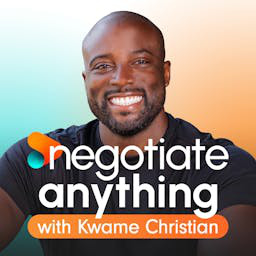
Pod Insights Negotiate Anything Erika Ayers Badan: Nobody Cares About Your Career About this episode Request A Customized Workshop For Your Company In this episode of Negotiate Anything, host Kwame Christian is joined by Erika Ayers Badan, the CEO of Food52 and former CEO of Barstool Sports, to discuss the nuances of workplace negotiations and the power of authenticity in one's career. Erika shares her journey of negotiating in various industries, from sports entertainment to lifestyle, and highlights the importance of staying true to oneself. The conversation delves deep into how authenticity can be a powerful tool in both personal and professional negotiations, as well as the courage it takes to say no when necessary. Listeners will gain insights into Erika's vast experience in negotiations, her thought process behind tough decisions, and how she navigates complex deal-making scenarios. What will be covered: The significance of authenticity in successful negotiations and career growth. Insights from Erika's personal negotiation experiences, including the sale of Barstool Sports and dealings with major media companies like ESPN. Strategies for setting boundaries and saying no in professional settings. Connect with Erika Ayers Badan Buy the Book: Nobody Cares About Your Career Follow Erika on LinkedIn Contact ANI Request A Customized Workshop For Your Company Follow Kwame Christian on LinkedIn The Ultimate Negotiation Guide Click here to buy your copy of How To Have Difficult Conversations About Race! Click here to buy your copy of Finding Confidence in Conflict: How to Negotiate Anything and Live Your Best Life!
Transcript 0:00 Speaker 00 Today's episode is brought to you by Shopify, Granola AI, Quince, and the Anxious Achiever Podcast. Stay present in your meetings. Get three months of granola free at granola.ai/Quami. For your gift list, shopquince.com for free shipping and 365 day returns. And make sure to tell them that Quami with big swings only sent you. Subscribe to the Anxious Achiever today on Apple Podcasts, Spotify, or wherever you listen to podcasts. Do you have an idea that you want live for the holidays? Launch before Black Friday at Shopify.com/Quami. Erica, thanks for joining us today.
0:35 Speaker 01 Thank you for having me.
0:36 Speaker 00 It is our pleasure. So how would you get us started by telling us a little bit about yourself and what you do?
0:40 Speaker 01 Okay, I am the CEO of a company called Food 52, which is a home and lifestyle and food company based in Brooklyn, New York and Portland, Oregon. Prior to joining Food 52, I've been at Food 52 about a month. And prior to that, I was the CEO of Barstool Sports for almost a decade and grew that business from 12 people and a couple million bucks in revenue to a pretty big cultural juggernaut in the US. And with about $300 million in revenue, we sold the company twice in the last year. So it was kind of this wild, crazy run. And I've spent most of my career in the internet and thinking about media,
1:22 Speaker 01 which is publishing and content, thinking about marketing and growing brands. And then being able to monetize both of those things in multiple ways, whether it's through commerce or through advertising or subscriptions or creating products or you name it. So that's the gist on what I do now.
1:42 Speaker 00 Love this. And your background is so diverse and unique. And now also, we cannot forget that you're publicizing a book right now. So tell us a little bit about the book.
1:54 Speaker 01 Oh yeah, I forgot to mention that. That's bad. The publishing people will not like that. So I just wrote a book. It's called Nobody Cares About Your Career. And I wrote the book on the train into Barstool Sports. I wrote it mostly talking to myself and recapping. What was happening at work or what I was thinking about work every day. And what my goal was with the book is I really believe a couple of things. One is I think you can be yourself and be successful. I don't think you should have to wear anybody else's image of you or live anybody else's dream for you. You should do what makes you happy. And you should be definitive and defiant about going for that. And then the second is when I started to look at business books
2:39 Speaker 01 or books about careers and work, they really came in two varieties. One, well, all of them I felt were kind of boring. And two, it was either I'm perfect. Look at me and my great career. I'm so successful. I'm the best, which I find kind of alienating and not approachable. And then the second was wagging the finger at you of you should do this. Like you should do that. Five habits to change your life, to be better, to be different. And I wanted to write a book for people who care about their careers, whether you work at Google or you work in a gift shop or you work, you know, at a car wash or you pump gas
3:22 Speaker 01 or you're a waitress or you're a marketing executive or a salesperson, whatever that may be. I wanted to write a book that was about making the most of your own career so that you can make the most of your own life. And to write it in a way that was conversational and approachable and fairly casual. And that's the book.
3:41 Speaker 00 Incredible. And I am all for books that are not boring.
3:46 Speaker 01 Yes, boring books are the worst.
3:48 Speaker 00 Yes, no, this is great. And I think I'm homing in on an angle here because what you said first, being yourself and being successful. I think that is something that is really challenging for people nowadays to embrace their own authenticity and recognize that it does not need to be a threat to their career. Of course, I know the listeners are saying, Kwame, can we get to negotiation stuff, please? But we actually need to address this authenticity part too. Because I think if we don't, then we just have a lot of people who are inauthentic negotiators, negotiating. Successfully for things that are not meant for them. So let's talk about that authenticity piece. What does authenticity mean for you?
4:27 Speaker 01 Yeah, I completely agree with you. I think that if you are not confident in who you are and what you represent and who you think you can be, and if you're not willing to put the work in to show that you are great, show that you are trustworthy, or that you deliver with excellence, it becomes very difficult to negotiate. And I think a lot of times, people think the negotiation starts in the moment where you're asking for something or vying for something. But the reality is, it starts way, way, way before that. And to me, being authentic is just being honest with yourself. What are you great at? What do you want? In this case, what does
5:08 Speaker 01 your company want from you? I have a whole section in the book, which really says, the dumbest person at the company is not the idiot guy in accounting. It's the person who doesn't know how the company makes money. And one of the things in this world of negotiation, and in your world, is if you don't understand who's buttering, who's bread, and why, and how, your ask for whatever you want can land accidentally very great, or more likely fairly bad. And you can have a better chance of becoming who you want, getting what you want, doing what you want in the way you want, if you approach everything with authenticity, which is earnestness, a desire
5:51 Speaker 01 to learn, a commitment to being who you are, and being acknowledging of what your strengths and your weaknesses are, always striving to evolve them and grow them, grow your strengths, not your weaknesses. And I think those things set you up for a far longer, bigger journey of success.
6:09 Speaker 00 I agree 100%. And really, a lot of times, what it seems like is that either the world, or your colleagues at work, your boss, or something, they might be pushing you into a specific direction because they have a vision for you, your life, and your career. And a lot of times, it's up to you to protect yourself and steer the ship in a way that's best for you. Now, in your experience, what is it that makes doing that thing just so tough?
6:37 Speaker 01 Yeah, I mean, that's why I wrote the book, which is, nobody cares about your career, which is what a great thing that nobody really cares about your career but you. It's, I think it's incredibly freeing, you know, and I write a lot about this. Your boss and your company are going to have a vision for you based on what they want for themselves. And it's always really important to keep that in mind because a lot of times I think we can get lost in doing what the boss wants or being who the boss thinks we should be or looking the part the company is looking for. And yes, that's important to understand all those things for what the company wants and how they want it.
7:17 Speaker 01 But it's also really important that, that you're vying for what you want and how you want to be and what you are looking for. And the great job, and I really believe everyone can have a great job, is when those two things intersect in a way that is very complementary. But it takes some work to figure out how to make what the boss wants or your company wants intersect with what you want.
7:44 Speaker 00 So essentially, we're trying to find that win-win. But again, easier said than done. Now, let's talk about with your career throughout the journey. When you think about the tough conversations that allowed you to shape your career in an authentic way, what are some of the conversations that come to mind for you?
8:02 Speaker 01 Oh, so many, and I've made so many mistakes. You know, I think that's part of becoming a better negotiator and part of becoming a better human and a better, more convicted version of yourself is understanding where you've messed up along the way. You know, early in my career, when things got ugly or things got rough, honestly, instead of negotiating, I just would up and quit and go get a different job. And that really isn't the right path. I think the conversations where I really negotiated hard and well are
8:38 Speaker 01 The situations, whether I was negotiating for a new job, whether I was negotiating for better pay, whether I was negotiating for more responsibility or a bigger opportunity. The best negotiations were what happened when I was very clear about the landscape. I knew where I was coming from, why I was coming from that place and what the proof points were for why I felt I deserved what I was asking for. The negotiations that didn't go well were when I only did that and I went off half-cocked on, hey, I want this and I want this because of this and you should give me that because of that. The most important piece, in my opinion, is sitting on the other side of the table
9:21 Speaker 01 and saying, where is that person coming from? What do they want? What do they see? And a lot of this book really talks about, how do you have empathy and perspective and hindsight and foresight to be able to look on all sides of the table and to be able to understand how to create something that works for everybody? It's a win, you know, to your point, the win-win. It's a win for you and it's a win for them.
9:49 Speaker 00 Hello, my friends. Before we get back to today's episode, I want to ask you a question. Have you ever wondered how to elevate your team's negotiation game and how you can help the folks on your team have better, difficult conversations? At the American Negotiation Institute, we offer transformative keynotes and workshops tailored to empower professionals with top-tier negotiation and conflict resolution skills. Whether it's a keynote for your next event or hands-on training for your team, we've got you covered. Don't just negotiate. Master the art with the American Negotiation Institute. Click the link in the description to find out more. Elevate, negotiate, and succeed.
10:30 Speaker 00 You make it sound so easy.
10:32 Speaker 01 Oh, it's not. It's a disaster. And it's a, it's a, then you get what you want and then you're like, ah, this isn't what I wanted. It's hard. It's, and you're never perfect at it. And it, you know, I think people think it just happens once and you're done and wah, you have what you wanted. You know, I was just, I just went to, to Rwanda and I was really struck in Rwanda. In Rwanda, they're trying to grow tourism by promoting the gorillas. But in order to promote gorillas and to get people to come to Rwanda, they've got to make it work for the farmers, right? They want more land given to the gorillas so the gorilla population can increase. Now, as it happens, the gorillas and the, you know,
11:14 Speaker 01 all the wildlife are eating the crops of the farmers, which are just pissing the farmers off. And the farmers are like, what the heck? Like, that's a month's worth of income. That's a week's worth of pay. And so what the government of Rwanda has done, which I found really smart, and I, I took a lot of this into my own thinking about negotiation, is they make it work for the gorillas, which make it work for tourism, but they also make it work for the farmers and they make it work for, for the hotels. And by really thinking through, where can this go right? And where can this go wrong? And how do we make sure everybody has aligned incentive to do the right thing? And how do we take care of people when things go right and when things go wrong? That's a negotiation, because a negotiation never
11:59 Speaker 01 happens in just one conversation. It's an iterative set of conversations. You get to an agreement and then something's going to go wrong. Somebody eats your crops and you got to start it all over again. So that's very long-winded, but it really was very inspiring to me about how people are thinking about the ecosystem. And I think you've got to, in your career and in your life, think about your ecosystem.
12:25 Speaker 00 Ooh, Erica, the last week, we did landscaping. And when I was driving up, I saw this bunny eating our flowers. And I was saying, oh, my gosh, my mom and my wife, they're going to be so pissed. And now what I'm going to say next time I see that bunny is, thank God, it's not a gorilla. My goodness, could you imagine?
12:43 Speaker 01 I know, like a gorilla comes in and eats your crop. Like the elephants come in and eat your crops. Like, you're lucky to have a bunny. They're cute and small.
12:51 Speaker 00 Yeah, but I love this story because it's so indicative of what negotiation really is like. Every solution comes with a problem attached. There are always these trade offs. And the reason I wanted to hear more about that story, and not only that, but also your experience in negotiation, is that you are an expert negotiator, savvy dealmaker, leader of a massive multimillion dollar company, and now CEO of another great company, too. And so from the outside looking in, people are going to say, Erica's got it together. Negotiation's easy for her. But I love the fact that you're humanizing this because it's hard and challenging for everybody. And you, it doesn't just take one conversation done, nice little bow, look at this amazing deal that I have. It's, hey, this is going to be, I'm going to try my best. I'm going to try to understand myself, which is challenging.
13:35 Speaker 00 I'm going to try to understand the other side, which is challenging. And I'm going to have to adjust to every single inconvenience and surprise along the way. But that's what's required to just keep on moving forward in our business deals, but also in navigating our career, too.
13:48 Speaker 01 Definitely. I think my biggest learning in negotiating is when something feels wrong and you feel very far apart and it feels inequitable or just doesn't sit right with you. It's not right. And the biggest mistakes I've made in negotiations were going along with things. Even when I was like, I'm not comfortable with this. This is going too far. I'm giving up too much. I'm acquiescing to too much. I'm getting too little in return. I think a lot of times what happens when we get into negotiations, at least from my experience,
14:28 Speaker 01 is you get on this conveyor belt and the conveyor belt is moving to like, we're going to get something done. We're going. You know, going to get a deal done. We're going to get a deal done. And you get on the conveyor belt and you've already told people you're working on this deal. You're going to get the deal done and the deal could be in your life or I'm just using that word loosely. But when you get on it and you feel like the belt is tripping and it's maybe going a little bit too slow and you want to get off, but you don't know how, most people continue on the conveyor belt. And I think that's the biggest mistake, which is no is an incredibly powerful answer in a negotiation.
15:07 Speaker 01 You've got to be consistent. You've got to be constant. You have to be dependable. But if you're making your way in a negotiation and it just doesn't feel right, one of the most powerful words in the universe is just no, I'm not doing this. And then you see things for what they really are. The other party, the other person either comes back to the table with more of what you want, or they say pound sand, we're out of here. And both answers are okay because what you've decided for yourself is where this is going is not good for you. And I wish more people felt the confidence to get off.
15:49 Speaker 00 If you were going to take a big swing this holiday season and start a business, what would you build? Maybe it's that one idea that you can't stop thinking about. I've built a business from the ground up and I can tell you that the hard part isn't the idea. It's getting it live. That's where Shopify comes in. You can sell everywhere people shop, online, in person, across social media, even in AI chats. And Shopify checkout with Shop Pay converts up to 36% higher than the competition. So more of the people who show up actually buy. Plus, Black Friday is when more people are already shopping and ready to buy. So the sooner you're live, the better. If you're ready to launch your business before Black Friday, go to Shopify.com/Quami to start your free trial.
16:34 Speaker 00 That's Shopify.com/Quami. Go to Shopify.com/Quami to hear your first.
16:41 Speaker 00 Try this. Pull up your notes from a meeting last week. Do they still make sense? Or do they just seem like random notes that only the old version of you could decode? That used to be me. And as a negotiator, that's a real problem because my job is to listen, not type or write notes. That's why Granola has been one of my favorite tools, period. It's an AI-powered notepad. I jot my usual rough notes and then Granola securely transcribes the meeting in the background. And when it ends, I get clean, structured notes that still make sense a week later. Decisions, owners, next steps, everything that I would need to feel good about going forward. And it works through your device's audio too. So there's no additional setup or any annoying AI joining your call.
17:24 Speaker 00 Just your normal meeting, but with superpowers. If meetings are eating up your day, Granola is a no-brainer. You can try it totally free for three months. Just go to granola.ai/Quami. That's granola.ai/Quami to get your time back. Get three months free at granola.ai/Quami. I think not just in negotiation, but in life. I think our success and failure is going to be dictated by not just the yeses, but I think more so than with the no's that we have to say. Because every yes has to be protected by hundreds, if not thousands of note, right? Now, let's say somebody's listening to this and they're saying, alright, cool. I find myself in a situation, my gut is telling me things are not okay, but it's almost like the emperor has no clothes.
18:06 Speaker 00 Everybody else is going in the same direction as if everything is okay. How do you find the strength within yourself to say no when everybody else is saying yes?
18:15 Speaker 01 Yeah, it's super hard. I mean, it's middle school. It's peer pressure. I talked to this college kid the other day. And I was like, James, what are you doing for the summer? And James said, oh, I have an internship in a finance company and I hate it. And I was like, well, why are you doing it? And he said, because everybody from Princeton has an internship at a finance company. And I was like, why do you want to be like everyone else from Princeton? That sounds absolutely terrible to me. But it's hard to go against the grain. And the reason it's hard to go against the grain is most people want to be liked and they want to feel safe.
18:55 Speaker 01 It's the more time you spend wanting to feel safe and wanting to be liked, the less original, the less interesting, and I really believe the less fulfilled you will be because you're too busy looking at everybody else and trying to make yourself the same as everyone else. You're not the same as everyone else. That's a wonderful thing. And being able to say no and being able to say, hey, this isn't for me is terrifying. It's you're out on a limb. You're vulnerable. What if people say you're stupid? What if people say you're an idiot? What if people say you're the worst scum of the earth? And to that's hard to put yourself out there to go against the quote unquote norm.
19:38 Speaker 01 But I think what you find is when you believe in yourself and that little voice inside of you that says, I really don't want to be a finance person. I want to be a circus performer. If you listen to that voice, it's going to open up a whole new world to you, which may be full of circus performers and other people that you really love to be around. And I think a lot of people spend a lot of their life, which is for me, it was a big motivator in this book, just feeling stuck and feeling inside screaming, but outside trying to look the part. And I think that takes a real lot of energy. I think that takes an inordinate amount of energy. And big message in the book is to fail always. Like the more you're failing,
20:23 Speaker 01 the more you're trying, the more you're figuring out who you are, the better off you'll be because your gut will be better. You'll have more experience. You'll have more insight. Your world will be better because you'll be curious and you'll be on a journey to be fulfilled. And your happiness will be better because you will be on a path to something that for some amount of time you want.
20:44 Speaker 00 What I love about this, Erica, is that you're giving people license to be themselves and to be happy on their own terms.
20:52 Speaker 01 Definitely.
20:53 Speaker 00 It's so funny. Let's go back to the Princeton.
20:56 Speaker 01 James.
20:57 Speaker 00 James. Yes, James. That's much better than the Princeton person. I might call him that, by the way.
21:02 Speaker 01 I will. He'll like that.
21:04 Speaker 00 Well, you know, we go and we get these incredible educations, but nobody teaches us how to be ourself.
21:09 Speaker 01 Anything.
21:10 Speaker 00 Right? It's so interesting. And now, when you look at your career and you think about some of those tough conversations, specifically in times where you had to say no or set a boundary, can you think of an example of one that was especially pivotal for you?
21:24 Speaker 01 Sure. So the first thing I'd say, I worked for Microsoft early in my career. And one of the funny things about Microsoft, I didn't like it very much. I found it enormous. There were thousands and thousands of people working there. I found it to be very insular. Microsoft people just talk to other Microsoft people. I found it to be quite political. But the one thing the Microsoft people were great at was saying no. And they built, there were so many people and there were so many ideas and so many different agendas that they built this structure called your commitments. And your commitments were what you were signing up to do every quarter. And they mapped to the goals of your group and your division and blah, blah, blah. It was this whole process.
22:08 Speaker 01 And if something wasn't written on your commitments, people would write their commitments and post their commitments in their queue. And if someone came up to you and asked you to do something that wasn't on your commitments, people would very liberally be and very forcefully say, no, this isn't on my commitments. And it was a very good lesson to me. I'm tend to be kind of an idea person and I want to do a thousand things and I want to do them all right now and I'm very excited. And it really taught me that, you said it really well, probably better, is saying no is more important than saying yes.
22:47 Speaker 01 Because saying no reserves your energy and your spirit and your time and your ability to focus and your energy to accomplish something. And I find a lot of times for me, I was always running the risk of making too many commitments and saying yes to too many things. And so that to me is an example where, working at Microsoft, even though I hated it and I was like, I don't want to be a software engineer, I don't want to Work for, I don't want to work for Microsoft. I took so much away from it. And then I think a negotiation where I've said no, a lot of negotiations. I'm still mad at myself for a lot of negotiations, which I didn't say no early enough
23:29 Speaker 01 or forcefully enough. And even when that voice inside me was like, you're on the conveyor belt and it's not going anywhere good, I still kept on with it. And I think most people are optimists. I'm an optimist. And the great thing is even when things get totally messed up, you're still going to say, yeah, but I learned this and look what happened because of it. So I tend to look at everything that way. And I think generally people look at things that way. But I do think saying no earlier and saying no with more conviction, it can get you to peace faster.
24:04 Speaker 00 I agree. I agree. And it's so frustrating those times where you, you say no, and then you realize, I should have said this earlier. Time, energy, emotions. I think that's the most disappointing thing, sometimes looking at me. One of the things I've found is that when you become, and let me speak for myself. As my negotiation skills have gotten better, my willingness to walk away from deals sometimes has gotten worse because I say to myself, well, I'm Kwame Christian. I'm the negotiation guy. I can figure this out and it'll be a great story at the end of the day. Oh, great. Now the story is the deal I should have walked away from months ago.
24:39 Speaker 01 That's so funny.
24:42 Speaker 00 Yeah.
24:43 Speaker 01 You have a great name. It just rolls off your tongue. That's so funny. I'm the opposite. The better I get at negotiation, the more I'm like, don't waste my time. I don't want to do this.
24:53 Speaker 00 Smart. For the people listening, tip towards Erica on this one.
24:58 Speaker 01 Only this one though Kwame, only this one.
25:00 Speaker 00 This is great. And now let's talk more about negotiation too, because you've been in several different industries, which is really interesting. Now, you're in the food lifestyle business before you were in sports and entertainment. When you think about some of the deals that you've had, if we were to put, create this, Mount Rushmore of Erica's favorite deals, what are some of the negotiations that come to mind for you?
25:21 Speaker 01 Oh, so many. We sold Barstool Sports to a company called Penn Entertainment. The negotiation took six months. You know, I lost 30 pounds. I was doing it 24/7. It was exhausting. It was stressful. It was multiple parties. It was the sale of a company, which was really an extraordinary experience. I learned so much in that process and I'm very grateful for that process. Other negotiations, even, you know, we negotiated to, to have a TV show on ESPN, which was summarily canceled after one episode. And the negotiation took a year for, the show lasted 30 minutes,
26:02 Speaker 01 which in hindsight was a really horrific use of time and, and energy and resources. But was a good example for me of negotiating well, but for the, with the wrong people and probably for the wrong reason. I also struck a lot of partnerships where we launched a flavored vodka with a company called Gallo. And Barstool and Gallo created a flavored vodka called Pink Whitney. Awesome negotiation. We then, it was such a good negotiation. We did it once and then we did it again and we did it again and we did it again. So it was really, I think that is one thing in, when you find a great partner
26:41 Speaker 01 and the negotiation while having its tough moments and certainly having its, its issues. Once you go through something like that, if it really works, you want to do it again and again and again. And that can be a really rewarding experience. So all sorts of negotiations, real estate negotiations, firing people is a negotiation, hiring people is a negotiation, selling a company, buying a company is a negotiation. So I feel like I've been really fortunate and very grateful that I've gotten to see all different things like that.
27:15 Speaker 00 I love these stories because it shows just how much you can learn through the process of negotiation. Because when you, I'm assuming, when you went through college and everything, you were not saying yourself, you know what? I am going to negotiate with ESPN for a sports show. Probably not on your like bingo.
27:31 Speaker 01 Definitely not, definitely not. You know, it's funny, when I was in elementary school and middle school, my parents were teachers and we didn't have a television for most of my childhood. And then when we got a television, my brother and I were allowed one hour of TV a week. And We had to negotiate. So we could either both take a half hour and then be disinterested in the other's show, or I was like, let's band together and have an hour of great programming that we're both kind of happy. And that was to me a good, I think you learn how to negotiate at a really young age. You negotiate with your parents, you negotiate with your siblings,
28:13 Speaker 01 you negotiate with your teachers, you negotiate with your coaches. And learning how to negotiate is really, hey, what do you want? What do I want? Is there some place where we want the same sort of thing? That was fun for me. We didn't have MTV and I remember faking my mom's voice and calling the cable company every month and being like, this is mine airs. I'm so sorry. I meant to have the MTV turned on. If I didn't have an hour of television and wanted to watch MTV and that was the one thing my brother and I could agree on, I wouldn't have been motivated to figure out how I could be scrappy and call the cable company every month. So I also think like, you can learn this stuff from just life.
28:53 Speaker 00 I agree. And for me, seeing my kids too, it's cool to see their different negotiation styles.
28:58 Speaker 01 Definitely.
28:59 Speaker 00 It starts to formulate. And even if you have the same influences, the personality still shows up.
29:04 Speaker 01 So different.
29:05 Speaker 00 Yes.
29:07 Speaker 01 So different.
29:08 Speaker 00 One thing that I noticed in your book, you talk about how to have tough conversations with bosses too.
29:14 Speaker 01 Yep.
29:15 Speaker 00 And that's one thing that people have been asking about a lot. How do I manage up? So boss has power, I don't have power. How do I negotiate in those situations?
29:26 Speaker 01 Yeah, that one's always tricky because you put so much in your head about what your boss must be thinking, right? I think people tend to make themselves very small and the boss very big. And I think people genuinely, part of the reason I called this book, Nobody Cares, is I think people think that their bosses think about them way more than their bosses actually do. So, and I think that that can feel like a really great negative, or it can actually be wildly freeing. I choose to think of it as being wildly freeing, and I think people should think about that. Negotiating with your boss. Is a really important skill and helping your boss is a really important attribute at
30:07 Speaker 01 work. And one of the things I write a lot about is even if you think your boss is the biggest idiot of all time, you've got to work to make your boss look good because if you make your boss look good, you look good. And it may be the most aggravating, like, like test of your patience and your stamina and your resilience and your tolerance for nonsense. But the reality is if you work really hard and you deliver for your boss, there is going to be somebody that sees you doing that. It may not be your boss because your boss might be a self-absorbed, you know,
30:47 Speaker 01 moron, but it will be somebody else in your environment and they will take notice of that work and that effort. So that's kind of my first thing there. I think the second thing is to be less emotional about your boss. This is a business relationship. Your boss has certain objectives. They have certain desires or they they want certain things accomplished. They have certain expectations of you and really understanding what kind of pressure your boss is under. What are your boss's motivations? Where is your boss coming from? I wish more people spent more time doing that because I think just getting out of your own head and your own needs and your own ego
31:30 Speaker 01 and thinking about where that person is coming from will really help you have a better conversation because then you can play to that versus just blurting out what you need. And then I think the third thing is in the content world, I used to always say, you gotta give, you gotta give, you gotta give, you gotta give, and then you take. And that's how when you think about Gary Vee or you think about Barstool Sports, like Barstool Sports gives you content, they give you more content, they give you more content after that, and then they ask you to buy a t-shirt. And the same is true with a person and their boss. You gotta give, you gotta give, you gotta give, and then you ask. And making sure you're delivering on the giving and then being very
32:13 Speaker 01 purposeful and thoughtful about the ask will help you get more of what you want because the ratio is generous.
32:20 Speaker 00 I love these three points. Let me do a quick recap for the audience here. So first, work hard to make your boss look good. Try to detach yourself from the emotionality of the situation and then give, give, give, then ask. And what's great about this, Erica, is that this aligns perfectly with everything that you have been saying throughout this entire interview. Right? So you need to be clear on what it is that you want. You need to be able to empathize with the other side, understand what it is that they really want, focus on them. And I think a lot of times what ends up happening in these tough conversations where there is a difficult power dynamic is that we focus on the deficiency. So we just say, okay, they have more power. Anything else you'd like to add to this analysis? I am also powerless. That seems like the exact same thing, just worded differently.
33:05 Speaker 00 Yes. They can't get beyond that. And if you can just recognize that you're a person, they're a person, and we're two people trying to work together to figure something out. I think it simplifies the conversation so we can actually engage. But that fear and that focus on the deficiency holds us back from having the conversation at all. And then if we do have the conversation, we go out there feeling disempowered and then therefore ineffective. Try this. Pull up your notes from a meeting last week. Do they still make sense? Or do they just seem like random notes that only the old version of you could decode? That used to be me. And as a negotiator, that's a real problem because my job is to listen, not type or write notes. That's why Granola has been one of my favorite tools, period. It's an AI-powered notepad.
33:48 Speaker 00 I jot my usual rough notes and then Granola securely transcribes the meeting in the background. And when it ends, I get clean, structured notes that still make sense a week later. Decisions, owners, next steps, everything that I would need to feel good about going forward. And it works through your device's audio too, so there's no additional setup or any annoying AI joining your call. Just your normal meeting, but with superpowers. If meetings are eating up your day, Granola is a no-brainer. You can try it totally free for three months. Just go to granola.ai/Quaami. That's granola.ai/Quaami to get your time back. Get three months free at granola.ai/Quaami. If you were going to take a big swing this holiday season and start a business, what would you build?
34:33 Speaker 00 Maybe it's that one idea that you can't stop thinking about. I've built a business from the ground up and I can tell you that the hard part isn't the idea. It's getting it live. That's where Shopify comes in. You can sell everywhere people shop, online, in person, across social media, even in AI chats. And Shopify Checkout with Shop Pay converts up to 36% higher than the competition. So more of the people who show up actually buy. Plus, Black Friday is when more people are already shopping and ready to buy. So the sooner you're live, the better. If you're ready to launch your business before Black Friday, go to Shopify.com/Quami to start your free trial. That's Shopify.com/Quami.
35:15 Speaker 00 Go to Shopify.com/Quami to hear your first.
35:20 Speaker 01 Completely. I think the other place where people get tripped up is it's very easy to be too tactical and small. I find a lot of times, I'll give you an example. I've had a lot of people in my time managing people come to ask for a raise, which is great. People should ask for raises. That's awesome. Where I don't give them is when people say, I want a raise because so and so makes more money than me and I think so and so stinks at their job. And to me, that's petty. It's not inspiring. Bosses don't want people to be sharing their salaries. Obviously, everybody does, but it's not motivating.
36:02 Speaker 01 It doesn't make me as a boss feel like you really want to be rewarded. You're committed to the company. You want it for the right reasons. You're in it for the long haul. It doesn't achieve any of that. And I think a lot of times, people can be very, very petty. And they can also be too tactical. I'll give you an example. Today, I had somebody come to me and she wants another headcount. She wants another employee. And it was this vomited email about, we're underwater, like, we're drowning. We need resources, like a tantrum. It was a tantrum in an email of pounding the table. I need resources now. And I was
36:43 Speaker 01 like, okay, great. Like, I'm super down to give you resources, but what is the plan? I can't give out a headcount every time somebody has a tantrum. Mantra in my inbox about how much work they have. So how are you thinking about how many total heads are you going to need this year? Is there a formula that makes you feel that, hey, when we get to this much revenue or we have this many projects, we need this many more people? And I think a lot of times people don't get out of that emotional, small, like this is bothering me right now. That's not motivating to bosses and it's not good in a negotiation.
37:23 Speaker 01 It's dialing things back and zooming out and looking up is really important because doing that and solving for that problem will ultimately solve your small problem.
37:35 Speaker 00 I agree 100% and I think too, I don't want to speak for you, but I know other people in the same situation where they receive an email like that. It is unpleasant, first of all, which makes it unpersuasive also. And then you say to yourself, if, let's say the person, what the person's asking for is completely legitimate. If I say yes to this, am I tacitly endorsing this type of behavior?
37:56 Speaker 01 Exactly.
37:57 Speaker 00 I'm just going to write these bombs in my email every day. I think when we, again, we have to be able to think a little bit deeper about these things, but we're not going to be able to think deeper about them. If we are overwhelmed with that level of emotionality because we can't think clearly. And so for the person who says, all right then, well, how do I have these conversations while at the same time managing my emotions? Even though I feel so strongly about it, what advice do you have for people who are in that situation?
38:23 Speaker 01 I think this is a little bit like when somebody really pisses you off and they send you the email and you want to like write back to you right away, the nastiest thing imaginable, like that inside. I don't know if you've seen Inside Out, but it's that you like fire guy is like, I hate you. Everyone has that inside of them. I had one of those like 25 minutes ago and I literally, I was in the middle of a conversation and my, I just stopped listening and my head exploded. Don't send that email. Obviously don't send that email. You can still write it or you can have a great, rich, full of expletive conversation in your head in the shower.
39:05 Speaker 01 You can mime it out to your husband or your wife or your partner or your girlfriend or your boyfriend or whatever. Don't act on it. And my advice is to, one is to don't fall to the lowest common denominator and just complain about it with other people at work. I think that's toxic, negativity is contagious and it's really unbecoming. And I write actually a lot about this, but whether you know it or not, people will remember you for the things you say about other people at work. The second piece is even though you're having this visceral reaction and you feel a certain way, take a beat, sleep on it, let it sit for three days and then do something about it.
39:49 Speaker 01 Reacting in the moment never goes well. I still do it because I can't help myself and I'm like, what did I just do that? And I think that it's human nature, but the more you can try not to do that, the better things go.
40:01 Speaker 00 I agree. I agree. And I appreciate your vulnerability, admitting that it is hard to do and it's something you still struggle with, something I still struggle with. And I sometimes think to myself, at what point will I grow out of this? And I say,
40:15 Speaker 01 Never.
40:16 Speaker 00 Never. I'll never grow out of humanity. That will always be with me. I think about it just like anything else. We're thinking about it from a sports perspective. Yeah, I am going to try to increase my shooting percentage while understanding it's not possible for me to shoot 100%. And so the better you get at it, the higher the percentage of success will be when it comes to emotion management and just take every conversation as practice and you'll start to get better.
40:39 Speaker 01 Yep, 100%.
40:41 Speaker 00 Love this. And Erica, when you think about somebody sitting down, reading your book, and then they close the book, what in your vision would you want them to be able to say has changed about their life after reading the book?
40:57 Speaker 01 Oh, I love that. I hope if someone makes it through this whole book, which would be amazing, that they feel motivated and that they feel empowered and they feel that somebody out there understands how they feel about where they work, who they are, what holds them back, what they wish they could be and That they know that they could take a risk and fail or take a chance and it will be okay.
41:30 Speaker 00 That is powerful, my friend.
41:33 Speaker 01 Thank you.
41:34 Speaker 00 No, thank you. Thank you for writing the book on the train. I'm glad that it came to life. And thank you for coming on the podcast today. We really appreciate it.
41:44 Speaker 01 Thank you so much for having me.
41:46 Speaker 00 Congratulations, you've just joined an elite club. By listening to a full episode, you're now officially on the Negotiate Anything team. So, welcome aboard. What most team members do is they subscribe to the podcast because that allows them to automatically get the latest episodes of the show. The best things in life lie on the other side of difficult conversations. Keep learning, keep practicing, and keep getting better. Your relationships will improve, your career will soar, and you'll have the confidence you need to get the most out of these crucial conversations. Again, thank you for joining the team. We're excited to have you, and I will see you in the next episode. I'll catch you later.
42:31 Speaker 00 Hey, everyone. I want to tell you about a podcast I'm really excited about. It's called The Anxious Achiever, and it's hosted by my good friend, Maura Aron's Mele, and it's part of the Yap Media Network. Here on Big Swings Only, we're all about going after the big stuff. But anyone who's taken a real swing knows anxiety usually comes along for the ride. And honestly, nobody handles that better than Maura. Since 2019, her show has helped millions of listeners navigate stress, mental health, and the search for meaning through work. With personal stories, expert insights, and evidence-based tools, she tackles anxiety, perfectionism, ADHD, and psychological safety at work with guests ranging from the US Surgeon General to NFL and NBA stars. It's a top 10 management podcast and a Signal
43:16 Speaker 00 Award winner for Best Commute Podcast. And she's been a guest on our show, too. If you're ready to take control of your anxiety and your life, you definitely want to check out The Anxious Achiever. Subscribe to The Anxious Achiever today on Apple Podcasts, Spotify, or wherever you listen.
Previous Split the Pie: A Radical New Way to Negotiate - with Barry J. Nalebuff Next The Hidden Job Market: The Best Opportunities Aren’t Where You Think Page updated November 7, 2026 · transcript and summary are machine-generated