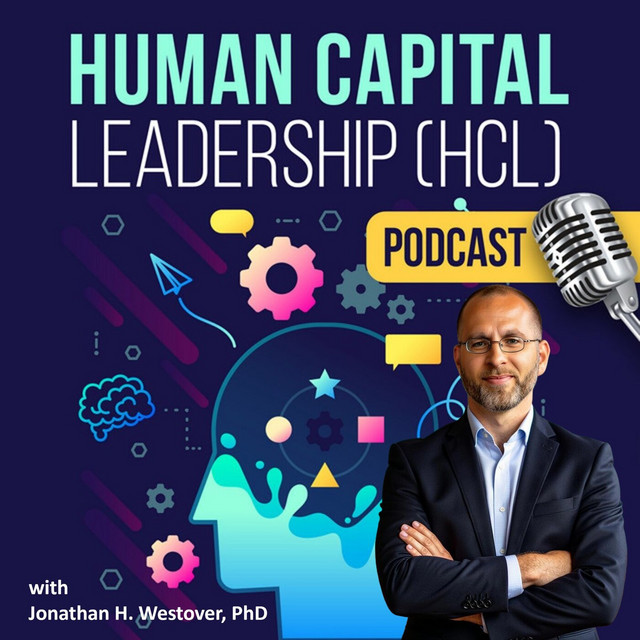
Pod Insights Human Capital Leadership Amazon HR Cuts Signal Dangerous Trend Across Corporate America, with Erin DeVito About this episode In this podcast episode, Dr. Jonathan H. Westover talks with Erin DeVito about Amazon HR cuts signal dangerous trend across Corporate America.
Erin DeVito is the General Manager of Impact North America, leading teams that design transformative, people-centric learning experiences. Since joining Impact in 2012, she has helped organizations navigate change, strengthen leadership, and build cultures where people thrive. With more than a decade of experience across operations and senior leadership, Erin brings a deep belief in the power of human connection to everything she does. A mom of five, she’s constantly reminded of the beauty in imperfection, growth, and humour in chaos—and she channels that perspective into creating workplaces where people can bring their whole selves to work and do their best, most meaningful work together.
Check out all of the podcasts in the HCI Podcast Network!
See Privacy Policy at https://art19.com/privacy and California Privacy Notice at https://art19.com/privacy#do-not-sell-my-info.
Transcript 0:03 Speaker 00 Welcome to the HCI family of podcasts where your source for personal, professional, and organizational growth and development. We share our own original research, explore industry trends, and interview executives and thought leaders from across the globe. Join us for practitioner-oriented content around all things leadership, HR, talent management, organizational development, and change management. Maximize your personal and organizational potential with the HCI family of podcasts.
0:35 Speaker 00 Andrea DeVito, welcome to the conversation today.
0:37 Speaker 01 Thank you very much, John. Nice to be here.
0:39 Speaker 00 It is a pleasure to be with you. You're joining us from the New York area. I'm south of Salt Lake City in Utah. And today, we're going to be talking about Amazon HR cuts and what that signals for trends across corporate America, perhaps a dangerous signal here. And I think it's a really important item to be discussing. And frankly, it's not just Amazon, right? It's lots of organizations, and what it means for companies and for human capital and for labor markets and for all of that. So as we get started, I wanted to share Erin's bio with everybody. Erin DeVito is the General Manager of Impact North America, leading teams that design transformative, people-centric learning experiences. Since
1:19 Speaker 00 joining Impact in 2012, she has helped organizations navigate change, strengthen leadership, and build culture where people thrive. With more than a decade of experience across operations and senior leadership, Erin brings a deep belief in the power of human connection to everything she does. A mom of five, she's constantly reminded of the beauty in imperfection, growth, and humor in chaos. And she channels that perspective into creating workplaces where people can bring their whole selves to work and do their best, most meaningful work together. I love everything about that. Everything about that tail end that I was just sharing is 100% like my mantra. And I'm a father of six, and so I can relate
2:01 Speaker 00 to the mother of five, you know, like the chaos aspect that you were sharing in your bio. Humor and chaos, I think, is very apt.
2:14 Speaker 01 I mean, even being one upped in this moment, it's rare that I find someone who's like, I have more kids than you. It's wonderful. And I could probably talk to you and get some advice for hours after this, but thank you so much for having me. And even as you were teeing this up, talking about Amazon, I immediately went to so many other contexts, right? Where we are experiencing AI, the speed of that. And it's, it's one of those that it's happening in the workforce. And that's where we drive a lot of attention to, but we also have, as you know, you have six, I have five. Like there is a whole generation of people coming into this workforce who have a completely different exposure to AI and all that's doing in the school system. So it's touching us everywhere. And I think it's really, really timely conversation.
2:59 Speaker 01 So, because he caught me on a Monday where I'm half in kid mode and half in work mode right now, just adjusting.
3:04 Speaker 00 Yeah, yeah, exactly, exactly. Well, very good. So why don't we start by digging into Amazon a little bit? Like you said, I think this applies to lots of different contexts, lots of different examples. But we know that many industries are automating HR, automating many functions. And but within HR, there's certainly this desire through agentic AI and through other AI automating automation opportunities, you know, to just to streamline a lot of those processes to, to, to, a lot of those jobs are stalling or, or in some ways, or at least pieces of getting displaced.
3:47 Speaker 00 And then my, my oldest two daughters are college students and they're approaching, you know, completion and entering the workforce. And they're kind of freaking out and I'm kind of freaking out for them. Like, what does this look like for, for early career professionals when organizations seem to be, you know, at least in a wait and see mode, if not have, having already decided we're not hiring people right out of college because we have AI agents and whatnot to do this work for us. It's a really interesting time and I don't think, I mean, this is kind of a wild, wild west. I think we have anything figured out yet and and there's going to be so many implications. What are you seeing as some of the the challenges
4:31 Speaker 00 that are coming from this kind of Amazon effect of of of what companies like Amazon are doing in terms of of reducing or at least pausing on their their HR hiring?
4:41 Speaker 01 I love the wild, wild west theme because I think we don't know. I mean, it is. It's changing rapidly. There's all sorts of information. I mean, even if you think to the point where we have access to so much data, so much information, everything in the world that people are saying. It's easy to make quick judgments on it. So I think and it's easy to be scared of it and it's easy to be like, oh, my God, what is going to happen? How? Sorry, gosh. How am I going to make my way through this? And, you know, whether I'm dealing with clients or working with my own team or my kids, I think it's really, really important now more than ever to come back to that human connection and that human piece because at the end of the day,
5:25 Speaker 01 AI is a technology. It's massively changing. It will continue to massively change and impact our work. And automation and all of those things are also they have benefits to them and opportunities there. But when we talk about jobs being displaced, people struggling, I mean, even down to recruitment for people as they enter in the workforce, that's completely automated and changed. So how you have the right things in your resumes written. I think it's a constant opportunity to keep staying current on a lot of it, but the most current you can stay is human. Right? And so how we continue to build those skills to think through not just the automation, but what it's for, how it's going to impact people, how we
6:07 Speaker 01 how we continue to bring the human aspect because that's what's going to keep a healthy organization healthy. It's the people doing the work being brought in, being exited. I could ramble on for a while, but I think sometimes it's easy to look at it like I'm in this like I have five kids, so I'm in a fitness craze right now. They all make fun of me and yell at me. But it's a new thing and I keep coming back to this like, well, AI isn't the fix, right? It's not going to make us all lean and muscular and healthy. It's a supplement. It's can be useful. It can be dangerous depending on how you use it. But it still requires the training, the discipline, the hard work to get where you want to get to.
6:47 Speaker 01 So I think the more we look at AI as something that is part of a solution and not all of it. And it still requires our human hard work, our discipline, our training. Our leadership is is the right steer, right? How we navigate it.
7:02 Speaker 00 Yeah, I think that's a really wise way to kind of frame that. And I think, you know, maybe maybe a slight tweak. Or we're really just a complimentary kind of way of thinking about it is just augmentation, human augmentation via this tool, just like we've had at every stage of innovation in the workplace. You know, you think, you know, people talk about how we're in industry 4.0 or even 5.0. And every stage of the industrial revolution, you know, we've automated and we've displaced jobs. But we've also, at the same time, we've freed up people to do less mundane and to do more creative and innovative types of things.
7:44 Speaker 00 And and I think when when companies, say in Amazon or name any, you know, long list of them, are are cutting jobs or reducing hiring or or whatever. They're looking at it from a from a lens of of labor cost savings, right? They're like, how can we do what we're doing for less and we can use more AI agents and whatever? And I think.
8:14 Speaker 02 When you buy LG, you get so much more than just an appliance. You get more done, more cost savings, more peace of mind and more control. Because LG appliances are designed to do more. Like washers and dryers with AI tech to take out the guesswork. Refrigerators that fit in tight spaces and keep food fresher longer. Or ranges with precise induction cooking and easy cleanup built in. All with the style you want and reliability you can count on. So you can get more from your home every day. LG Appliances, so much more. Make life easier with LG. See the latest models and savings now at LG.com.
8:57 Speaker 00 I mean, there are so many potential unintended consequences from that that that they need to be very careful about. But I just think the whole framing is wrong. I think what, you know, it's driven by short term incentives and and quarterly earnings reports and all that kind of stuff. But like if we're really looking at long term, sustainable, um, you know, success for organizations and ongoing innovation. You cannot lay the human side, you know, you can't put the humans aside. They have to work hand in hand and it's not about reducing labor costs as much as I think it's really about human augmentation via these tools. And so how can we, what we're already doing, how can we do it better? How can we do more of it better, um, more efficiently?
9:40 Speaker 00 And and having having humans that can curate the the outputs of of these AI tools. So that we're still having good quality and we're still, you know, bringing real value to the market and not just a whole bunch of AI slop. That's where I I think it's really going to matter and I I see that as the differentiation between. You know, what many companies are doing and kind of approaching. Now, I we should also say, and I kind of alluded to this earlier, especially as it relates to my daughters, but many companies are just completely in a wait and see mode. They're they're not sure what to do. They're not they're not cutting jobs. They're not displacing workers. They're just kind of like, we're not sure what to do.
10:21 Speaker 00 Um, and so we're just kind of gonna wait and see. They don't want to hire and then have to lay people off, etc. And so it it really is, um, just really an interesting time to see how all this evolves. Nobody knows how it's going to continue to evolve, but one thing is clear, humans still have to be in the loop, right? And if they're not in the loop, then we're going to have all of these super negative unintended consequences. And as I mentioned, the engagement declines that we're seeing in in organizations in terms of employee engagement. Employee activation, employee satisfaction, all of these things are are not going well. And we either have to adjust for it, or we're gonna kind of be shooting ourselves in
11:04 Speaker 00 the foot and hurting our own opportunities in the future.
11:08 Speaker 01 Absolutely. I had so many thoughts as you were speaking because it's spot on. I mean, I went, it's the last time I'll go back to the fitness analogy, but you can get short-term wins, right? You can
11:18 Speaker 00 Absolutely.
11:18 Speaker 01 diet, you can, you know, starve yourself, you can run thousands of miles, but if you're not paying attention to your body, to your system, you could be reducing your muscle, you could be malnutritioning, like have malnutrition. There's so many effects that will show up in the long term, but even if you're getting short-term results, you've lost 10 pounds or whatever it is. So I think you're spot on with how we need to think through and be really intentional with what we're trying to do. What is our purpose? What are we trying to be more efficient for? What do we want to hold on to with our people, with our culture? If we're gonna make, because we, I mean, and some organizations might be in a position where they have to make mass layoffs because everyone is in a holding pattern and that's
12:00 Speaker 01 from buyers to general economy. And because it's nerve wracking right now, so they might be forced to do that and it might be automation is the way to go. But even with making the tough calls, how we nurture and take care of what we want to have at the end of that is so vital, you know, because as we're doing that, people don't understand why, if they're not communicated with consistently, clearly, if they aren't feeling like what I do matters and I have a value to bring that can be enhanced by technology or not, then we run the risk of losing that muscle, losing the heart, losing the motivation to keep going. And I
12:42 Speaker 01 think that's where, you know, going through any kind of change, even if you're in a holding pattern, it is so important to be checking in. Are we communicating what people need to hear? Because people will fill in the blanks and make up the stories that that you'll, you know, give them either drives the fear or drives the motivation. And are we being consistent? Are we being ethical? Are we are we valuing people and what we have through whatever change? You know, like, how do we lead people through this change to lead Is through the change because change is inevitable as we're seeing and we're seeing that every day with our clients like at one point it was, you know, leadership development and the soft skills and upskilling and, you know, through the, through all of the things that were happening, there was still that leadership development focus.
13:25 Speaker 01 Now it's all, how do we lead through change and complexity and all of that. So I think even if you're in a standstill, we can still be helping people navigate change because it's inevitable.
13:36 Speaker 00 Yes, it is. And I really like the, I know you say you don't want to keep going back to the fitness analogy, but I think it's just a really good one. You know, because you're absolutely right. How many people get the short term wins with weight loss? But it's not done in a healthy way whatsoever. It's not done in a sustainable way, first of all. So they're going to yo your diet, right? And they're going to end up just gaining the weight back. But yeah, you lose muscle mass or you just have other negative health impacts because it's not just all about weight, right? It's about the holistic health of the individual and weight is one symptom. And if you're totally focused on just the weight, then you can do all sorts of other things to kind of screw yourself up.
14:16 Speaker 00 And, and you won't necessarily see it immediately. You'll just feel good because, hey, look, I dropped 10 pounds or whatever. And yeah, I mean, apply that directly over to, okay, we just cut 20% labor costs because now we're, we, we put in place these, this agentic AI. Okay, great. But what does that mean in the long run? Like there's very little conversation around work redesign as it relates to the humans integrating with any AI use, which baffles me because, you know, that's, that's one of the differences, I think, between what we're seeing happening right now versus other stages of disruptive innovation over the, say, the last 150 years of the industrial revolution.
14:57 Speaker 00 Every, at every stage, you, you would redesign work to go along with whatever the new innovation was. And right now, I don't see that. I just don't see much meaningful or intentional work redesign. It's just everyone's saying, use AI. And then you have all this haphazard adoption across units and teams and individuals using all these. Different tools and in some cases you're able to actually displace whole tasks or even people with agents or whatever. But in many cases, you just have, I mean, there's quite a few studies showing that the ROI on AI implementation is not there yet. And yet, companies are investing an incredible amount of money into it.
15:39 Speaker 00 And they're reducing their their labor costs, at least in the short run, but at what cost in the long run? I mean, are you just completely eroding your own capabilities in the long run? And I'm super worried about that. Not not just for for organizations or for my daughters or whomever, but like for the state of society as a whole. Like, I'm really worried about how we how we wrestle with this. Because if we don't, if if if HR is not at the forefront of trying to think through how we redesign work in in relation to this technology, then we're just going to have it imposed upon us and it's going to be a mess. And there's going to be so many negative unintended consequences from it.
16:23 Speaker 01 Absolutely. And I go, I mean, I love that point. And I go as far as to say, if purpose and why isn't at the center of that? And that is driven by HR, by people. We're, we will struggle, we'll, we'll keep dealing with a challenge versus turning it into an opportunity, right? Because I think with technology and things like AI, we can easily get into a pattern of like, oh, this is great. It's thinking for me. It's starting to sound like me. It knows my personality. It will just create all of this stuff for me. But if you don't have a stronghold on purpose and what you're trying to achieve and why you're trying to achieve it. And everyone in your organization isn't like really clear on that.
17:05 Speaker 01 You lose slowly over time, direction with that. And all of a sudden, the words start to form differently and you start making up like, oh, we're over here because AI is telling to. And I guess the best way I can describe it, I was recently working on a performance review revamp. And, you know, AI was extremely useful, right? Like, it came in and it helped like revamp different expectations. How will word different things, but and it saved so much time that I would have spent helping someone work through. Okay. Well, the semantics of this word versus that word and four different drafts and everyone aligning around language.
17:44 Speaker 01 But so, yes, it saved a ton of time, but it doesn't change the fact that it doesn't know your company's values or expectations or guiding principles or mission. And so you have to align that language to that. It has to sound like you. It has to, it has to promote the votes that your company has. And it's not going to replace the training or need of people to have those conversations. So at the end of the day, it's still humans driving that process. It can make it cleaner. It can make it easier to build the process, but you still need drivers. And so if you can use that technology to help you, like we said, and you said in the beginning, the front work, you still can't take your foot off the gas.
18:24 Speaker 01 So you have to, you have to look at and be driving that why and the purpose and the ability for people to have the right conversations in the performance review example. Because the technology is not going to do that. They're not going to make the discernment of like, okay, yes, this is where someone's doing really, really well. And this is, you know, not part of the role, but where that person is so valuable behind the scenes, connecting different functions and stepping up into, into things they're not necessarily supposed to do or have to do, but it's carrying a heartbeat in the organization. There's people behind that context that are really, really important in a noticing that deciding to do something with that and acting on it.
19:06 Speaker 01 But also having people be seen, right? Like, that's so important. I remember someone's like, all they had to say to me was I was having a tough week with something. And so I was just like, I see you. And I was like, wow, that's really, really powerful and important. I needed to hear that, right? So AI can't do that. Automation can't do that, but it can empower us to find those moments where we can be more intentional, more mindful and more present for people to do that. Because I didn't spend 50,000 hours trying to draft 10 expectations, right language, right?
19:38 Speaker 00 Yeah, it's, it's. Algorithmic, right? And so that's, that's the challenge. You brought up a great example of why this matters so much. It's because there are so many people that do so many things behind the scenes. They're outside of perhaps the strict scope of their job to connect and to collaborate and to innovate. That drives so much value. I mean, there are lots of studies on this, you know, about how, you know, a relatively small percentage of people within any team in any organization drives so much of this value. But in an age of metrics driven organizations, and I'm not against metrics, don't get me wrong, but, but, you know, it's like the old saying goes something to the effect of what you can measure doesn't matter and what matters can't be measured.
20:21 Speaker 00 You know, something to that effect. AI is algorithmic and, and so you're only putting in what specifically you're measuring. And, and then it's not going to see the other stuff that actually really matters. That's really hard to quantify. That's really hard to measure. And if, if you just have a race towards the KPIs, and there's nothing wrong with KPIs, but like if, if, if it's just a race across the whole organization towards, towards these metrics, um, and you completely disincentivize any of this other behind the scenes, real important work that happens in every organization. You're just going to have a hollow shell of an organization. You're going to have a house of cards that's ready to completely collapse.
21:03 Speaker 00 If you're not investing in your people, and that's just the short sightedness, I think of, of how some organizations are approaching this right now. And it, it makes me really concerned for them and their long-term success for their people and the ripple effects it's going to have throughout society. Well, Aaron, this has just been a fantastic conversation. I know the time and I need to let you go here in a minute. But before we wrap up, I wanted to give you a chance to share with the audience how they can connect with you. I know more about your work, your team, and then give us the final word for today.
21:30 Speaker 01 Okay. Um, well, you can find me on LinkedIn, like most people, Aaron DeVito. ImpactInternational.com is our website and, um, yeah, I'm sure if you're listening to people have a way of contacting you, John, and you can connect them over, but I would be delighted to connect with anyone. Um, and this, this is just a story. That popped in my head. And if you know, you don't know much about me, but I tend to go with whatever moves me. So if you have a minute, I'll tell a simple story. I have a four year old daughter who is slightly on the spectrum. We're not sure we're diagnosing, but she gets very fixated on things and has a really tough time when she doesn't like when it goes awry. And we're all learning to manage. This is new for us. It's a change in our family dynamic, but
22:15 Speaker 01 she she had these six eggs all through Thanksgiving and she's carrying them around and she's like making sure that she has them at all times. And anytime she lost one, she'd kind of like have a bit of a meltdown and we'd go find it. And so it became a bit of a pattern. And I got everyone home and that night we went up to bed and she lost one of the eggs and she was just unconsolable. And I bring her upstairs and I'm like hugging her and singing Old MacDonald and trying everything. And my seven year old daughter went downstairs. I guess she knew what was she was paying attention. She knew what was going on. And she drew, she cut out in paper, six eggs. She made all the designs like the eggs were that my four year old had. And she comes running up the stairs and she's like, mommy, mommy, I think this will help.
23:00 Speaker 01 And she hands her the six cut out eggs. And it worked like all of a sudden Josie was so happy. She was like, oh, my God, this is great. And my daughter, seven years old, made that happen. And I think the reason the story comes to mind is we still need to pay attention to our environment. We still need to understand what is going on with people on whatever level, because there's so many things that are behind, you know, closed doors that we would never notice unless we start to pay attention and ask. And AI is not going to come off with that solution. That was someone thinking, oh, understanding the context, thinking through all the different solutions she could come up with. And that was one she thought of and she gave it a try at it. She's like, I'm not sure this is going to work or not, but here you go.
23:44 Speaker 01 And luckily it did, but I think it's so important that we're paying attention to the environment around us, the people around us, what drives them, what makes them frustrated, what triggers them as best as we know how or can open up and then still using the power. Power of our brains with the help of technology, with the help of crayons and paper to work on solutions to the best that we can, whether they'll work or not, and doing the human thing of taking care of each other, right? Like seeing someone in need and trying to help. So silly little story. Still a mom at the end of the day.
24:16 Speaker 00 What a sweet story. Yeah, that is a really sweet, touching story and it's really apt. Thank you so much. Amen. Well said. As always, you know, I hope everyone will reach out to Erin, that you'll find out more about what Erin and her team can do for you. And I hope everyone can stay healthy and safe. That you can find meaning in the works that work each and every day. And I hope you all have a great week.
24:43 Speaker 00 Thanks for joining us for this episode of the podcast. We hope you stay healthy and safe and please join us again soon.
24:54 Speaker 02 When you buy LG, you get so much more than just an appliance. You get more done, more cost savings, more peace of mind, and more control because LG appliances are designed to do more. Like washers and dryers with AI tech to take out the guesswork, refrigerators that fit in tight spaces and keep food fresher longer, or ranges with precise induction cooking and easy cleanup built in, all with the style you want and reliability you can count on. So you can get more from your home every day. LG appliances, so much more. Make life easier with LG. See the latest models and savings now at lg.com.
Previous Creating a Magnetic Culture in Your Organization, with Cyndi Wenninghoff Next The Importance of Empathetic Leadership in the Modern World of Work, with Ashlie Marshall Page updated November 6, 2026 · transcript and summary are machine-generated