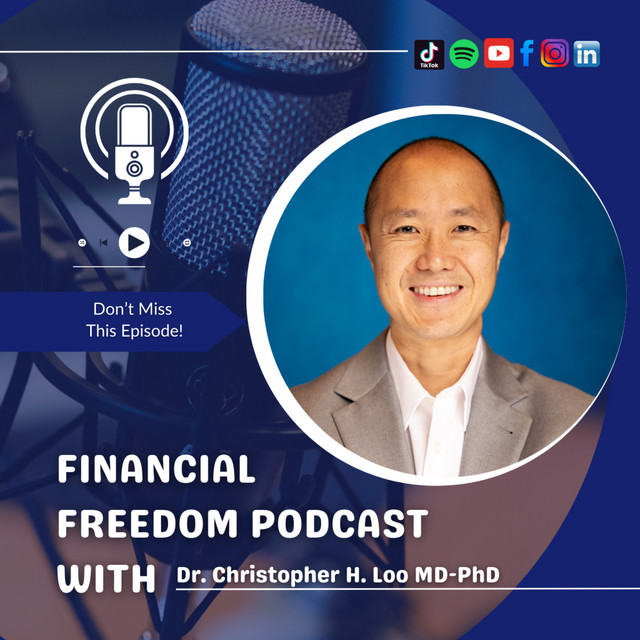
Pod Insights Financial Freedom Podcast with Dr. Christopher H. Loo, MD-PhD #1320 - Unleashing the Power of Local SEO: A Masterclass with Bradley Benner About this episode Are you ready to revolutionize your local SEO strategy and dominate Google search results? Join Bradley Benner, a veteran in local SEO, as he shares invaluable insights on leveraging Google Business Profiles to skyrocket visibility and attract more leads. In this episode, Bradley unpacks the nuances of local versus traditional SEO, reveals common pitfalls in Google Business Profiles, and offers robust strategies to enhance your online presence. Whether you're a small business owner or a digital marketing professional, this deep dive into local SEO is a goldmine of practical tips for immediate application. To check out the YouTube (video podcast), visit: https://www.youtube.com/@drchrisloomdphd Disclaimer: Not advice. Educational purposes only. Not an endorsement for or against. Results not vetted. Views of the guests do not represent those of the host or show. Click here to join PodMatch (the "AirBNB" of Podcasting): https://www.joinpodmatch.com/drchrisloomdphd If you enjoyed the audio and video quality of this episode, enhance your own productions by signing up through our Descript affiliate link: https://get.descript.com/gaei637mutik Click here to check out our Amazon product of the day (affiliate):https://amzn.to/4fA3R1g We couldn’t do it without the support of our listeners. To help support the show: CashApp- https://cash.app/$drchrisloomdphd Venmo- https://account.venmo.com/u/Chris-Loo-4 Spotify- https://podcasters.spotify.com/pod/show/christopher-loo/support Buy Me a Coffee- https://www.buymeacoffee.com/chrisJx Click here to schedule a 1-on-1 private coaching call: https://www.drchrisloomdphd.com/book-online Click here to check out our e-courses and bookstore here: https://www.drchrisloomdphd.com/shop Click here to purchase my books on Amazon: https://amzn.to/2PaQn4p For audiobooks, visit: https://www.audible.com/author/Christopher-H-Loo-MD-PhD/B07WFKBG1F Follow our YouTube channel: https://www.youtube.com/chL1357 Follow us on Twitter: https://www.twitter.com/drchrisloomdphd Follow us on Instagram: https://www.instagram.com/thereal_drchrisloo Follow us on Threads: https://www.threads.net/@thereal_drchrisloo Follow us on TikTok: https://www.tiktok.com/@drchrisloomddphd Follow our Blog: https://www.drchrisloomdphd.com/blog Follow the podcast on Spotify: https://open.spotify.com/show/3NkM6US7cjsiAYTBjWGdx6?si=1da9d0a17be14d18 Subscribe to our Substack newsletter: https://substack.com/@drchrisloomdphd1 Subscribe to our Medium newsletter: https://medium.com/@drchrisloomdphd Subscribe to our LinkedIn newsletter: https://www.linkedin.com/build-relation/newsletter-follow?entityUrn=6992935013231071233 Subscribe to our email list: https://financial-freedom-podcast-with-dr-loo.kit.com/ Thank you to all of our sponsors and advertisers that help support the show! Financial Freedom for Physicians, Copyright 2024
Transcript 0:00 Speaker 00 Progressive's Accident Response can contact emergency services if you're in a major accident. The only thing worse than someone you love being in an accident is not being able to help them. So Progressive is here to help when you can't. So get peace of mind knowing your loved ones are protected with Progressive's Accident Response. Learn more at progressive.com. Progressive Casualty Insurance Company and Affiliates. Limited availability in California. Driver is responsible for emergency and towing charges not covered by the policy. Coverage subject to policy terms and conditions.
0:30 Speaker 01 Your sausage McMuffin with egg didn't change. Your receipt did. The sausage McMuffin with egg extra value meal includes a hash brown and a small coffee for just $5. Only at McDonald's for a limited time.
0:42 Speaker 02 Price and participation may vary. Promotion pricing may be lower than meal pricing.
0:45 Speaker 03 Good morning, guys, and welcome to the podcast. Now, I would ask you, with the digital landscape evolving faster than ever, what's the secret sauce behind turning a Google business profile into a lead generating powerhouse for local businesses? Today's guest, Bradley Benner, coming out of Virginia, is going to answer that question for us and many more. So thanks for tuning in and I'm really happy to have him on. So Bradley, welcome.
1:10 Speaker 04 Hey, thanks for having me, Christopher.
1:12 Speaker 03 Yeah, briefly introduce yourself and I'm excited to dive into the questions.
1:17 Speaker 04 Okay, thank you for having me. My name is Bradley Benner. I'm with Semantic Mastery and I've got really four different companies that are all local SEO related businesses and local marketing related businesses. And I started off learning how to do local SEO for my own business. I was an electrical contractor, so I was an electrician. And I was trying to generate work for myself back in around 2010 and I would have been doing kind of traditional marketing, direct mail, flyers, knocking on doors in neighborhoods and things, canvassing, doing all the kind of like guerrilla marketing type of stuff as a small business owner that I could do to generate work. And I ended up talking to some of the other contractors that I worked with in the construction industry that were also business owners that were generating leads for their, I asked them, how were they generating leads?
2:02 Speaker 04 And several of the more successful companies or contractors that I was working alongside in some of the construction projects, they said. That they were generating leads from Google and this was back in two thousand and ten when I could barely turn on a computer. So I started, like at the time, I didn't really have the money to buy a, to hire a digital marketing professional. So I, I just started learning it on my own and I became fascinated with how to manipulate Google. And, and once I, after several months of toying around with learning how to do local search engine optimization. And at the time it was called Google Places, now it's Google Business Profile, but at the time it was called Google Places, which was the kind of maps profile that you could create for a local business. After several months, I finally was able to get my own site ranked and I had started testing on some other type of lead generation
2:46 Speaker 04 type of sites for other contractors, just so that I could have other test projects to try to hone my skills on. And so after having my own site rank and start generating leads for my own contracting business and then started to rank a couple of other websites that I had built as kind of test cases for other type of contractor industries, carpet cleaning, locksmiths, et cetera. I started generating leads from those other sites. And so I started selling a kind of a side hustle, a side business. I started selling leads to contractors. So I was generating leads from my own company and then I was also generating leads for some other contracting, home service contractor industries and I was selling leads as a, like a side hustle or whatever, a part-time gig.
3:30 Speaker 04 And after about two and a half years of doing that, I had made, built up enough revenue from selling leads because I had started building more and more digital assets, so more virtual real estate, so to speak. And started, like I got to a point where I was making almost as much money from digital marketing as I was from my electrical business. And I said, why the hell am I climbing up and down ladders pulling wire when I can stay at home and work? So I ended up starting my own agency in two thousand and twelve, a local marketing or a local SEO agency, really, and switched to do, offering traditional retainer-based marketing services to local businesses of all different types. But I specialized mostly with contractors because that was always my industry, uh, working with home service contractors. Long story short, about two years later, I ended up starting semantic mastery,
4:15 Speaker 04 which is the company that I'm coming in on today, which is my coaching and consulting company where I teach. Local SEO and between my lead gen business, my agency and in my coaching and consulting business, that was three local kind of SEO type businesses. And then probably in two thousand and twenty ish timeframe or so, I finally took my own local SEO agency and niched it down to just working with tree service contractors. So I only work with tree contractors now in my own local SEO agency. But I also have white label and SEO agencies, which is where I do marketing services and SEO fulfillment for other agencies. So we do local SEOs fulfillment for other local marketing agencies. So we'll do things like link building, on-page optimization, Google business profile optimization,
5:00 Speaker 04 those types of things so that agencies can focus more on marketing and sales, on-page optimization or web design, which a lot of agencies do, but they want us to handle the this, the search engine optimization. So I've been doing local SEO now for about fifteen years across various industries, mostly in the kind of home services industries, as I mentioned before. But a local SEO is local SEO and it's, it's a different animal than traditional SEO is. There's a whole lot of different things that we have to do to be good at local SEO. And there's things that we can do, that business owners can do to help assist how their, the performance of their campaign, so to speak, in local search. And that's, I think, what we're going to be talking about today.
5:39 Speaker 03 Yeah, it's really interesting and I actually came to that epiphany the other day. I'm like, yeah, if I can grow my social media following to hundreds of thousands, that's actually going to be more profitable than just selling courses and digital products and consulting. So I'm like, wow, there's a lot of, one thing that was really interesting when you mentioned local SEO. People, most people on this podcast have heard about SEO. So talk about the difference between local and traditional and how it fits into your work.
6:09 Speaker 04 Okay, perfect. Yeah, there's, there's multiple kinds of SEO really. Because there's traditional SEO and then there's specialized SEO services like for e-commerce sites, for example, so like e-commerce SEO, there's local SEO, there's regular SEO, there's social SEO, there's video SEO, there's all kinds of different types of search engine optimization, depending on what platform you're optimizing for really. For today's purpose, we're really going to be talking about mostly local businesses in Google Search. Google's still the big, the eight hundred pound gorilla. You know what I mean? It's still the big kid on the block, although it is losing some market share right now because of things like ChatGPT and all that. But it's still the big kid on the block. For the most part, we still optimize mainly for Google.
6:54 Speaker 04 The difference between regular search engine optimization and local SEO is that traditional search engine optimization is organic only, which means there's no, no maps component, which means you're going to rank in universal search, which means when you go to google.com, that's universal search because that's a blend of all the different types of search algorithms, right? So there's that universal search. Sometimes when you do a search, you'll get not only webpage listings, but you also get images and you also get videos. And sometimes you'll get social media posts that show up. And that's why it's called universal search because it's a blend of all the different search algorithms into one kind of results page. Local SEO also includes maps, right?
7:33 Speaker 04 So Google Maps and that's really going to be for anybody that is doing a, performing a search in their local area. When Google thinks that they search with a local intent. So a search query with local intent, then Google is going to return localized search results. Meaning if somebody searches or like tree service near me as an example, or foot doctor in my area or something like that, Google is going to return businesses that are within close proximity to where the searcher is at the time that they search. So there's a lot of geographic signals that are sent when somebody performs a search, when Google knows that it's a search with local intent, that as long as Google understands that,
8:14 Speaker 04 if Google is unsure of what the search query is, it's going to return results based on what it thinks the search's intent is. But if, when you add a modifier to a search query like near me, in my area, close to me, or a city name, or some sort of location modifier, that is an explicit reference to a, it's a, it explicitly tells Google that it is a search with local intent. And then locals, Google's going to return localized search results that has a lot to do with the strength. The brand, the strength and authority of the local business and also the proximity and where that business is located next in in relation to where their searcher is at the time that they search.
8:53 Speaker 04 So those are all kind of signals that we can influence as either marketing professionals or business owners or a combination of both. We can help influence what Google understands about the business and how prominent it's going to be in a local area. That's what local SEO is.
9:08 Speaker 03 Yeah, it's really interesting because, you know, just doing a search on Google Maps in different areas and basically it's like some things. Where a local business here in Texas may not show up, but but which brings me to my next question. For the audience listening, we're going to talk about the impact of AI and chat GPT and how it's different than Google search. So but the question, so stay tuned, but the question for the next question is, what are some common mistakes business owners make in their Google business profiles that makes them less visible? And how can they do to fix and improve it?
9:44 Speaker 04 Great question. So there's a number of things that people do incorrectly that cause problems with Google map search right now. And it there's also a direct correlation between how the self-hosted website is optimized and how well the Google business profile performs in map search, right? Because when you do a local search, a search of local intent, it's you're going to get, you you want to rank. A local business is going to want to rank in both organic search and map search technically, right? And now I know a lot of you, if you've done local searches, you'll know that there's usually a discrepancy between the top ranked companies in the maps pack and the top ranked companies in organic section.
10:22 Speaker 04 They don't usually relate to, there's not usually, it's not usually the same companies at the top of map search and also the top of organic sometimes, but it's not all that common really. And so I always recommend trying to strike a balance between map search and organic search. And so there's really two things that we should be focusing on. Depending on which algorithm or platform, whether it's Google or Maps, Google Universal Search or Map Search that we should be optimizing for. And there's topical relevance and geographic relevance. And so topical relevance has more of an influence on how you're going to perform in organic search. And geographic relevance is more of an influence on how you're going to rank in map search. And so what are some of the mistakes back to your question that people make? There's a number of them.
11:01 Speaker 04 Number one is for a lot of, I would assume a lot of your audience is storefront type of businesses, which means they're published street addresses where the customer comes to the business location to conduct business or transact business. But then there's service area businesses, which is where the business goes out into the field to perform or conduct business, like a tree service contractor would be, or a plumber, or something like that, or a concierge doctor, right? Something like that. Those are all kind of service area businesses. One thing that I see is a service area business that has an unpublished street address. That's literally like fighting with one arm tied behind your back because a published street address is going to help the Google business profile perform better in map search.
11:43 Speaker 04 Okay, even if it's a service area business, Google tells us in its Terms of Service or Acceptable Use Policy that if it's a service area business and the customers do not come to the business location, you shouldn't publish the street address. But we know for a fact, if you publish the street address, you will rank better in Google Maps, period. So I always recommend to all my service area business clients to publish the street address if possible, because it's going to help them to perform better. Number two, it's also over optimizing the site or trying to opt. I see a lot of search engine optimization professionals because I coach and teach also. So I see a lot of experienced SEOs doing this wrong, which means there's also a lot of local businesses that are doing it wrong, because they probably hired SEOs that are doing it wrong, which is the self-hosted site.
12:27 Speaker 04 A lot of the times, for years, what we would do in order to rank better in local search would be to, however many products or services were on, like the business provided, you would multiply however many products or services, times however many locations within the area that they wanted to target. So cities, towns, census designated places, unincorporated communities. The names of areas, sometimes it's neighborhoods or districts within a city. But naming the different locations within the area that a local business wants to target. And then creating a separate page on the site for keyword or product or service keyword plus city. For every keyword plus every city. And what you end up having is a whole bunch of pages on the site that are saying the exact same thing.
13:12 Speaker 04 Over and over again, and we all used to do that in SEO because that's what we used to have to do. In order to get results, but. Over the last three years, since the large language models in AI have been implemented and now fully integrated into the Google search algorithm. Google has a much deeper understanding of our language now than it ever did before. And so now Google can understand what a site is about through. The main pages of the site, we don't have to hammer Google over the head with keywords like we used to. Google is no longer a keyword based algorithm. It is an entity. Based algorithm. Which means that Google understands. There's essentially what is an, when I talk about entities versus keywords in the SEO world.
13:55 Speaker 04 What is an entity? An entity is a person, place, or thing. And the semantic web is an entity based algorithm. And the semantic web is about how entities relate to each other or associate with each other. And I'm getting to a point here, and that is before the large language models were integrated into the algorithm. Google, we had to basically hammer Google over the head with the keywords that we wanted to rank a page for because Google didn't really understand the language. And so it was really about. Keyword density, the frequency of how many times the keyword appeared on the page. The higher the count or the quantity, the more relevant that page would likely be to the search query, et cetera. So we used to have to hammer Google over the head with keywords by doing keyword plus city for every keyword plus every city within the area.
14:40 Speaker 04 But now, because Google understands topics, essentially entities, there are a whole group of search queries or keywords associated with an entity or a topic. Let's just use topics and entities interchangeably. Because I like to, when I talk about a topic, I think people understand that better than an entity. And so I like to consider an entity as a topic. And so when you optimize for topics, then Google knows that there's a whole group of or bucket of search queries or keywords that are associated with a topic. And so when you optimize a page for a topic, you can rank that page for every search query that Google understands is associated with that topic, even if that search query or phrase is not explicitly mentioned on the page.
15:23 Speaker 04 And so all of that was a long-winded way to get to the point that, right now, the most efficient way to optimize for local search is to structure the site in an efficient way to where you are targeting, every product or service should have its own dedicated page, fully describing that product or service. And then every location within the area that the business wants to target should have one location page for each one of those towns or city names, neighborhoods, whatever, within the area. And then it's done through internal linking is how you associate the pages. As I just mentioned a moment ago, the semantic web is how entities relate or associate to each other. So the way that we should be optimizing for the semantic web is to create pages that are optimized at the topic level or entity level, and then associate the pages with
16:08 Speaker 04 other pages through internal linking. That's going to reduce the number of pages needed, the number of, the amount of content needed, the amount of work needed. It's going to reduce the link building target. In other words, when you start building links to the website, if you have less pages, you're going to need less links. So it's just a more efficient way to build right now a site and to optimize. And again, I've seen even really experienced SEOs and agencies, because I do white label fulfillment services for agencies, and I see a lot of projects come to me that are still optimized like it was 2020. It's 2024, almost 2025. The algorithm is a completely different animal than it was four years ago. And so that's one of the things I recommend is number one, optimizing for efficiency,
16:50 Speaker 04 which is going to be reducing crawl resistance, making the sites efficient, and optimize for topics and entities. And then the other thing is, again, not doing a whole lot of redundancy and duplication, trying to consolidate things to make the sites efficient. That's what I'm getting at.
17:07 Speaker 00 Life is all about making decisions. Sometimes you make questionable ones. Like buying a new TV that's too big for the wall because the electronics store employee was a little too good at their job. Then sometimes you make great ones. Like protecting your home and auto with Progressive. You get customized coverage options so you can be sure you have the right coverage. Get your quote today at progressive.com. Progressive Casualty Insurance Company affiliates and other insurers not available in all states.
17:37 Speaker 01 Your sausage McMuffin with egg didn't change. Your receipt did. The sausage McMuffin with egg extra value meal includes a hash brown and a small coffee for just $5. Only at McDonald's for a limited time.
17:49 Speaker 02 Price and participation may vary. Promotion pricing may be lower than meal pricing.
17:52 Speaker 03 Very beautifully said, and I know we have around seven minutes. And what I wanted to ask about is this new, because you described Google very well. It's like this new, it's like this way of measuring social value and reputation and score using algorithms. What in a recent guest was mentioning that people are using ChatGPT like Google and people are saying ChatGPT is going to take out Google, which I don't think it will. But they're saying Google search and ChatGPT search are totally different things. How do you reconcile those two?
18:25 Speaker 04 They are very different things. There it's what they call AI SEO or AI optimization, artificial intelligence optimization. And that is totally different. I've actually got some of my colleagues that are experimenting with how to manipulate that as well. There's are ways that you can feed data into the large language model so that then it'll recall that data when somebody queries something around that data. So there is ways to do that. But Google's algorithm is a lot different because it didn't start off as a large language model, right? And so Google's incorporated its own large language model into the algorithm, which is why it had shifted away from a keyword based algorithm to an entity based algorithm. Looks like I said, it's been about three, a little over three years now since that's occurred.
19:06 Speaker 04 But Google still has a lot of kind of old technology integrated into its algorithm that isn't, I guess, as efficient as a large language model. So, and also remember, Google search results are also. They're monetized. In other words, Google makes its money through ads, which is why Google search results keep the non-paid listings. If you go do a local search query right now, you'll see that you literally have to scroll below the fold to get to the first non-paid listing because you have the Google guaranteed local service ads at the top, usually. Then underneath that, you have regular ads. Then you have the Maps three-pack with now ads at the top of the three-pack. So sometimes it's a Maps five-pack with the first two being ads.
19:48 Speaker 04 So you have to scroll all the way down to get to a non-paid listing. And so I think ChatGPT and some of the other kind of large language models that have search functionalities are definitely taking some of Google's market share because they are, they produce a different type of search result with usually, at least in my experience, better data that's not so commercialized, if that makes sense. If you think about it, like a lot of Google search results are terrible, like they really are. And it's because Google has gone out of its way to monetize and things like that. And so I think the large language models are going to either make, force Google to, to clean up its search results, to make it less commercialized and less messy and more relevant. Because right now it's such a mess. And I think as
20:31 Speaker 04 it continues to lose more market share, it will get better. But I agree with you. I don't think Google is going to be taken out by the large language models. But I think it's going to force Google to change how it produces or provides search results to be less spammy and more relevant, so to speak.
20:48 Speaker 03 Yeah. A follow-up question for that, and then we can let the audience and listeners find out how to connect with you and follow you and check out your work, is people said that before this AI wave came on last year, people were like, yeah, SEO is dead, blogging is dead. And they were saying that just social media is where it's at, you know, all these. But then with ChatGPT, now you've got transcripts and data and it's so what the question I had is there's talk with Trump coming in that DOJ is going to bust up the monopoly of Google. How do you, what do you see that? How do you think it'll affect it? And what do you see the trend going?
21:26 Speaker 04 That's a good question. I don't know that they will bust it up. I do think Google is a bit of a monopoly for sure. They've really dominated for 15 years, the entire search market and the global search market. I do feel like they're a bit too big for their britches, so to speak. That's why they're able to show crappy, terrible search results that are monetized to death because they haven't had any competition. So they're able to get away with whatever they want. So I would like, I wouldn't be opposed to having them be broke up. I'm not sure that it will happen. But as far as people saying search engine optimization is dead, they're wrong because fact of the matter remains, if somebody wants, it's somebody who's looking for a foot doctor, they're not going to Facebook for it. They're gonna, they're gonna go to Google and they're gonna search for foot doctor near me or in my area or foot doctor plus city or whatever.
22:12 Speaker 04 That's what they're gonna do because social media is not somewhere that people go to search for products or services typically. They're going there to socialize and they might get interrupted with an ad for a product or a service that catches their interest. But their intent on going on social media is not to find products or services usually, but search engines are. So it's still, in my opinion, when you have a direct need for something and you go query the search engine for fulfill this need for me. It's gonna return exactly what it is that, or at least you hope it's gonna return what it is that you're seeking. And that's something that social media really can't do. At least it doesn't do it to this point. It may at some point, but right now that's not really the, the proper avenue for that.
22:53 Speaker 04 And so I think especially when it comes to local, search is still going to be a very critical part. And so search and local search engine optimization is something that I feel all local businesses should be doing in order to secure more business from search engines, which I think is where most people go still to try to find local products or services.
23:12 Speaker 03 Yeah. And how can people find more about you and connect with you and reach out to you and work with you?
23:18 Speaker 04 Probably the easiest thing is, and no pitch here, I just, we have a YouTube channel called Semantik Mastery. That's like my shirt says, Semantik Mastery. And I've been hosting and doing local SEO training on my YouTube channel now for over 10 years. We've got over 4,000 videos, over 11,000 subscribers, all local SEO related. So if you just go to youtube.com/ Semantik Mastery, you guys can check out the YouTube channel, you can subscribe. Every single Wednesday, I do a live local SEO Q and A from 4:00 PM until 5:00 PM Eastern. It's called Hump Day Hangouts. We've been doing it for over 10 years. We're on, I think, episode 522 this week. So that's 10 years and two episodes. If anybody wants to, if anybody has any questions about local SEO, it's 100%
24:02 Speaker 04 free. You can come attend the Hump Day Hangouts on Wednesdays at 4:00 PM Eastern and ask as many questions as you want about local SEO, and I answer 100% of them for free.
24:11 Speaker 03 So awesome. Yeah, thanks so much. And I really enjoyed talking with you and just picking the brightest minds and keep up the great work.
24:19 Speaker 04 I appreciate you too, Christopher. Thank you for having me on.
24:23 Speaker 00 Life is all about making decisions. Sometimes you make questionable ones, like buying a new TV that's too big for the wall because the electronics store employee was a little too good at their job. Then sometimes you make great ones, like protecting your home and auto with Progressive. You get customized coverage options so you can be sure you have the right coverage. Get your quote today at progressive.com. Progressive Casualty Insurance Company affiliates and other insurers. Not available in all states.
Previous #1317 - Escape Mediocrity: Unlock Your Full Potential with Matt Bonelli Next #1322 - From Childhood Wounds to Adult Wisdom: The Power of Inner Child Healing with Alicia Farricielli Page updated November 7, 2026 · transcript and summary are machine-generated