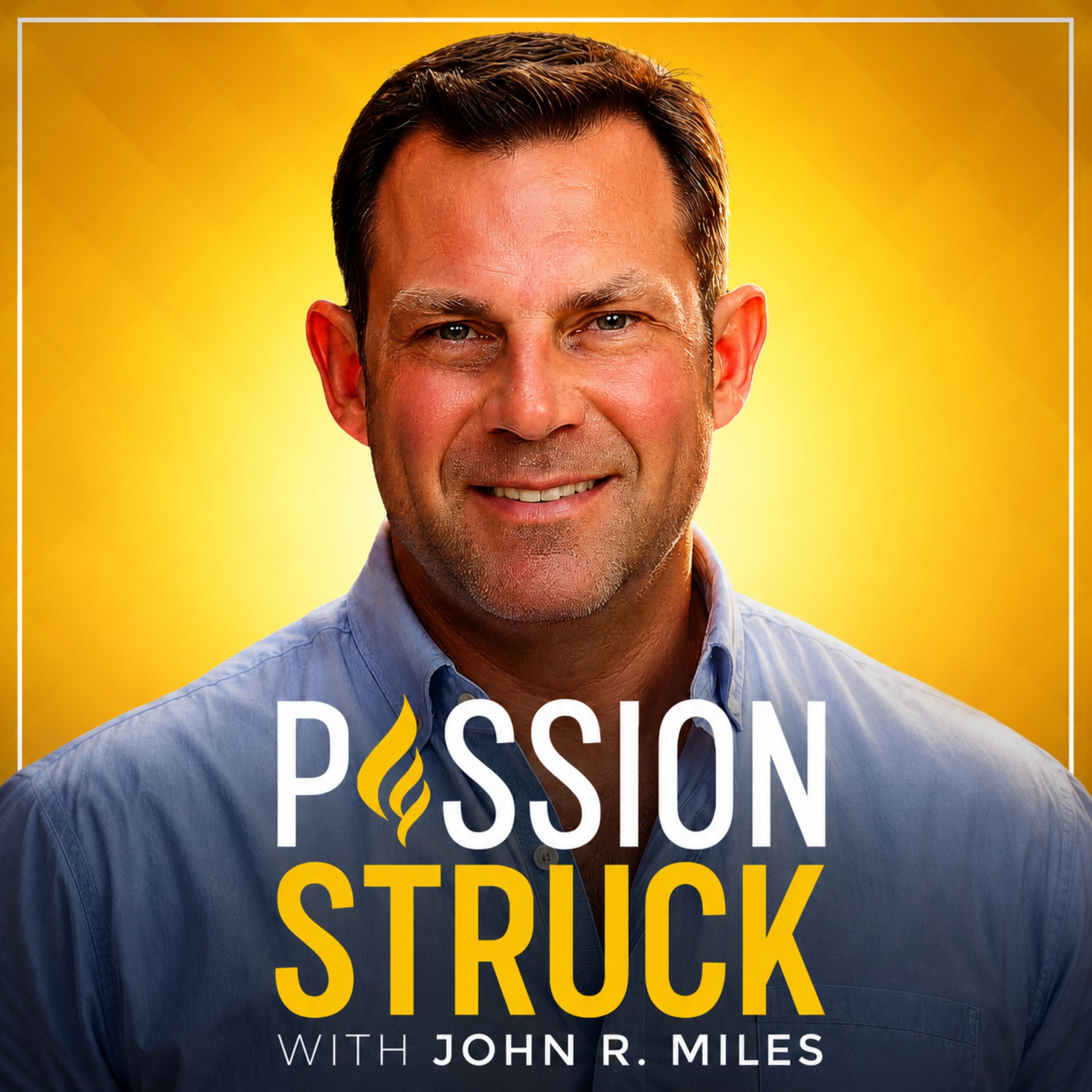
Pod Insights Passion Struck with John R. Miles ROI of Aliveness: How to Craft the Math of a Meaningful Life | John R. Miles - EP 753 About this episode Does your life look successful on the outside but feel empty on the inside? In this episode of Passion Struck, John R. Miles introduces a simple way to measure what truly matters: the ROI of Aliveness. Most of us spend our lives trying to be as productive as possible. We focus on checking off to-do lists and meeting everyone else's expectations, but we often forget to check in on ourselves. John explains why focusing only on your "output" leaves you feeling disconnected and replaceable. He shares a practical way to look at the "math" of your life—balancing the time you spend on chores with the time you spend truly being present. Featuring insights from experts like Arthur Brooks, Claude Steele, and Angela Maiers, this episode shows you how to stop living on autopilot and start building a life where you actually feel essential to the people around you. This isn't about working harder or doing more. It’s about making small, intentional shifts so your daily life actually feels like it belongs to you. Passion Struck is the #1 personal growth podcast dedicated to human flourishing and the science of mattering. Check the full show notes here: https://passionstruck.com/roi-of-aliveness-math-of-a-life-that-matters/Explore the daily reflection guide for this episode at: https://www.theignitedlife.net/p/the-roi-of-alivenessThank You to Our SponsorsLimited Time Offer – Get Huel today with my exclusive offer of 15% OFF online with my code PASSION at huel.com/passion. New Customers Only. Thank you to Huel for partnering and supporting our show! Connect with JohnKeynotes, books, podcast, and resources: https://linktr.ee/John_R_MilesChildren’s Book — You Matter, Luma: https://youmatterluma.com/Pre-Order The Mattering Effect: https://matteringeffect.com/In This Episode, We Discuss:The Meaning Gap: Why having a "good life" on paper doesn't always lead to feeling happy or valued. The Productivity Trap: How the pressure to always be "busy" keeps us from noticing what’s actually important. Feeling Replaceable: Why we often feel like anyone could do our job or handle our chores—and how to change that. Simple Lessons from the Classroom: How two basic ideas from kindergarten can help you feel more connected at work and at home. The 10% Shift: A realistic way to reclaim your time and energy by making tiny changes to your daily routine. Better Leadership: How to create an environment where your team (and your family) feels seen and needed. Support the MovementEvery human deserves to feel seen, valued, and like they matter. Wear it. Live it. Show it. https://StartMattering.comDisclaimerThe Passion Struck podcast is for educational and entertainment purposes only. The views and opinions expressed do not necessarily reflect those of Passion Struck or its affiliates. This podcast is not a substitute for professional medical or psychological advice. Connect with John Pre-Order The Mattering Effect: https://matteringeffect.com/Book John to Speak: https://johnrmiles.com/speaking/Keynotes, books, podcast,...
Transcript Speaker names marked ? are inferred from speaking time and the show’s known hosts — they are not voice-verified.
0:00 John R. Miles? Coming up next on Passion Struck, does every day feel like Groundhog Day? You wake up, execute the routine, and move through the world like an automation. Maybe you're navigating a corporate boardroom, or maybe you're managing the chaos of school runs and household logistics. Either way, you're technically alive, but it doesn't feel like you're actually living. You're winning the efficiency game. The targets are met, the kids are fed, the boxes are checked, but you're losing the human game. And here's the uncomfortable truth: you're not exhausted because you're doing too much. You're exhausted because you're getting no meaningful return on the life you're spending.
0:43 John R. Miles? Every day, you invest hours of your time, your only non-renewable asset. And what do you get back? If the answer is burnout, numbness, or just getting through the day, then you're operating with 0% return. So today, we're changing the metric. We're calculating the ROI of aliveness. Welcome to Passion Struck. I'm your host, John Miles. This is the show where we explore the art of human flourishing and what it truly means to live like it matters. Each week, I sit down with changemakers, creators, scientists, and everyday heroes to decode the human experience and uncover the tools that help us lead with meaning,
1:24 John R. Miles? heal what hurts, and pursue the fullest expression of who we're capable of becoming. Whether you're designing your future, developing as a leader, or seeking deeper alignment in your life, this show is your invitation to grow with purpose and act with intention. Because the secret to a life of deep purpose, connection, and impact is choosing to live like you matter.
1:52 John R. Miles? Hey, friends, and welcome back to Passion Struck. This is episode 753, and we're continuing our Purpose by Design series. Over the last few weeks, we've been building a new framework for how we live. We started by diagnosing the meaning crisis with Arthur Brooks and the structural ...squeeze with Wharton professor Corinne Lowe. We identified the hallow ledger where we track our responsiveness while our intentionality goes bankrupt. But this week, we took the conversation deeper. I sat down with Stanford psychologist Claude Steele to discuss his groundbreaking research on churn, that invisible psychological friction that drains our energy when we feel judged or stereotyped.
2:34 John R. Miles? And yesterday, I spoke with Angela Myers, who reminded us that our most fundamental biological need isn't just to be useful, but to be needed. Now, if you step back and you connect all of those dots, they point to a single, critical miscalculation. We become incredibly good at measuring our utility value, our output, our productivity, our responsiveness. But we've completely lost track of something far more important, whether our lives actually feel alive while we're living them. That is what I call the ROI of aliveness. Not a return on investment in the traditional sense where the goal is to increase our financial
3:16 John R. Miles? wealth, but return in the form of presence, meaning, and emotional vitality. Because the real equation isn't how much you produce, it's this. How much life do you actually experience for the time you spend? In this episode, we're going to run a different kind of audit, not on your calendar, but on your lived experience. We'll explore how meaning quietly erodes even in high-performing lives, why modern structures are designed to deplete your energy, and three strategic shifts to help you move from a 0% return to a life of genuine aliveness. And if this episode resonates, if it helps you reconnect to something deeper, share it with someone who might be stuck in that same loop.
4:01 John R. Miles? Because there are way too many people out there who are living efficiently, but not living fully. And that's what we're here to change. Thank you for choosing Passion Struck and choosing me to be your hosting guide. Now, let's start measuring what actually matters.
4:24 John R. Miles? To understand why our aliveness is so low, we have to look at what we've been optimizing for and what that optimization actually produces over time. In my conversation last week with Arthur Brooks, we explored a pattern that is becoming increasingly common among high performers. Levels of achievement are rising, while the experience of fulfillment is quietly declining. The issue sits in the underlying metric. We have built lives that are highly efficient at producing results, but far less effective at generating a felt sense of mattering. Arthur uses a useful structure for understanding this. He describes meaning as emerging from three elements. The first is coherence,
5:09 John R. Miles? the sense that your life fits together in a way that makes sense. The second is purpose, the presence of goals, direction, and forward movement. The third is significance, the feeling that your existence genuinely matters. For many people, the first two are very well-developed. There's direction, there's progress, there is measurable output. What becomes less stable is significance. And this is where the internal experience begins to shift. You can complete meaningful work, meet important goals, and maintain a high level of performance, and still encounter moments where the experience feels unexpectedly thin. A milestone is reached, a result is delivered, and instead of depth,
5:52 John R. Miles? there's a brief, almost imperceptible flatness. That signal is easy to dismiss. Most people move past it quickly and return to execution. But over time, those moments accumulate. They point to a structural gap between what life is producing externally and what it is generating internally. From the perspective of the ROI of aliveness, this gap is decisive. Time, energy, and attention continue to be invested at a high level, yet the return in terms of meaning and emotional vitality remains inconsistent. In other words, Portfolio looks strong, but the experience does not.
6:34 John R. Miles? And that divergence left unexamined becomes the foundation for a life where we perform well, but we feel less fully inhabited. So if the erosion of significance explains the internal experience, the next layer sits in the structure of modern life itself. In my conversation with Wharton psychologist Corinne Low, we examined what she describes as the structural squeeze, a condition in which multiple domains of responsibility expand simultaneously, each with increasing expectations. Work intensifies. Family responsibilities deepen. Social and institutional demands accumulate. The system, though, doesn't rebalance. Instead, it compounds.
7:19 John R. Miles? And within that environment, a specific adaptation begins to take hold. Self-sacrifice becomes the default strategy for maintaining performance. Time is reallocated away from restoration and toward obligation. Recovery is deferred. Activities that replenish energy are treated as discretionary, while demands are treated as fixed. The trade-off is rarely framed explicitly, but it is consistently made. Energy inputs decline. Energy output is maintained. And for a period of time, this appears to function. Responsibilities are met. Standards are upheld. The system around us continues to move, but the underlying equation has shifted.
8:04 John R. Miles? As Corinne pointed out, when energy is no longer being replenished, the energy that is deployed begins to degrade in quality. Output remains visible. Capacity does not. And this distinction becomes critical when viewed through the lens of the ROI of aliveness. Because what is being delivered is no longer just effort or time. It is presence. And presence is highly sensitive to depletion. You can occupy the same physical space at a meeting, at a dinner table, in a conversation, while operating at a fraction of your actual... ...capacity to engage. What ends up happening is attention fragments, emotional availability narrows,
8:48 John R. Miles? and your responsiveness becomes mechanical. The interaction remains intact at the surface level. However, the experience does not. And this is where the return on aliveness begins to invert. More time is invested, less aliveness is experienced. In other words, more is given, but less is felt. The system continues to reward output, while the internal quality of that output steadily declines. From a portfolio perspective, this is not neutral. It is a lost condition. You're allocating increasing amounts of a non-renewable resource, your time and energy, into conditions that reduce the experiential value of what you produce.
9:33 John R. Miles? The result is a life that maintains its structure, but gradually loses its depth. And if you're hearing this and something in that feels uncomfortably true, that's not a coincidence. That is awareness. And awareness is powerful, but on its own, it's incomplete. Insight might show you the gap between your portfolio and your experience. But reflection is what helps you actually close it. That's why I created The Ignited Life. One of the core ideas in this Purpose by Design series is that meaning isn't something you stumble into. It's something you build. But most of us don't pause long enough to answer the question that actually moves the needle. In my current routine, what is the actual return on my aliveness? Where am I performing a script that doesn't belong to me?
10:16 John R. Miles? And what would change if I stopped being just useful and started being needed? For this episode, I've shared companion reflections and articles on my Substack, designed to help you perform a significance audit of your own. We look at where your energy is being degraded and how to begin reconnecting with a sense of purpose that is practical and grounded. Because insight creates awareness, but reflection creates direction. You can find the companion guide for this episode and join the conversation at theignitedlife.net. Now, a quick break for our sponsors. Thank you for supporting those who support the show.
10:53 John R. Miles? You're listening to Passion Struck right here on the Passion Struck Network. Now, come back to the question underneath all of this. If you're living by the wrong scoreboard, if you've been winning the efficiency game while losing the human game, how do you begin to change that without dismantling your entire life? This is where so many of us get stuck. The assumption is that a different result requires a completely different structure. A new career, a new environment, a clean break. But the ROI of aliveness doesn't shift through disruption alone. It shifts through the reduction of friction. Before significance can stabilize, before the kind of meaning that Arthur Brooks describes becomes accessible, there's a more immediate constraint that has to be addressed.
11:37 John R. Miles? An ongoing, often invisible drain of your energy. And this week, I sat down with someone who has spent decades studying the mechanics of that friction. My guest, Stanford psychologist Claude Steele, calls it churn. Steele's work provides a critical piece of the equation. Because the exhaustion many people feel is not always tied to physical effort or visible workload, it emerges from the internal expenditure of energy required to manage how you are perceived. It's the cognitive and emotional load of being always on guard. Monitoring, adjusting, anticipating. Claude's early work on stereotype threat revealed how individuals perform under the
12:20 John R. Miles? pressure of potentially confirming a negative perception tied to their identity. But the broader implication is not limited to a single group. That's because churn is a universal condition. Any environment that introduces uncertainty about how you are being evaluated, or whether you fully belong, creates churn. And when churn is present, the cost is immediate. Your attention is divided, your energy is redirected, and your presence is diluted. And you can remain fully functional in that state for a while. You can contribute, you can perform, you may even succeed, but the internal allocation of energy has already shifted.
13:01 John R. Miles? A meaningful portion of your cognitive and emotional bandwidth is no longer directed towards engagement, it's directed towards self-management from the perspective of the ROI of aliveness. This is a hidden cost center. When you are churning, whether you're a CEO in a high-stakes board meeting, or a parent at a difficult conference, you are spending forty percent of your cognitive and emotional bandwidth on defense. You're technically in the room, but you aren't present. Your return on that hour is actually negative because the energy required to sustain the facade is greater than the value of the interaction itself. And that division compounds across meetings, across conversations, across
13:46 John R. Miles? entire environments. Until exhaustion begins to feel disproportionate to the work itself, Claude offers a precise counterbalance to this condition: trust. He describes trust as the tension between remembering and forgetting. It's the moment when you can stop remembering how the world might judge you, and start forgetting yourself enough to actually engage with the person in front of you. When we build this kind of trust, the churn evaporates, and our ROI of aliveness skyrockets. Because we are no longer spending our presence on image management, we are finally free to bring our unique genius into the room. So
14:27 John R. Miles? that begs the question: if churn explains where your energy is being lost, what actually restores it? This is where the conversation shifts, because removing friction stabilizes your energy, but it does not on its own generate aliveness. For that, you need a different input. In my conversation yesterday with Angela Myers, we explored a principle that sits at the center of this entire episode, and really at the heart of this entire podcast. Aliveness is not created through efficiency, it's created through a sense of mattering. In my upcoming book, The Mattering Effect, I examine a distinction that Angela articulated with remarkable precision: the difference between being useful and being needed. Most people have become
15:11 John R. Miles? Highly optimized for usefulness. They are reliable, responsive, capable of producing results on demand. But usefulness is inherently transactional. It exists within an exchange. A useful person can be replaced by someone equally competent. A useful role can be redesigned, redistributed, or automated. Usfulness creates value. It does not on its own create significance. And over time, a life organized primarily around usefulness begins to feel increasingly interchangeable. Angela's work points to a deeper human requirement. The need to know that your presence is not optional. That something meaningful changes when you are there and when you are not. This is the experience of being needed.
15:56 John R. Miles? And this is not a philosophical preference. It is biological. As Angela explains, the absence of mattering is processed by the brain as a threat condition. The same neural pathways associated with physical pain are activated when a person feels insignificant or excluded. Which means the pursuit of mattering is not indulgent. It is stabilizing. It is how the system regulates itself. To make this concrete, Angela points to a setting where this dynamic is still fully intact. The kindergarten classroom, where it operates with a level of structural clarity that most adult environments have lost. In the kindergarten, contribution is visible. Roles are defined. Participation carries consequence.
16:41 John R. Miles? Two practices anchor that system. Show and tell and jobs. Both function as mechanisms for establishing significance. In its original form, show and tell is not performance. It is a declaration. It is the act of making your internal world visible to others and offering it as something that might contribute. As Angela describes it, it's the dance between positioning and pitching your value. A child stands up and communicates. This is what I have. This is what I care about. This is what I can offer. There's no abstraction, no hierarchy, no need for permission. The contribution is direct. Over time, most Adults abandon this practice. Value becomes implied rather than expressed.
17:26 John R. Miles? It's hidden behind roles, titles, or assumptions of recognition. But unexpressed value cannot be engaged, and what cannot be engaged cannot become needed. From the perspective of the ROI of aliveness, this matters because aliveness increases when your unique capabilities are visible, accessible, and actively used in ways that matter to others. Without that visibility, your contribution remains latent, and the return on your presence remains limited. The second mechanism is even more concrete. In a kindergarten classroom, a job is not a task. It's a role with a consequence. If you are responsible for watering the plant, and you don't show up, the plant deteriorates.
18:11 John R. Miles? If you're responsible for leading the line and you disengage, the system loses coherence. The role carries weight. It establishes that your participation is not interchangeable. Somewhere along the way, this structure changes. Jobs become tasks. Tasks become units of efficiency, and efficiency becomes the dominant metric. But a task can always be reassigned. A role, when properly defined, cannot. When you begin to reorganize your life around roles that carry relational consequence, where your presence meaningfully affects the outcome, something shifts. You move out of commodity logic and into significance. This is the inflection point.
18:55 John R. Miles? You're no longer asking, "How can I be more efficient?" You are asking, "Where does my presence make a difference that cannot be easily replaced?" That question reorganizes everything. Because when your presence becomes consequential, when it is felt, relied upon, and integrated into the system, your ROI of aliveness changes. Not incrementally, fundamentally. Time is no longer just spent, it's experienced. Energy is no longer just deployed. It is returned with meaning, with connection, with depth. And what begins to emerge is not just a more productive life, but a life that is fully inhabited. Up until this point, we've been looking at the forces that shape a life from the outside
19:40 John R. Miles? in, how meaning erodes, how energy gets compressed, how attention becomes divided, and how easily presence is diluted. The question now is practical. How do you begin to change the return on your life without changing the entire structure of it? The answer is found in how you allocate three things that you already control. The first is your attention. The second is your role. And the third is your energy. These are the primary drivers of aliveness, and small shifts in each of them compound quickly. So let's talk about those three shifts. The first one begins with conducting an attention audit.
20:21 John R. Miles? It starts with where your attention is actually going, not where you intend for it to go, but where it is consistently pulled. So for the next 48 hours, observe your interactions with a single question in mind: how much of me is actually here? In some environments, your attention will feel steady and available; in others, it will fragment. You'll notice moments where part of your energy is directed towards the work itself, and another part is occupied with monitoring, adjusting, or anticipating. That division has a cost. It reduces the quality of your presence even when your performance remains intact. The objective is not to eliminate those environments entirely; it is to reduce the internal friction within them.
21:05 John R. Miles? That begins with shifting your attention outward, listening without rehearsing, responding without over-calibrating, allowing the interaction to unfold without constant self-editing. As attention consolidates, presence deepens, and when presence deepens, the experience of the moment changes, even if the structure around it remains the same. And that brings us to shift number two. We need to look at how your contribution is currently defined. Most of life is organized around tasks, and tasks are necessary, but they are interchangeable. They measure output, not significance. Our aliveness increases in a different context. Where your presence carries weight,
21:47 John R. Miles? where something is meaningfully different because you are there. So the shift is simple, but not always easy. Move your focus from tasks to roles. Ask yourself, where in my current life does my presence make a difference that is felt? This may not be formal. It may show up in how you stabilize a conversation, how you create clarity in moments of confusion, how you bring consistency to people who rely on you, or how you offer a perspective that changes how others see things. And once you identify those roles, treat them as primary. Give them visibility, give them consistency. Allow others to rely on them. Because when your presence becomes something that others depend on, your time stops feeling interchangeable. It starts to feel meaningful.
22:32 John R. Miles? And lastly, shift three. Look at the energy equation underneath everything. Most people operate with a consistent imbalance. Energy is spent continuously, but rarely replenished with the same intention. For a while, that imbalance is manageable. Then the quality of your presence begins to change. Your attention shortens, your patience narrows, and your engagement becomes harder to access. The solution to all those problems is not more discipline. It is reallocation. Identify a small percentage of your time, around 10% is enough, that is currently absorbed by low-value, low-attention activity, and redirect it towards inputs that restore capacity.
23:15 John R. Miles? These are restorative activities that require your full attention, require your energy rather than you consuming it, and reconnect you to that sense of depth. When energy is restored, presence follows. And when presence returns, the value of every interaction increases without adding more time. So we have spent today, looking at the math of a life, the return you experience from the time you spend. And what emerges from all of it is a simple but demanding truth. Significance isn't something you arrive at. It's something you inhabit. But there's one final trap worth naming. It shows up quietly, often disguised as growth, you become disciplined about reflection.
23:59 John R. Miles? You learn how to observe your patterns. You begin to understand your past with more clarity. And at first, that work is necessary. But over time, it can become a place you stay. The process becomes the identity. You organize your thinking around what needs to be healed, what needs to be understood, what still needs to be worked through. And without realizing it, your attention remains anchored to what was instead of what is now available to be lived. Awareness is essential, but awareness without integration becomes its own form of attachment. Familiarity has weight. Even when it's painful, it can feel more stable than stepping into something unpracticed. And this is where many people pause, right at the edge of transition. The work has been done.
24:43 John R. Miles? The insight is there, but the movement into a different way of being never fully happens. There's a point where reflection has done its job. And what remains is the decision to continue analyzing your life or to begin inhabiting it. Carl Jung wrote, "I want to exist from my own force like the sun, which gives light and does not seek it." To exist from your own force requires a shift in identification, away from the struggle towards the self that is capable of moving forward without needing to resolve everything first. That is the threshold and crossing it is quiet. It shows up in how you enter a conversation, how you make a decision and how you carry yourself through an ordinary day.
25:26 John R. Miles? Next week, we continue this conversation from a different angle. I'll be joined by my friend Kayla Shaheen to explore what happens at that exact edge, the space between insight and action. We'll look at why so many people find themselves circling change without fully stepping into it and what it takes to move into a way of living that feels aligned, grounded and fully your own. If today was about understanding the return on your life, next week is about stepping into it. Your time is not renewable, but your experience of it is. It changes with where you place your attention, how you define your role and whether you allow yourself to be fully present in the life you are already living.
26:01 Speaker 01 Becoming aware of the inner voices within you and What they're doing, you know, what function they have in yourself. And then striving for wholeness, which is found in the present moment. If you're aware of all your senses here and now, then you can show up more presently and consciously versus if you're not feeling your senses and your mind is somewhere else and you're striving for perfection, then that really takes you outside and into a liminal place that doesn't exist, but we're creating in our minds.
26:36 John R. Miles? Thank you for being here. Thank you for choosing to engage with your life this way. I'm John Miles and this is Passion Struck. Go out there and live like it matters.
Previous Why You Feel Like You Don’t Matter (And How to Fix It) | Angela Maiers - EP 752 Next From Shadow Work to Light Work: How to Actually Heal | Keila Shaheen - EP 754 Page updated October 30, 2026 · transcript and summary are machine-generated