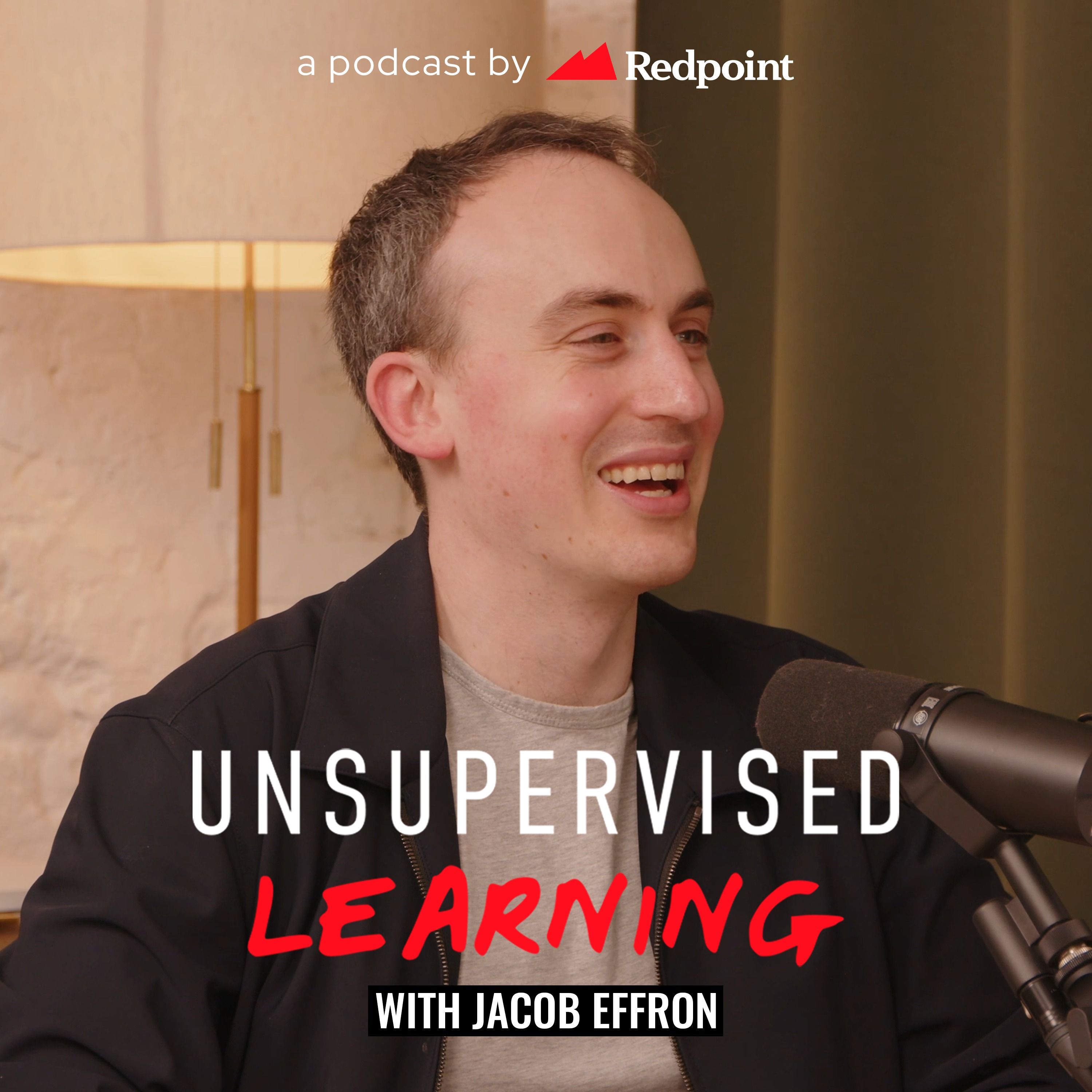
Pod Insights Unsupervised Learning with Jacob Effron Ep 42: CEO of Grammarly Rahul Roy-Chowdhury on the Future of Communication, Impact of LLMs and How Grammarly Does Eval About this episode If you don’t know Grammarly, it’s a personalized AI assistant for writing that has over 30 Million Daily Active Users. Grammarly has been building AI productivity tooling long before the most recent GenAI wave and has raised over $400M, with a current valuation of $13B.
Rahul believes AI will enable everyone to focus on more meaningful, creative interactions by automating the "drudgery" of daily tasks. It was interesting to hear him talk about how he thinks about competition and his longer-term perspective on how AI will be adopted by the enterprise.
Transcript 11,489 words · 2 speakers
Speaker names marked ? are inferred from speaking time and the show’s known hosts — they are not voice-verified.
0:00 Jacob Effron? This is Unsupervised Learning, Red Points AI Podcast. And today, we have on Rahul Roy Chatterjee, the CEO of Grammarly. If you don't know Grammarly, it's a personalized AI assistant app for writing that has over 30 million daily active users. They've raised over $400 million, at the most recent valuation of $13 billion, and are one of the most established players in the space. Rahul was the perfect guest to have on, and that Grammarly has been building AI productivity tooling long before the most recent Gen AI wave. Given the high-stakes nature of handling communication and wide variety of companies that Grammarly serves, Rahul had some super interesting insights, including how to think about evals. I was also interested to hear Rahul talk about how he thinks about competition in the space long term, and his perspective on how AI will be adopted by enterprises and educational institutions. Overall, this was a really fun episode with a CEO I have a ton of respect for. Now, here's Rahul. Rahul, thanks so much for coming on the podcast. Really appreciate it.
0:45 Speaker 01 Yeah, thanks for having me on, Jacob. Appreciate it.
0:46 Jacob Effron? This is one I've been looking forward to. As a Grammarly user for a while, it's always nice to get to meet the people that have made your life easier in person.
0:53 Speaker 01 Well, thank you for being a Grammarly user. Send product feedback my way.
0:56 Jacob Effron? Definitely will do. And I'm sure I'm not the only one of our listeners who's used it for a while. I thought I'd start in the most zoomed-out way possible, which is that we're obviously seeing this trend of AI writing more and more human communications. And you can imagine, these models are only going to get better.
1:11 Speaker 01 Yeah.
1:11 Jacob Effron? I'm sure in the future, we'll have plenty of emails, texts, all sorts of things written by AI.
1:16 Speaker 01 Yep.
1:17 Jacob Effron? What do you think that means for human-to-human communication in 10 years? Or are AIs just going to be having long conversations that we occasionally come in on? Or what actually happens as the way we communicate with these models gets better and better?
1:28 Speaker 01 So imagine 10 years from now, we are communicating with each other in ways that are more meaningful, forming deeper connections, because a lot of the drudgery of our day-to-day work has been taken away because of AI. And so, we can focus on the things that we do best: being creative, synthesizing ideas, connecting with other human beings. And that's the future we want to bring about. Hopefully, we're sending less email and reading and writing fewer documents. I hope to God that's true, because I'm already at the limit of what I think I can do today. And so, I think it's not about creating more content. It's not about creating more volume. It's about just making things better, more memorable, more evocative, more on point,
2:13 Speaker 01 more just precise.
2:16 Speaker 01 And that's a future I'd love to bring about today. For example, the average person, and this rings true for me and maybe for you. We switch contexts 1,200 times in an average workday.
2:27 Jacob Effron? Yeah, that sounds right.
2:28 Speaker 01 1,200 times. That's crazy. So I'd love a future in which AI enables us to just be in flow state and focus on what we do best. That's a promise of AI. And hopefully, we're doing less of it because each conversation we have becomes measurably more valuable. That's, I think, the promise of AI. That's what we're working on at Grammarly.
2:46 Jacob Effron? So do you think there's like less emails overall and less texts? But the ones that you do get are just the ones that actually matter and the ones that either facilitate connection or really lead to some kind of important or creative decision?
2:57 Speaker 01 I don't think it necessarily has to turn out that way, but I think we should push towards that outcome because that's a better outcome for us. And I'm a big believer that we, as humans, as users and purveyors of AI, we have agency. We should bring about the world that we want to see. So there's an alternative world in which we are kind of like now cost of content is zero. And so there's a lot more content. And I'm already today drowning in the amount of content I got to consume. So now there's 10x more. How do I do it? Well, I can turn to AI. So now you have AI generating content, AI consuming the content. That's not a world that I want to live in. That seems quite dystopian. For me, writing, communicating, it's part of what it means to be human. It is, it's how I think. And we shouldn't outsource that to AI.
3:41 Speaker 01 That's something that is uniquely ours. And so let's bring about that world.
3:45 Jacob Effron? Well, I'm sure we'll get into how exactly you kind of think about bringing about that world. But maybe to start would just be helpful to maybe contextualize for our listeners. I'm sure most folks have used Grammarly, they've been exposed to it in some way. But for the few of our listeners who haven't, maybe just talk a little bit about the Grammarly product today and kind of, you know, what you can and can't do and where you kind of hope things go.
4:05 Speaker 01 Yeah, we've been around for 15 years. So we launched in 2009. And so hopefully, many of our users have been using our product for a while. And we've actually ridden many technology waves. We started out as being mostly rules based, using natural language processing, moved to a lot of deep learning models, and now we're using LLMs and GenAI. So we kind of figure out what use cases we need to solve for our users. And then we figure out what technology we can bring to bear to solve those use cases in the best way. So that's our track record for 15 years. If you so to talk about the product and where we're going, maybe a very simple conceptual framework is think about a life cycle of communication as having four stages. Just a simplified view of the world, but like it's helpful. Stage one is I'm ideating and conceptualizing what I want to say.
4:51 Speaker 01 Stage two is I compose, I write down what it is I'm actually trying to get across. Stage three is I revise it and polish it and make it better. And then stage four, because communication is a multiplayer game, is someone at the other end is receiving what I've just written down and is comprehending it. So there's ideation, there's composition, there's revision, and then comprehension at the other end. So if you think about that life cycle, Grammarly for most of its history has been primarily focused in the revision phase of that communication life cycle. So you've written a piece of text, you're writing an email or writing a doc, and Grammarly comes and helps you get the words correct, but not just getting it correct, making sure
5:32 Speaker 01 that you're on point, you're following your organizational style guides, you are striking the right tone, maybe if you're too verbose, helping you with brevity, one of the problems I have. And so we help you with all these things. And then going forward, I think what LLMs enable us to do is really turbocharge the value we can provide to our users. And you can think of this as two ways. One is we can actually tie communication to business outcomes. So increasingly, what you're going to see from Grammarly is our suggestions are going to be much more strategically aligned to the outcomes you want to achieve. So Grammarly will increasingly become a lot of the correctness and a lot of the polish, we can just auto apply for you. So we can focus our attention on helping you achieve your outcomes.
6:17 Speaker 01 So imagine you're writing an email and you're trying to get drum up enthusiasm for some event you're hosting in the office.
6:24 Jacob Effron? Been there.
6:25 Speaker 01 Been there. So people are like, you know, so hey, this is going to be awesome, everyone, please, please show up. And then Grammarly looks at it and says, it looks like you're trying to drum up enthusiasm for this event, but maybe you should say why people should go. Is there free food? Great, please add that in the email and kind of make demonstrate the value. Or maybe you're writing an email to your board and you're asking for something, but the call to action isn't very clear. So Grammarly may suggest, it looks like you're trying to achieve this outcome. Add a call to action that is very clear that people understand what they need to do to respond to your email. So we're going to move towards more strategic suggestions. And a lot of the mechanics of correctness and tone will sort of fade into, we'll just auto apply that for you. It's kind of the table stakes.
7:09 Speaker 01 So that's one big avenue vector of kind of how the product will evolve. The other one is we're going to move from focusing on the revision phase to really being with you through the entire lifecycle of communication. So you can use Grammarly, it's always available, you can call it up, you can conceptualize and ideate with Grammarly, you can compose with Grammarly, you can revise and polish like you always do, and then you can use Grammarly to comprehend. So if you look at a long email thread, you can say, hey, Grammarly, please summarize what this says and give me the main points. And by the way, is there an action item for me? I'd like to know that, you know, so I can take action on this.
7:44 Jacob Effron? Totally.
7:45 Speaker 01 So that's kind of, that's how the product is going to evolve.
7:47 Jacob Effron? I love that vision. And maybe, you know, to take, I think, three of the things I heard there, one of them is kind of, you know, getting involved in the brainstorm phase. The other is kind of more strategic edits at a higher level of, insert the free food or the call to action, and then the third being comprehension. I'm sure you're playing around with a lot of this stuff internally.
8:02 Speaker 01 Yeah.
8:03 Jacob Effron? To what extent, you know, across those three, on a scale of you just put, you throw an LLM at it and it kind of just works to like, oh my God, you should see the raw results when you try and do some of this with an LLM today. Like, across those three, like, you know, what have you kind of observed of where we are from capabilities today?
8:18 Speaker 01 LLMs are very powerful technologies, but it's early. And I think you cannot take the output of an LLM and just throw it over the wall. We are, also, we're operating at scale. We have a lot of users. And communication, the use cases we support for our users are pretty important use cases. You're writing an email, it's an important email. So false positives or sensitive text or some other safety issue actually has real consequences. So we have a responsibility to our users to make sure that we're not just throwing a model over the wall, but we do a lot of work to fine tune the model for our use cases. We do a lot of work on quality evals, on safety evals. So there's actually quite a bit of work that goes into, a new model is released, to how
8:59 Speaker 01 do we shape it and fine tune and customize it in a way that we feel good, that we can... Kind of be consistent with that promise to our users before we ship it out to them.
9:08 Jacob Effron? I feel like there's always this question of what accuracy level you need to get to. And I feel like in the early days of using these LLMs, the use cases that really took off were the ones that could be 60% or 80% accurate. Like, marketing, where it's like hallucinations could be a good thing.
9:20 Speaker 01 Yeah.
9:20 Jacob Effron? Or a copilot-type use case. And obviously, these more deterministic, like, I just outsourced the AI and I trust it 100% of the time, has been much more challenging.
9:30 Speaker 01 Yeah.
9:30 Jacob Effron? How do you, because a lot of your workflow is copility. Like, how do you think about how accurate these models need to be? So I guess for the editing one, or sorry, the revision one.
9:41 Speaker 01 Yeah.
9:42 Jacob Effron? Does it need to be, maybe 90% of the time, it's a really good, free food, call to action, whatever it is, and then 10% of the time, it says something that's kind of gibberish? Or like, what bar do you feel like you need to get to, to be useful to your users?
9:54 Speaker 01 I think the users tell us what the bar is. Because we can see how users are responding to these features, and we are tracking how users accept or reject suggestions. We're tracking how users are engaged or not engaged with the features. And that's actually a big source of quality input that we keep getting. It's kind of a continuous loop that we keep getting from our users. We use that to fine-tune quality, but also, we understand, we run experiments to start with, to say, we think it's met our quality bar, based on the evals we've done. We do side-by-side evals. So we have human experts rate an LLM output versus a curated output to say which one they prefer. So we have our own sort of objective measures of what is good quality. And then our users tell us if we hit the bar or not. And it's contextually dependent, it's use case dependent, so there isn't a one-size-fits-all.
10:38 Speaker 01 But we look at all those things holistically. So maybe there could be a feature that met all of our evals and passed all of our evals with fine colors, launch an experiment to our users, and users just don't engage with it. The use cases they were using it for were things that we hadn't seen, we didn't perform that well, so we have to go back to the drawing board and do a much better job before we do a broader rollout. So there's a lot of iteration involved. I think it's not a, let's throw it over the wall and see what happens.
11:02 Jacob Effron? Totally. Is there an example of that that comes to mind, like a feature you thought worked pretty well internally? And then, one of the benefits you have is you have so many users. So I'm sure the second you launch something, you quickly learn all the kind of edge cases and different ways folks do it.
11:14 Speaker 01 So one interesting thing, we learn a lot of interesting edge cases and use cases from our users. One that's interesting is, we have a tone detector, a feature. So we're writing an email, and we can detect what the tone of the email is, and then you can change the tone if you'd like. And so we could say, this sounds a bit grim, maybe you want to sound a bit more positive or happier. And one of the things we learned was there were some scenarios in which surfacing these suggestions were very inappropriate because actually it was a not a pleasant email or it wasn't a pleasant document. Actually, the most extreme example of this was a police department in one of our local police precincts somewhere said, hey, we use Grammarly and we actually find Grammarly invaluable in typing up reports of crimes, sometimes serious crimes, but can you stop
11:59 Speaker 01 with the sound mob positive? That's not the intention here. So we're like, got it. Not a thing we had actually anticipated.
12:06 Jacob Effron? Right, right.
12:06 Speaker 01 So we learn and we iterate and we. And so in that scenario, we say, all right, well, there may be some scenarios in which the sense the text is sensitive. And so we need to make sure we know what to suppress and what to show in terms of what suggestions are most helpful in these scenarios.
12:19 Jacob Effron? Yeah.
12:19 Speaker 01 And so, so we keep learning and iterating. It's a, it's a, the kind of the things we, all the ways in which we communicate with each other is just infinite. So it's just endlessly varied set of use cases.
12:29 Jacob Effron? You know, one thing, I feel like so many people are trying to figure out how best to use these tools, right? And I think there's so many people that use Grammarly and use, you know, are using AI for writing. And I'm wondering if you've seen any emerging, like, as you think about the best practices or the folks that you're like, God, those people use these tools really well, like, anything that, that you've noticed in, in people who seem to be using them effectively?
12:48 Speaker 01 Yeah, you know, so we, we are here to help you. We provide communication assistance. We help you to help you communicate better. The people who really, I think, exemplify what we'd love to see in terms of how Grammarly is used is understand that communication is a strategic imperative. It's how you can achieve your goals as an individual and it's how organizations can actually function and operate better. So connecting communication to organizational goals and personal goals strategically is actually the, is kind of the, is places where I've seen Grammarly provides the most amount of value. So as an example, one of our customers is a company called ModMed, stands for modernizing medicine. And they've deployed Grammarly organization-wide and they're an e-health company and they're
13:32 Speaker 01 using Grammarly very strategically to drive better performance as an organization. You can imagine they're writing sensitive documents, they're writing, you know, patient reports and they're using AI-enhanced communication to achieve better patient outcomes and they can track it and measure it. And so I think that's the key importance of what we do. And as AI gets more prevalent across the workplace. Got to understand what are we trying to accomplish here? What is the goal we want to achieve? And how does this AI solution, whether it's Grammarly or something else? How is it helping me achieve that goal? So it's not just a, hey, it sounds like it's a cool thing and we should use it. It's more like, what is the goal? And how am I getting better or closer to my goal?
14:11 Jacob Effron? Totally. It's so interesting. I feel like this comes up in so many contexts on this podcast where, you know, everyone wants to put in some Gen AI feature. And it's actually come up in the context of evaluations where I feel like frequently folks are like, the reason evaluations are difficult is a lot of time people are like, oh, we should ship this Gen AI feature. And then it's like, well, what does success actually look like? What are you actually evaluating, whether it can or can't do? And I feel like that's a, you know, I think being really thoughtful about what you're actually trying to achieve. It's really cool technology, but obviously to have a business impact, you need to know that.
14:40 Speaker 01 And because it's so hyped up, like most massive hype cycles, it's, I think it's always like, it's overhyped in the short term and then actually underhyped in the long term. It is very transformative, but right now this, let's just stick AI into everything and like, it's going to be great, is not actually a way to solve user problems. It's funny, actually, the FTC released a document, maybe a couple of months ago, I think I saw it, where they say, hey, there's, we have some rules around the use of the word AI in your product descriptions. Rule number one, it's actually got to have AI. So I'm like, yeah, makes sense. I'm glad you have that rule.
15:12 Jacob Effron? Did a lot of the dot AI companies have to go to dot com again after that? Obviously, as you mentioned before, you've kind of ridden a bunch of these technology waves. And obviously, as the models have gotten better and as techniques have changed, you guys have adapted the product. I guess it's always interesting to hear like, you know, one, what were things like at Grammarly? When like ChatGPT came out and kind of people realized the power? I mean, you might have already played with GPT three before then, but like, and then also, you know, with each subsequent model, like GPT four, what have kind of been some of the stuff that's been unlocked as these models have gotten better?
15:43 Speaker 01 Yeah, you know, it's interesting. So GPT, I think we were, we saw ChatGPT as kind of this watershed moment. But I think we were taken aback at the speed and scale and pace of change, as I think many people were. Honestly, I mean, just it was just the fastest growing consumer product in history. Just the pace at which the quality was improving was pretty incredible. And so we had built this track record of serving users with a different technology stack, using natural language processing, using deep learning. So there's a moment for us to figure out. Well, how do we respond to this kind of this new technology stack that can actually help us with the use cases we've always cared about? And ultimately, we see this as just a huge enabler for our mission.
16:27 Speaker 01 What we provide is we understand communication. We are the domain experts in communication. And we've had a long track record of saying, we understand our users, we understand what good communication looks like. That's our bread and butter. And then we will harness technology, whatever the latest tech is at the point, to be able to provide the best possible solution to our users to solve those use cases. NLP was what was the best available tech at the time when Grammarly launched. NLP is rule-based. So we start with grammar because grammar is rule-based. So we kind of like, you know, NLP doesn't let you do ideation and co-creation, so we couldn't do it. So we always, we always want to figure out, let's take this technology and then solve the user problems we've always cared about in a better, deeper, more meaningful way. So ultimately, it was a catalyst and enabler for us.
17:12 Speaker 01 And so we kind of just embraced it. We launched our own version of GNI shortly after, and we're learning and iterating from it.
17:19 Jacob Effron? And is rules-based grammar still like the best way to tackle some of those use cases versus, you know, LLMs, which maybe are right about grammar 80% of the time and 20% say something crazy?
17:27 Speaker 01 I think when we, when GPT-3 launched, for example, we used to do side-by-sides, and the precision of NLP was, was far greater. These models were hallucinating a lot, quality wasn't great. But the, the improvements in quality I've seen over the last couple of years is just phenomenal, fantastic. So right now, there may be some deltas, edge cases here and there, but I think that's largely disappeared. I think essentially, these models are as good as anything that we would have with a rule-based system.
17:54 Jacob Effron? It kind of leads to an interesting question. I feel like the, the most common question we get from, from startup founders is this idea of like, how do you think about what to build when there's shortcomings now, there's things that these models can't do?
18:04 Speaker 01 Yeah.
18:05 Jacob Effron? And then it feels like at the same time, if you went to a beach for two years and then came back, maybe you just get for free some of these underlying capabilities in the models. And I'm curious, as you guys think about your product roadmap, I'm sure there's all sorts of things that state-of-the-art models can't do today that you're like, this would be so valuable to our customers.
18:20 Speaker 01 Yeah.
18:21 Jacob Effron? And I'm sure there's a subset of that that you're like, hmm, I wonder if GPT-5, GPT-6 like might actually have this long-term. Like, how do you, how did that influence your product roadmap and how do you think about that?
18:29 Speaker 01 You know, I think it comes down to what what is the problem we're solving for our users? And then what is your brand promise to your users? So as an example, if there's safety issues in models, that's not something we can punt to the future. If models are not safe and we need to do a lot of post-processing on these models to make sure that we are providing a safe environment for our users, we're going to do it and we're going to make this. In fact, we have done it because safety is not something you can outsource. So we do a lot of work on fine tuning, on safety evals that is really custom to our use cases. So we, you know, maybe models will get better in two years and then we can say, you know what, all of that work is no longer necessary or we can do it in a much more efficient way. But that's not true today and we can't punt on that problem. So we got to do it.
19:12 Speaker 01 And so you've got to just make sure your user is not getting stuck in the middle of technology gaps or deficiencies. There are other ways in which I think there's exciting work we want to start prototyping and testing out. So like one of the things that's interesting is models are getting much more efficient. So if you get smaller models that are much more efficient at inference, that implies that you can move a lot of inference to the edge. And so that means a lot more on-device. So that's something we're playing around with and testing out and seeing what does it mean if actually a lot of these things could actually happen on-device? And so we're, you know, we're testing it out, we're iterating through it. And then I think that's something we can evolve in the future.
19:49 Jacob Effron? Is the appeal of on-device like security or privacy or?
19:52 Speaker 01 It's a lot of things. I think it's security, privacy, it should be cost of inference. It could be latency and user experience. So depending on like if you have, you know, some compute intensive prompt, let's say with a large context window, having it on-device could actually make the difference between this is unacceptably slow to actually this is a joy and a delight to use. So I think it's all of the above. And then so you've got to just figure out where it fits in your portfolio of investments you want to make.
20:18 Jacob Effron? When GPT-5 comes out, like are there a set of things you're like, I really hope the next version of an L M can do X, Y, or Z that would be kind of really important for our product. Like what, when it comes out, like what are the first things you're going to mess around with and see if it can do?
20:29 Speaker 01 I think it's not a GPT-5 specific thing. I think it's just the next gen of models. I think a capability that's going to be super exciting for us is. Communication workflows are pretty complex. They're multi-step. Like, think about, let's say, an email I need to send to my board of directors about some big product launch. There's so many things that go into crafting this email. First of all, what is the product launch? Where are we? What's the marketing team doing? What's the engineering team doing? What's the product team doing? What's the cost structure of this launch? What's our comms and PR plan? It's an email to the board, so that has certain connotations. I've got to keep it brief, got to keep it succinct, get the main points across. So there's so many steps, actually, that goes into crafting this important piece of communication.
21:15 Speaker 01 And so as these models get more capable of multi-step reasoning, I think you can kind of enable these agentic workflows where increasingly grammarly can help you orchestrate through a complex and reason through a complex, multi-step communication flow. And I think that's just super exciting. Like, when I think about the drudgery of work, so much of it is just cutting and pasting context. Maybe not literally, but figuratively, cutting and pasting context from one place to another. Like, okay, I got this detailed email. I've got to summarize it for this other person or for this other team. And so so much of what we do is just synthesize and summarize and cut and paste context. And so multi-stage reasoning and orchestration, I think, could be a game changer
21:57 Speaker 01 in just making this magical, easy, super smooth, so we can unlock that flow state we talked about.
22:04 Jacob Effron? Yeah, so in that board email example, you'd be pulling in context from a lot of different places. And even the model might have a hypothesis of like the best set of steps to do to write that update.
22:13 Speaker 01 That's right.
22:14 Jacob Effron? And you could probably edit it or kind of.
22:16 Speaker 01 That's right, and there's some domain expertise involved. Like, what constitutes a good email to the board? You sound confident, you've got to be brief. And so like, what are the attributes of that piece of communication? So you've got to bring it all together. Domain expertise, multi-step reasoning, contextual awareness, and then put it all together to just get exactly the right words at the right time for that audience.
22:36 Jacob Effron? Are there any weird quirks of like the models today? I mean, I feel like the one that went viral on the internet was like Delve and the fact that it just shows up everywhere. Like, I don't know, have you seen other things that you've had to correct for?
22:45 Speaker 01 Yeah, I think models have generally gotten a lot more sophisticated, a lot more capable. But what's surprising to me is to the extent to which these models, I had this maybe misconceived idea of, I thought these models would be basically plug and play. At some point, there would just be, you can swap one out, put another one in, and it would just work fine. But actually, that's not how it pans out. That's not how we experience it as well. These models are all quite idiosyncratic. They operate differently. They respond differently to a common set of prompts. They have different sort of parameters around safety. And so with each new model, there's actually a lot of work that goes into making it fit for purpose. Like what use case did you want to use it for? How are you going to do the model evals? It's a little bit different for every model.
23:28 Speaker 01 And so each model is still kind of a special snowflake.
23:32 Jacob Effron? Yeah.
23:32 Speaker 01 And so, and so I think that's, that was surprising to me. I thought they would be more interchangeable now, but, but that's the case. That's the reality.
23:39 Jacob Effron? And then I guess, you know, obviously I imagine behind the hood, you guys are orchestrating a bunch of, you know, you use a larger model and most capable model for some things, smaller models that are faster and for less complex tasks.
23:49 Speaker 01 Yeah.
23:49 Jacob Effron? You know, where are you using kind of like, okay, we have to use largest state of the art, you know, models for these things? And where have you been able to be like, actually, we could use a smaller open source model or fine tune a smaller model?
23:59 Speaker 01 So we typically, what we do is we, we have, I would say maybe a half dozen or so models in production, combination of closed source, open source. And so we use models of different sizes. Most of them are fine tuned on our user data. And so we can, so we can be more precise for the use cases we support. It's less about do we use a large model or a small model? What we typically do is we will figure out the use cases that we want to use this model for. And then we'll distill the model down using fine tuning to the smallest and most efficient model possible for that use case without decreasing quality. At some point, we're going to see a degradation in quality and we'll say, okay, let's stop there. Our goal is not to get the smallest possible model. Our goal is to just get to the most efficient model without any loss in quality and fidelity.
24:43 Speaker 01 Because we want to make sure we are providing high quality assistance for our users.
24:47 Jacob Effron? It's interesting. I feel like so many companies that are in the early days of their AI journey are just in like, hey, let's just discover what's possible with these models. And we'll use the largest models possible that are the best.
24:55 Speaker 01 Yeah.
24:56 Jacob Effron? And then later we'll get to cost. But given just the user base you have, I think you probably have to, to take cost more into consideration than, than your average.
25:02 Speaker 01 It's cost and also latency. Like one of the things that lower latency allows you to do, it's, it's not just the cost of inference and serving, but it's also, you have a better user experience.
25:10 Jacob Effron? Well, back to your thing on Flowstate. Like I feel like it's way easier. If this is happening in real time.
25:15 Speaker 01 Exactly.
25:16 Jacob Effron? And then, you know, one thing I think you guys do so effectively is tailoring the, you know, Grammarly's product to, you know, a company and like, you know, their kind of brand or style and individual user. You know, you mentioned kind of the idea of a board email being very different than a police report than other things.
25:32 Speaker 01 Yeah.
25:32 Jacob Effron? How does that actually happen behind the scenes? Like, are you like, fine tuning models or just providing more context in the context window or like, how do you guys do that so effectively?
25:40 Speaker 01 Well, one of the things we have that I think make Grammarly special and unique is that we have a ton of users and they're using us in a lot of different contexts. And so we have a lot of just relevant, contextual, fresh, high quality user data that we can use to fine tune and train our models for different use cases. Just to give you a sense of scale, we process 75 billion user events every single day.
26:02 Jacob Effron? Wow.
26:03 Speaker 01 And so that's the scale at which we operate. And so that's great. That gives us a huge advantage in terms of, and you talked about, you know, like, what is a mode and how do you actually navigate through this kind of fast changing landscape of AI? I think it's, for us, one of the big areas where we feel like we have a unique advantage is the quality of our user data and we use it to make the product better. So we, we fine tune these models using our user data across different use cases. And then we personalize in different ways, as you said. So for the individual, we allow you to figure out how to sound more like you, like, what is your voice? And you can kind of fine tune that. Today, it's a bit more manual than we'd like. And so over time, we think we can automate most of that away. But that's kind of the direction we're going to go in.
26:45 Speaker 01 And for organizations, it's really about, how do you make sure that if you have a style guide, if you have a set of brand, if you have sort of considerations about how you like to communicate, maybe you have a set of corporate values and you want to make sure you're, you're consistent with those, we can make sure that you're enforcing that and you're compliant with it. And then you can apply that across all the communication happening inside the organization, but also with customers, to make sure that when you're sending out external communication, it's consistent with your corporate brand and identity.
27:16 Jacob Effron? Right. And is that mostly like, kind of rag on the values and kind of putting context into the context window or like, are there cases where you'll actually fine tune? You're like, this is the board model and, you know, communication model and this is the, you know, casual email model or?
27:29 Speaker 01 Yeah, the, the granularity of fine tuning is still a work in progress, but yeah, typically we fine tune on use cases. And then separate from fine tuning on use cases, we kind of take, we kind of ingest. Organization-specific knowledge, like these are your style guides, these are your brand tones. For example, if you're a loan officer and you're communicating to a customer, there are actually very strict rules around what you can and cannot say. And so if you have a set of rules, typically what they end up being is they end up being in some large documents sitting around somewhere saying, here's like twenty-five thousand rules that you got to follow when you communicate with someone who's applying for a loan. We can automate that as we're in the flow of the communications, we can actually apply those.
28:11 Speaker 01 So that's what we do at the organization level as well. So to make sure that, you know, like all these things that are sort of manual out of the flow can actually be automated in the flow.
28:19 Jacob Effron? And you mentioned now a few times things you do, you know, post-output of the LLM. And so obviously there's tons you do around safety. Like what have you, what have you built for kind of the, the, the post-output processing? And then, you know, how have you actually gone about building that?
28:32 Speaker 01 Yeah, there's, there's a whole set of things we do. So like if you think about like we look evaluate in the LLM and you want to figure out, okay, is this good enough to ship for this use case? There's, there's actually quite a complex, there's no one size fits all, there's no one magic number that once you hit that number, ship it. There's actually a kind of a multi-dimensional process. So first, we look at external benchmarks. There are lots of different general purpose benchmarks. We look at the ones that are closest to our use cases. And so we get some objective external measurements. So we have that. Then we have safety evals. So we run through sort of, we have seen so many safety challenges because we operate at scale. We get a lot of user feedback and input on false positives in the field. We take action on those things.
29:14 Speaker 01 And so we have built up a very good understanding of like, what are the guardrails and parameters around safety? So we do our own safety evals on models.
29:22 Jacob Effron? Totally. What a powerful thing to have an eval data set from the real world, from actual things that users care about.
29:26 Speaker 01 Exactly, exactly. And then, and then we have our own side-to-side comparisons because there's nothing like having an expert, a linguistic expert, looking at output from a model, looking at idealized output from a human and saying, yeah, this is the one I prefer.
29:40 Jacob Effron? Yeah.
29:41 Speaker 01 And so we have that side-by-side data. And then we do experiments. We ship a model maybe to a small percentage of our users. And you know, that's the asset test, as I mentioned. Sometimes you think everything's good and your users look at it and say, actually. You know, I don't like it. I'm rejecting suggestions at a very high rate. And we can look at that and say, yeah, we didn't meet the mark. We got to go back to the drawing board. So yeah, and you iterate through that process. So it's four or five different things that we do. And we kind of look at it's it's art, not science.
30:06 Jacob Effron? Yeah.
30:06 Speaker 01 And so you got to look holistically and say, yeah, on kind of taken together. This is good. This is good to go. Let's ship it.
30:13 Jacob Effron? I mean, one thing I know our listeners will be interested in, I think everyone's thinking about in the Gen AI landscape today is just competitive landscape.
30:18 Speaker 01 Yeah.
30:19 Jacob Effron? And how it evolves. And, you know, in the same way that it feels like these models have dramatically increased the capabilities of what you guys can do. Grammarly, you know, I'm sure there's folks now that are taking email, putting it in a chat GPT and say, you know, make this sound more professional or whatever it is.
30:31 Speaker 01 Yeah.
30:31 Jacob Effron? You know, Apple is Apple Intelligence. I'm sure, you know, Notion, Google Docs, all these folks will kind of, you know, be able to benefit from these models too and put it into their products. How do you think about like the way this, I mean, it seems like an inevitability that like the space you were building for is going is now going to happen. Like it's going to be, it's going to be ubiquitous. That seems clear. And there's just a question of like, well, who gets to capture the the end user?
30:54 Speaker 01 Yeah.
30:54 Jacob Effron? How do you think about that?
30:56 Speaker 01 So a couple of ways. One is I, first of all, competition is great. The attention is great. I welcome it. Like, we've been at this for a long time. The fact that someone else comes in and tries to solve use cases that we know how to solve. Brings attention to the problem space and that's great. We actually see increased interest every time. There's a launch like Apple Intelligence because people are like, oh, so what does Grammarly do again? Let me go back and take another look at it. So it's a massive market. And so I want to be laser focused on solving our use cases because if we can just do that and do it well, I think we're going to be in a great spot. Second way I look at it is we got to be clear eyed about what are the differentiators? What are the modes? I talked about one of them being the fact that we have all of this great user data.
31:40 Speaker 01 That we can actually use and apply and and do this in a kind of a in a in a cyclical loop. To make the product quality better. And I think that's a unique advantage we have. And, you know, no advantage is infinite. Eventually, every mode is breachable. But we have a big advantage and we're going to stay focused on improving it and making sure that our service gets better and better for our users. We also have the another advantage, which is that. We operate everywhere people work. It's a very, very fragmented landscape of tools in which we communicate. Just to give you a data point from Grammarly, we at Grammarly use 200 different B2B SaaS apps. I mean, maybe we're a little bit too fragmented and we should consolidate a bit. I think there's some work happening on that front, but we're not that far off the norm. It is a very fragmented landscape.
32:25 Speaker 01 And maybe that's fine because you want to use best of breed tools to run your business. And so we are the providers that can sit in your Gmail, in your Microsoft Word, in Slack, in Salesforce, in Greenhouse for candidate feedback, whatever line of business app you're using, we can be across all those different touchpoints. And we can elevate the use of AI to have a uniform stack across all these different apps. We're not here to sell you Grammarly because we really want you to use our email tool. We're not here to sell you Grammarly because we really have this other platform we want to use. We're here to just make all the existing investments you've made across all these different tools better, because that's what we spend most of our time at work doing.
33:09 Speaker 01 So making that better is a huge unlock for the organization. You know, earlier when you mentioned one of the best uses of Grammarly, it's people who've recognized that unlocking communication effectiveness to drive business outcomes, that is the way that Grammarly should be used.
33:23 Jacob Effron? That was interesting, especially as you talked about some of the places where the product's going. Obviously, having context across a bunch of different parts of your organization end up being so crucial to being able to actually do some of the kind of brainstorm and initial, you know, more higher level reasoning work, because there's only so much reasoning you can do without the context.
33:39 Speaker 01 Yeah, yeah.
33:40 Jacob Effron? AI just seems so core to what you guys do, but obviously there's workflow in the product you build and all sorts of other things. How do you, you know, think about structuring your AI team internally? I feel like we see these, these two models. One is like, we have this kind of like core research group and they're kind of pushing the boundaries on, on the model side. And the other is, well, we kind of just embed it in each, you know, existing product team we have. They all have, you know, they're all AI teams now. Like, how do you guys kind of structure that internally?
34:04 Speaker 01 We, we do both, and it's a time scale issue. So like, one of the things I mentioned earlier was, we think in the future, looking at the trajectory of how effect, how efficient these models are getting, that on-device is going to be very, very capable. We're not ready quite yet, but it's something we want to keep exploring. And so when we are ready, we'll actually have infrastructure and kind of an architecture to then embed into our products. But that's not something we can do in our product teams yet. So we have a core research team that is doing things like that, that are looking a little bit further out and understanding sort of what are the next eighteen, twenty-four months look like and what do we need to do, what capabilities do we need to build, is there some gaps in our data collection framework that we need to kind of enhance? And so they're kind of working through those things. So that's a core research team. And then we have AI engineers embedded
34:48 Speaker 01 into each of our product teams and feature teams, because these are full stack teams. We're launching a feature, it's got front end, back end, and it's got AI capabilities, and we kind of work together to enable that use case.
35:00 Jacob Effron? And is on-device not ready because it's just hard to get these models small enough to at the quality level you want? Or what are like the barriers to doing that?
35:07 Speaker 01 No, I think it depends on the use cases you want to support. I think for some of the complex, I think for simple use cases today, I think on-device is ready. So it's a question of, you know, we're watching to see how quickly this evolves. It feels like efficiency gains are coming fast and furious.
35:21 Jacob Effron? Yeah.
35:22 Speaker 01 And so that's great. And so we want to make sure we kind of hit that optimal point of, wow, this is now ten X more efficient, we can do a lot more, and here's why we want to do it. Latency is way down, cost is essentially zero at this point for inference. And so we're just, we're waiting to see kind of what that, when that point is, when we can actually say, we're at a point to deploy. It's not that far away. So I think we are kind of moving in that direction.
35:44 Jacob Effron? It does seem like it. I feel like next year feels that there's going to be a lot of
35:47 Speaker 01 I think next year is a safe bet. Yeah.
35:48 Jacob Effron? Yeah. What are other parts of like the enterprise AI market that you pay attention to or things that, you know, that you think are particularly exciting?
35:54 Speaker 01 You know, what's really interesting is, first of all, AI is really going to transform the way we work. I think, like with all these big transformations, it is overhyped in the short term, underhyped in the long term, and really it is going to transform everything. It is a journey, though. I think today what I see is, there's a bit of, maybe, let's set it and forget it, or deploy it once and we've checked the box and we're done. I think it is a transformation journey, just like On prem to cloud didn't just happen with one deployment. It was a multi-year transformation. So you deploy some stuff onto the cloud. You see what it does to your business. Deploy more things onto the cloud, kind of evaluate what's going on. And then over time, you transform your business because that's what the cloud enables.
36:38 Speaker 01 So we're just in the early stages of this transformation journey. So one of the things that I think I see from a lot of enterprises is how do I select my AI vendor? Because this is not a one and done deal. I've got to be with the with the selection I've made for hopefully several years. And I need to trust the people I'm partnering with on this journey. So we really aspire to be that trusted partner because I do think it is a journey. And it's gonna it's gonna kind of play out over time. But the end effect, the end of all of this is going to be profound. And so I think that's going to be interesting. The other interesting thing about enterprise is I think there's a lot of experimentation and excitement. But the actual productivity gains are a bit elusive from what I can tell.
37:20 Speaker 01 You know, so like there's a ton of investment and there's a huge amount of CapEx in supply and compute predicated on all this massive productivity gain that's going to come from AI. Hasn't yet fully materialized outside of a couple of core use cases. Like, for example, I think software engineering and code generation is one that I think is very clear. But but it's not happening across the board. And so we, you know, one of the things that guides us in our work is we want to make sure that we can measure and demonstrate the value of the product. So it's not just a kind of a pie in the sky. It's got AI, what more do you need? It's like, actually, how is it driving your business forward? So an interesting stat we have is that the average user of Grammarly in an organization saves nineteen days per year. On average, single, single person.
38:05 Speaker 01 That's like a month's worth of work. And so when you think about what that does across the organization, that is what's going to drive business transformation. Now you're much, and this is today. This is not futuristic. This is happening today. And I think as we look forward and enable all these amazing use cases with AI, I think we want to stay grounded to that kind of building on that repeatability and measurability. Because We've got to demonstrate that AI actually is delivering the goods.
38:31 Jacob Effron? Yeah, it's a great point. I mean, I think for all the investment and excitement, I feel like, yeah, to your point, code generation. I feel like customer support has been an early use case that that works. Internal search, what you guys are doing, but there's not, you know, you could count them on on one hand, maybe two. Uh, there's there, I think it's still very early days and, uh, I mean, I think to to your point, like having a metric like the nineteen days you save or something like. There's a lot of of of products that are kind of interesting, but no one's really quantifying what the what the actual value is. And so, uh, that's a pretty cool stat.
38:59 Speaker 01 Yeah. So I think that's that's good for us, but I think that's generally something that, you know, enterprises should be, I think, are looking at like, A. Can I trust you to be that long term? And B, what is the measurable value? And I think I think that's good. That's a healthy sign.
39:11 Jacob Effron? I mean, one other area I think you have an interesting purview into is like AI in education, right? Because a lot of people use Grammarly as students, and I think you guys have done some really interesting work with the University of Texas. You know, I I and and kind of ship these features to you. That's like, I I believe it's like you basically can use Grammarly as you're as you're producing a paper or something. And then at the end, you can kind of cite, hey, here's all the places I used AI. So it's not like AI did the entire thing, but I was kind of using it as more of a co-pilot. Maybe talk a little bit about that work and like what's happening today with like the use of Grammarly and other AI tools in education.
39:42 Speaker 01 Yeah, I think it's a super interesting moment because the question is, this is a a very powerful new tool. How do we use it? How do we incorporate it into the classroom, into pedagogical methods? It could be misused like any tool, and I think this is true for education across the board. I remember when calculators were considered like, oh, you're cheating, using a calculator. I remember early, like maybe fifteen years ago, looking up code snippets online was considered cheating in an engineering interview. And then people quickly got past those things and said, no, that's not the, you're gonna, once you get hired, most of what you do is search online for code snippets. And so why are we using that as a gate? Um, and so let's focus in on what you can uniquely do, how you can be creative, how you can synthesize. If actually, if you can find code effectively on the web, that's great.
40:28 Speaker 01 I think AI is the same way. How do we use it in a responsible way? And what we found with that, we talked to a lot of educators, we talked to a lot of institutes of higher education. And what we found is generally people are very eager to engage. Uh, they want to partner with industry. They want to make sure that. They don't want to walk away from it. I think initially, maybe there was a bit of a, well, I think let's like ban AI. I think that's largely dissipated from what I can see. Now it's more about we are trying to equip our graduates to have skills that will enable to be successful once they graduate and enter the workforce. AI is going to be one of those critical skills. So how do we best equip our graduates? And so we are very committed to being responsible partners. So one of the things we launched that I love this feature,
41:12 Speaker 01 which is you can cite your use of AI in a work product. So let's imagine your assignment was, write a 500 word essay on the Civil War. And student A says, hey Grammarly, write a 500 word essay on the Civil War. And student B says, they write the essay and then they really engage with Grammarly to make the work product better. Like, hey Grammarly, can you give me feedback on paragraph number two? Do I need more data? Can you give me feedback on my conclusion? What other feedback do you have? Am I persuasive enough? And they engage, the tool is giving back suggestions and feedback. I'm looking at it, incorporating it. And student A, they didn't use the tool as intended. They didn't engage with the material. They haven't learned about the Civil War.
41:56 Speaker 01 Student B actually has gotten better and they've deepened their understanding of the Civil War. You can tell those two cases apart by the use of citations. So I think this is awesome. It's an example of the creativity I see from the kind of educational institutions where they're figuring out how to use these things. We're going to launch something, depending on when this airs.
42:13 Jacob Effron? I think we'll air it after you launch it. So you can talk about it. We won't spoil the release.
42:18 Speaker 01 Got it. So we're launching this thing called Authorship. And Authorship is another example of where we want to be responsible and give educators the tools to bring AI into classrooms responsibly. What Authorship does is it takes a piece of content and gives you the provenance of every piece of that document. This part was written manually. This part was cut and paste from somewhere else and maybe paraphrased. This part was AI generated or what have you. And you can look at every part of the document and figure out like what's acceptable. Maybe a piece of it was acceptable to be auto-generated, but most of it shouldn't have been and it wasn't. That's great. And so Authorship, I think, is another step in that direction, like citations, where we're just providing people with transparency and tools so they can. Kind of build the guardrails for themselves on how to harness the power of the tech,
43:03 Speaker 01 because I think you have to. You cannot put your head in the sand and say, if I just ignore it, it'll go away. It will not go away. You've got to engage with it and let's do it right. And we are committed to partnering with folks who want to do that.
43:13 Jacob Effron? It's so interesting. So you basically give the academic institutions the opportunity to say what they, what they, what is acceptable and what isn't and, you know.
43:19 Speaker 01 And students as well, because students can then understand, you know, what, like, how they can actually harness the power of the tech in ways where they are kind of furthering their academic goals. Because, you know, like, if you, if you, if you're a student who wrote that 500-word essay on the Civil War without engaging, ultimately, that's to your detriment. Maybe you got away with it or whatever, but ultimately, you're trying to set yourselves off for success once you graduate. And so what are the, what do you need to do to be able to equip yourself to do that well? And so we want to enable that, enable that outcome.
43:48 Jacob Effron? And it's super interesting. I mean, that example you gave, obviously, you know, can, is powered by and can be done with the quality of the models today.
43:54 Speaker 01 Yeah.
43:54 Jacob Effron? As you think about like 10 years from now, that student that has the, I don't know, they'll still be assigned to write a 500-word essay on the Civil War, but let's say they are, like, what do you, how do you imagine they end up using AI tools, you know, that they get more and more capable?
44:06 Speaker 01 10 years, it's hard, it's hard to say. It's going to, it's going to change so much. But, but I think in general, like, my vision for how AI should be used, whether it's in the workplace or whether in schools, is it's, it's a, it's a tool to give us superpowers. It's a tool to augment us. Like, we've got to really keep in mind, as we develop this technology, that we see this not as a tool of displacement, but as a tool of augmentation. And so if you apply that lens, which I really deeply believe, then ideal scenario is 10 years from now, students are using AI as just a powerful tool to engage better with the material, to engage deeper, to get feedback in real time. And keep in mind, AI is also a great leveller. We are very fortunate in the US. We have access to a ton of educational resources. Many parts of the world don't. And so the, the choices are not.
44:51 Speaker 01 Do I talk to my teacher or do I use AI? The choice is, do I just not study? Or can I use AI to help me study? And so AI just really opens up the aperture for what's possible. That's super exciting.
45:02 Jacob Effron? Totally. And it's really powerful. I feel like a lot of times with these new technologies, people will glorify the status quo and be like, well, compared to this idyllic, eight-person class, is this really as good? And the reality is, already probably with the quality of these products today, it's just such a step change above a lot of global education. I'd be remiss not to ask you a little bit quickly about, obviously, before you were at Grammarly, you spent quite the run at Google. And as I understand, you spent a lot of time on the Chrome side.
45:31 Speaker 01 That's right.
45:31 Jacob Effron? I feel like that's a space that's going to change a lot. Like, what is the, what do you, if you were still at Chrome, what does the web browser of the future look like, given all the advances in AI?
45:40 Speaker 01 I think it's exciting. I think people are going to search for content and consume content very differently because of AI. And I think I've been out of Chrome for many years, but I'm imagining the Chrome team is really figuring out, how do I embed AI? And I think they started doing some of those things into the browsing experience, because so much of it now is going to be synthesizing information, maybe remembering things that I've seen in different places, keeping track of it, surfacing at the right moments. And so I think it enables lots of awesome use cases. That one of the things we always struggled with in Chrome was too many tabs. I'm just doing research, too many tabs. Maybe AI can finally solve that problem. That would be fantastic.
46:19 Jacob Effron? That would definitely be helpful. Well, we always like to end our interviews with a standard set of quickfire questions to get your take. And so maybe to kick it off, what's one thing that's overhyped and one thing that's underhyped in the AI world today?
46:31 Speaker 01 Overhyped, chat interfaces. I think chat interfaces, to me, are just a sidebar combined line interface, and I hope they'll just disappear into the background very quickly.
46:41 Jacob Effron? Yeah. And how about underhyped?
46:43 Speaker 01 Underhyped, I would say, I think AI is a great tool to upskill and up-level people around the world. And I don't see enough of that happening. It is really a great democratizer of skills. We gave the example of students who don't have access to education, and AI can really help with that. And I do think that's true in the workforce as well. People who are struggling, don't have the skills, can actually upskill very significantly with the help of AI. AI as a kind of a as a force multiplier to upskill people, I think, is a profound force.
47:16 Jacob Effron? Yeah.
47:17 Speaker 01 And I think that's going to be awesome. And I don't see that being talked about as much.
47:20 Jacob Effron? Yeah, no, it's really interesting. I feel like in a lot of the initial studies of the power of these AI tools, they're most impactful on folks that maybe are, you know, a bit in the bottom, you know, half of, you know, inability in something. And I think it's incredibly compelling to, you know, think about where that might be,
47:37 Speaker 01 Yeah.
47:37 Jacob Effron? you know, implemented. What's been the biggest surprise in building AI features for Grammarly? Like, maybe one thing you're like, this is definitely going to work, and the users didn't end up caring, or something that you were like, I don't, not totally sure if this will work, and the users ended up loving it.
47:49 Speaker 01 It's not like I went in thinking users won't like this feature, but the extent to which people resonate with the tone detector and tone AI feature has been just amazing to see. I routinely will, if I'm wearing Grammarly swag and walking down the street, someone inevitably will stop me and say, hey, you work at Grammarly? Let me tell you about this tone feature and how it saved my life in this one scenario, or I had this heavy thing that I was going to do, and Grammarly really saved me in this situation. And so that's really been something that's been very evocative for users. Just the extent to which it's helped people has been awesome to see and fantastic.
48:21 Jacob Effron? And is that like, is that a constant iterating feature that you're going to like, continue to provide even more nuance on the tone? Or what's like, kind of the future of that?
48:28 Speaker 01 Yeah, more nuance, connect your tone. As I said, you know, one of the, one of the kind of directions of travel is more connection with our suggestions to your outcomes, your desired goals. And so you can imagine tone getting connected to that as well.
48:41 Jacob Effron? What's something you've changed your mind on since, since running Grammarly?
48:44 Speaker 01 We were historically a direct-to-consumer business. A couple of years ago, we started an enterprise business. And we're seeing a huge amount of demand for Grammarly services in the enterprise. That's the fastest growing part of our business. It's like on fire, and that's great. I initially assumed that these would just be very separate things. We have a consumer business over here, enterprise business over there, and I've completely done a 180 on that. I believe that the distinction between consumer and enterprise is very artificial. And so many of our users today will buy Grammarly on, by themselves, what we'd call consumer, but they're buying it to use at work. And so the question is, is that an enterprise deployment of one? Or is that a consumer sale? I think it's a very kind of artificial distinction. And so we are really building the company.
49:29 Speaker 01 And as we scale the enterprise business, I see it as very much of a user journey. So maybe as a user, you started using Grammarly, the free version. You upgrade to premium. Maybe you do a self-serve purchase of five or 10 team licenses. And at some point, as you're scaling across the enterprise, maybe our sales team will get involved. And we can call that enterprise. But really, it's a seamless customer journey. So I think I didn't fully appreciate how connected these are. And that's how actually we're building the company.
49:55 Jacob Effron? Which AI startup outside of your space are you most excited about right now?
49:58 Speaker 01 I gotta say, I, one of the most exciting uses of AI is AI for healthcare, improving healthcare outcomes. I love what AlphaFold is doing. And I think just kind of the precision of figuring out where the most interesting fruitful areas of research are for drug discovery. Game changing, that's just awesome. ModMed, one of our Grammarly customers that I mentioned, they're using AI to drive business transformation. And they're using it to improve patient outcomes. And I think that's just such a great, awesome use of AI, having real tangible, life-changing impact today.
50:28 Jacob Effron? Totally. Hard not to get inspired about that. Well, this has been a fascinating conversation. I'm sure folks will want to pull on all sorts of threads. I'll leave the last word to you. Like, where can folks go to learn more about Grammarly, about the work you're doing? Anywhere you want to point folks, the mic is yours.
50:40 Speaker 01 Yeah, great conversation. You can go to grammarly.com to learn more. We're also available at Grammarly on X, on LinkedIn. We also have a presence on Instagram. We have a presence on threads. You have a presence on Facebook, on YouTube. So wherever you consume a social content, we're there. Come look us up.
50:58 Jacob Effron? Amazing. Well, thanks so much. This has been fantastic.
51:00 Speaker 01 Fantastic. Thanks for having me. This is a lot of fun.
Previous Bonus Episode: Trunk Tools CEO Sarah Buchner is Building Trunk Tools to Simplify the $13T Construction Industry Next Ep 43: CEO/Co-Founder of Contextual AI Douwe Kiela Reaction to o1, What’s Next in Reasoning and Innovations in Post-Training Page updated October 12, 2026 · transcript and summary are machine-generated